
“AI Rewrote My Love Letters”
You feed your cringy teenage love letters into an AI tool to "improve" them. The result is hilarious, chaotic, or surprisingly touching.
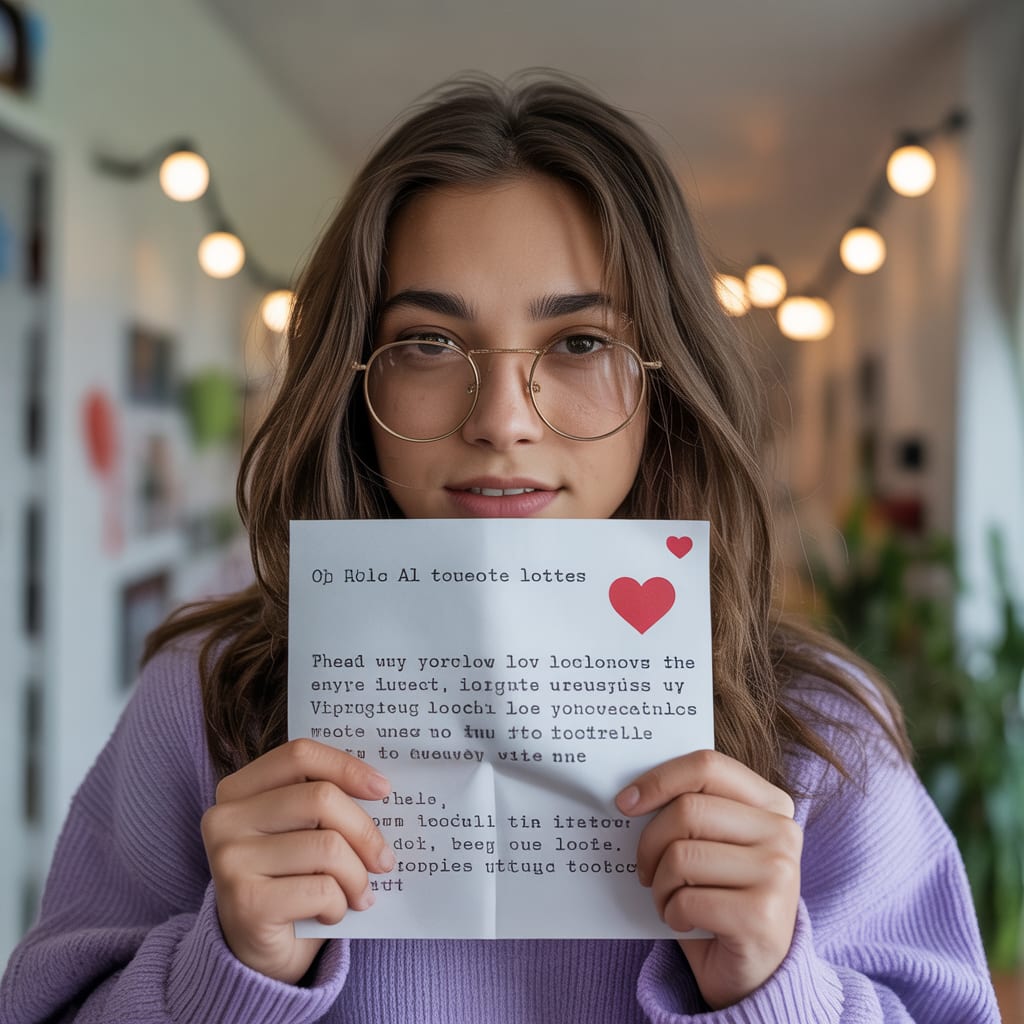
It all started with a folder called "Love_Letters_DO_NOT_OPEN".
I found it while cleaning out an old laptop I hadn’t touched since high school. The moment I saw it, I felt my stomach drop. I should’ve just deleted it. But, of course, I clicked.
Inside were a dozen Microsoft Word documents. Each one was a heartfelt disaster. I’d written them between the ages of 14 and 17 to Samantha, my first crush, and never sent a single one. For good reason.
The first letter opened with:
“Your eyes are like two orbs of sapphire drowning in the ocean of my soul.”
I gagged.
The second compared her laugh to “the chime of a thousand wind bells in a magical forest.” The third involved an awkward metaphor about pizza and loyalty. I’m not even going to explain that one.
I should’ve burned it all, but curiosity won. I recently subscribed to a trendy AI writing tool called HeartWrite™, marketed as "your emotional assistant." On a whim, I uploaded all twelve letters and selected the option: “Revise for clarity, tone, and modern romance.”
HeartWrite™ replied in a calm, polite tone:
Analyzing emotional tone… Removing excessive metaphors… Adjusting cringe factor by 73%... Done.
I opened the first AI-revised letter:
Original:
“Dearest Samantha,
I would walk across deserts barefoot, fight wild bears, and give up PlayStation just to see you smile.”
AI Version:
“Hey Samantha,
I really like you. I’d go out of my comfort zone just to make you happy. Even give up gaming… temporarily.”
I couldn’t help but laugh. It was way too chill, like a guy trying to flirt while half-asleep. I clicked through the rest. That’s when things got weird.
By Letter 4, the AI had started incorporating “advice” into the revisions.
“Dear Samantha,
Before we dive into emotions, a reminder: open communication is the key to healthy relationships. Also, consider mutual interests and consent when pursuing a crush.”
Letter 6 included a bulleted list of “emotional talking points.”
Letter 8 began with a quote from Brene Brown.
Somewhere along the line, the AI had stopped rewriting the letters and started offering therapy. I wasn’t sure if I was embarrassed or grateful.
But the real surprise came at the end.
The AI had generated an entirely new “Master Letter,” combining my old emotions with its newly-learned insights. I opened it expecting another tone-neutral essay.
Instead, it nearly knocked the wind out of me.
HeartWrite™ Final Compilation:
“Samantha,
I wrote you a lot of letters I never sent.
In most of them, I was trying too hard—trying to impress you with weird metaphors, fantasy quests, and poetic nonsense. But underneath all of that, I was just a kid learning how to feel.
You were my first crash-course in admiration. The first time I realized a person could light up a hallway just by walking into it.
I don’t know who you are now, or if you’d even remember me. But I remember you.
And I hope that wherever you are, someone is writing you letters that don’t need editing.”
I stared at the screen for a long time.
Somehow, the AI had filtered out all my teenage awkwardness and found something honest underneath. I didn’t know whether to laugh, cry, or send it.
I didn’t do any of those things. Instead, I saved the file. Not because I wanted to use it—but because it reminded me that even the messiest versions of ourselves are still worthy of love. Or at least, understanding.
Later that night, I texted my high school friend Daniel.
“Remember when I was obsessed with Samantha?”
He replied in seconds.
“Dude. You made a playlist called ‘Songs She Might Like If She Knew I Existed.’”
I did. I really did.
We both laughed for twenty minutes.
Then I told him about the AI, the letters, and the final draft.
He said, “Bro, that AI might be better at feelings than you.”
He’s probably right.
But maybe that’s okay.
Because in the end, it wasn’t just about rewriting the letters—it was about rewriting how I saw that part of myself. Not as something to be ashamed of, but as proof that I’d always been trying to love—even if I wasn’t very good at it yet.
About the Creator
Keep reading
More stories from Fareed Ullah and writers in Humor and other communities.
"Safety First: A Site Story"
The Day Everything Changed on the Site The sun beat down on the dusty construction site, casting long shadows of cranes and steel beams across the ground. It was just another day on the high-rise project downtown—a day like many others that would eventually transform the skyline. Among the orange vests and clanking tools, two figures stood out: Rafi, a seasoned construction worker with twenty years on the job, and Amir, the newly appointed safety officer. Fresh from college, Amir was idealistic, eager to make a difference.
By Fareed Ullah8 months ago in Education
Two Grumpy Old Men Solve the Problem
Marty and Steve were two grumpy old men who lived together. They had known each other for years. Marty had been a bachelor all his life. Steve said it was because no one could stand to ever live with him. Marty’s standard reply was “Well, you are, so what sort of a moron does that make you!”
By Calvin London12 days ago in Humor
The World Is on Fire, But My Freezer’s Been Stockpiling Since 2017
📦 Section 1: Frozen Time Capsules – A Love Letter to Foods That Shouldn't Be Alive There comes a moment in every adult’s life when you open your freezer, stare into the icy abyss, and realize you’ve been harboring culinary fugitives from the past.
By The Pompous Post4 days ago in Humor


Comments
There are no comments for this story
Be the first to respond and start the conversation.