
You gave me nothing. It was everything I needed.
on becoming a writer


Dear Ms. Staffa,
The older kids warned us about you.
Strict Staffa was probably the kindest name I heard, along with a sympathetic lip-pursed inhale, and an, "Oof. Staffa? Good luck," whenever I mentioned that I'd been assigned to your seventh grade English class.
You did little to dispel your reputation. Maybe you liked it. Maybe you appreciated a little frisson of fear in your middle schoolers. You wanted a classroom as neat and orderly as the sentences you made us diagram on the chalkboard, and anyone who threatened the peace was met with a snark-stopping glare and a few carefully clipped words. You kept your expectations high and the chaos low.
I loved it.
It helped, of course, that writing did and has always come naturally to me, that I was a voracious reader, and that I had a knack for spelling and an ear for good grammar. But you offered me the rarest kind of oasis in school: one where I didn't have to be the teacher's pet to ensure my safety.
I tried, of course. The campaign of ostracizing, teasing, mocking and occasional vandalism from the other students had started when I was much younger, and in our tiny school, it was impossible to escape. My reputation for being a daydreaming stuck-up weirdo teacher's pet was firmly entrenched by the time I got to your classroom. When I asked if I could show you some poems I'd written - my go-to for building both connection and a reservoir of teacher sympathy - I was running off a script I'd been using for years.
I remember how you looked at me coolly, as if you knew exactly what game I was playing, and were deciding whether or not you wanted to play along. I held out the poem I'd written that day in science class with what I hoped was an earnest, humble expression.
You took it, nodded, and motioned for me to skedaddle.
Days went by before I finally worked up the nerve to ask you if you'd read it. When I did, you pulled it out of your desk drawer. I could tell you'd read it because something on it was circled - a misspelled word.
You handed it back to me without a word of the praise I was starving for. Instead, you looked me in the eye and said,
"Very fine. Carry on."
That was it? Not a word about the content, the style, my obvious talent? My stomach dropped. While you didn't tolerate any bullying in your class, I didn't trust it to last. Would you protect me if you didn't think I was special when the teasing, the notes, the looks and whispers inevitably started up again?
Determined to win you over, I brought you another poem the next day. You held up a finger, motioning for me to stay as you read it; it was a haiku. Then you passed it back.
"Very fine. Carry on."
You looked back down at your desk and motioned me out again.
And so it continued. I brought you a poem or two a week. You read every single one, and gave each back with that same flat phrase.
I was beside myself. But I kept writing. Your class continued to be a sanctuary, where teasing and bullying were snuffed out at the spark. I began to relax when I came into your classroom. And something else happened - I started to not care whether you thought I was special.
And I kept writing anyway. I kept writing because I had finally begun to write for myself, knowing there was little other reward in it. I wrote because I had things to say. I wrote because I had things I wanted to remember. And I wrote because it felt like an extension of breathing: necessary. Essential. Involuntary.
The final piece I gave you was on the penultimate day of school - a hot, sticky June that left us all lethargic. You read it over while I stood next to your desk, then you looked up at me. This time, you paused for a second before you said anything. And then, the words came: the same words, but with just enough emphasis to change their impact.
"Very fine. Carry on."
I walked out on clouds.
*
Every November and April, for over a decade now, I've endeavored to write 30 poems in 30 days. No one makes me do it, and no one gives me a grade. I just do it because I want to, to see what comes out of it. A few years ago, my cousin decided, at age 15, that she wanted to give it a try. She asked if she could send me her poems each day.
"Absolutely," I told her. "But I want you to know that I'm not going to comment on them. The most important thing is that they get written."
I told her the story of your class, and of all those poems:
It was, in some ways, a test: could I keep writing without that fix, that hit of rare pleasure and pride that often eluded me in school?
I wish I could say sailed through that one, but it was a hard lesson to learn. Bitter and painful.
That said, Ms. Staffa's commitment to it is probably one of the reasons I continued writing into adulthood, and I give her credit for understanding that intrinsic motivation is the most critical muscle a writer can grow. And I'd like to help you grow yours.
My cousin has been writing with me for years now. She still sends me her poems privately, and she knows I will only ever reply with that phrase.
Very fine. Carry on.
No matter how today's poem turned out, it's worth writing another one tomorrow.
And THAT is what I learned from Strict Staffa's seventh grade English class. I learned how to be a writer.
With immense gratitude,
~DBH
About the Creator
Dane BH
By day, I'm a cog in the nonprofit machine, and poet. By night, I'm a creature of the internet. My soul is a grumpy cat who'd rather be sleeping.
Top Story count: 22
Check out my Vocal Spotlight and my Vocal Podcast!
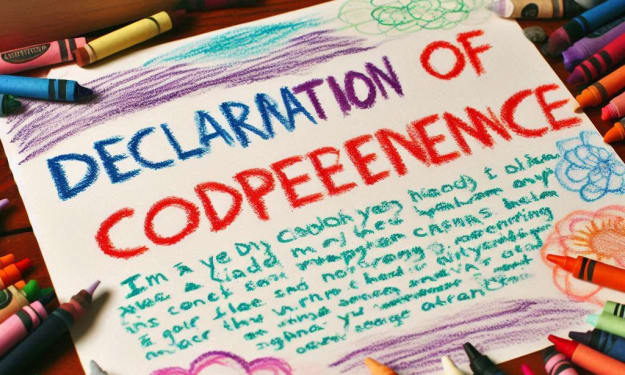
A Historic Declaration
We the People of the Husbands of the United States of America, in Order to form a more perfect Union, and I mean you...with me...establish Justice, insure domestic Tranquility, provide for the common defence, promote the general Welfare, and secure the Blessings of Liberty to ourselves, after Puberty, do ordain and establish this Declaration of Co-Dependence.
By Gerard DiLeo4 days ago in Humans
The Weight of Maybe
Trigger Warning: Sexual coercion and emotional manipulation Authors Note: This piece explores the confusion, mental conflict, and questioning that can follow experiences of coercive intimacy, a lack of clarity that often lingers long after an experience ends. If you relate to the themes present in this piece, you are not alone.
By Grace Ryder3 days ago in Humans



Comments (3)
Very fine, carry on- this one brought some tears of recognition.
I think we shared the same reputation in school, friend. She sounds like a heck of an interesting character. I'm not sure I'd have been able to keep offering them. Very brave, glad you carried on!
I imagine it sometimes takes a lot of restraint to say just a few flat words. I'm so glad you had Ms. Staffa in your life. Please do carry on!