

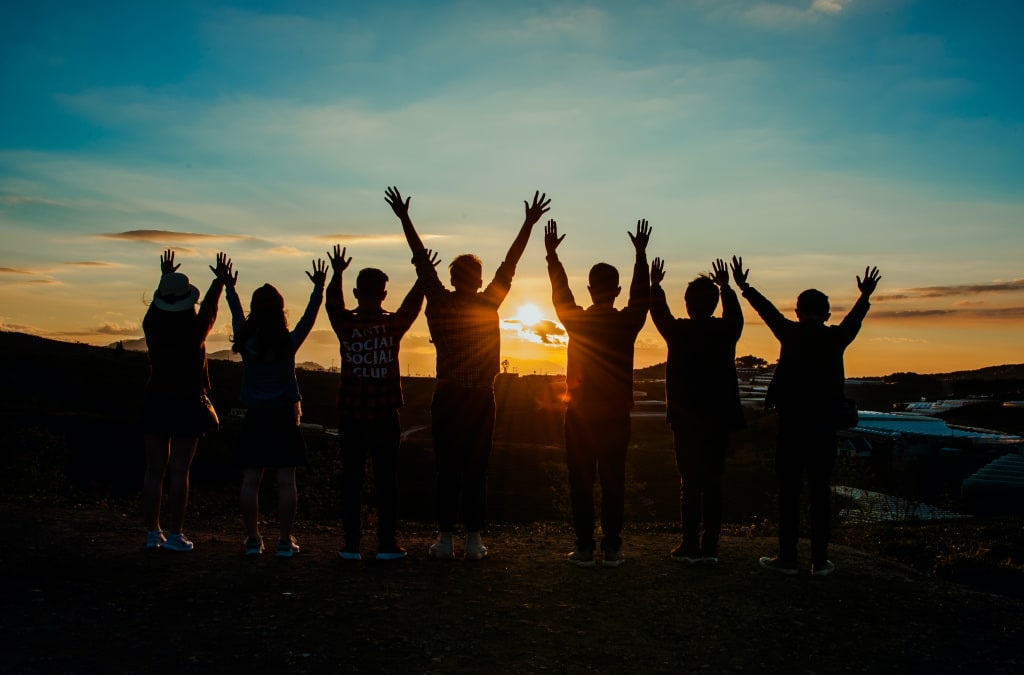
The story of humanity is a long and complex one that has been shaped by countless events and interactions over thousands of years. It begins with the emergence of our species, Homo sapiens, in Africa approximately 300,000 years ago. Our ancestors were hunter-gatherers who lived in small, nomadic groups, and their lives were shaped by their environment and the challenges they faced.
As our ancestors spread across the globe, they encountered a wide range of environments, from tropical forests to frozen tundra. They adapted to these different environments, developing new technologies and cultural practices to survive and thrive. Over time, human societies became more complex, with the development of agriculture, writing, and complex social systems.
One of the earliest civilizations was that of Sumer, which emerged in Mesopotamia (modern-day Iraq) around 4000 BCE. The Sumerians developed a system of writing, as well as advanced technologies such as the wheel and the plow. They also built complex cities with impressive public works, such as the ziggurat at Ur.
In ancient Egypt, another early civilization, the pharaohs ruled over a hierarchical society that was supported by a vast network of farmers, craftsmen, and laborers. The Egyptians developed a system of writing called hieroglyphics, as well as advanced medical knowledge and architecture, such as the pyramids.
In ancient China, the Shang dynasty (1600-1046 BCE) developed a system of writing and an extensive bureaucracy. They also developed bronze metallurgy and built impressive tombs for their rulers.
In Greece, the ancient city-states such as Athens and Sparta developed systems of government, philosophy, and art that would influence Western civilization for centuries to come. The Greeks developed the first democracy, as well as major advances in mathematics, science, and philosophy.
In Rome, the Roman Republic (509-27 BCE) and later the Roman Empire (27 BCE-476 CE) would become one of the most influential civilizations in history. The Romans developed a system of law, engineering, and architecture that would have a lasting impact on Western civilization.
Throughout history, humans have also experienced wars, epidemics, and natural disasters that have shaped our societies and cultures. The Black Death, which swept through Europe in the 14th century, killed an estimated 25 million people and had a profound impact on European society.
The World Wars of the 20th century saw millions of people killed and entire cities destroyed, leading to major political and social changes in Europe and around the world. The development of nuclear weapons during this period also had a profound impact on the course of human history.
In the 21st century, humans face new challenges, such as climate change, economic inequality, and technological disruption. However, we also have the potential to solve these challenges through cooperation and innovation.
The story of humanity is an ongoing one, and it is up to each of us to contribute to its future. Whether through science, art, politics, or any other field, we all have a role to play in shaping the course of human history.
As we look to the future, there are both challenges and opportunities ahead. One of the most pressing challenges is the threat of climate change, which could have catastrophic consequences for the planet and its inhabitants. It will require a concerted global effort to reduce greenhouse gas emissions and transition to a more sustainable way of life.
Technological advancements also have the potential to transform human society in profound ways. From artificial intelligence and automation to genetic engineering and space exploration, the possibilities are endless. However, it is important that these technologies are developed and used responsibly, with consideration for their impact on society and the environment.
Another challenge facing humanity is economic inequality, which continues to be a major issue around the world. As technology and globalization continue to shape the global economy, it is important that we find ways to ensure that the benefits are shared fairly.
Finally, we must also consider the role of politics and governance in shaping the course of human history. From ancient civilizations to modern democracies, the way we organize ourselves has a profound impact on our societies and our world. It will be up to us to create the institutions and systems that can effectively address the challenges we face and build a better future for all.
In conclusion, the story of humanity is a long and complex one, filled with triumphs and tragedies, joys and sorrows. From our earliest ancestors to the present day, we have been shaped by our environment, our cultures, and our interactions with one another. As we look to the future, there are both challenges and opportunities ahead, and it is up to each of us to play our part in shaping the course of human history.
Despite the challenges we face, it is important to remember that humans have also achieved incredible things throughout history. We have landed on the moon, eradicated diseases, and connected the world through the internet. We have created art, literature, and music that have inspired people for centuries. And we have shown remarkable resilience and adaptability in the face of adversity.
As we move forward, it will be important to build on these achievements and continue to strive for progress and innovation. However, we must also ensure that our progress is sustainable and equitable, and that it benefits all members of society. This will require a commitment to cooperation, compassion, and a shared vision for the future.
Ultimately, the story of humanity is one of resilience, creativity, and the endless potential of the human spirit. It is a story that is still unfolding, with new chapters being written every day. As we write the next chapter, let us do so with a sense of hope and possibility, knowing that we have the power to shape our own destiny and create a better world for generations to come.
The story of humanity is also one of diversity and interconnectedness. We are a species that has spread across the globe, adapting to different environments and developing unique cultures and traditions. Yet, we are all connected by our common humanity, and the challenges we face today require a global response.
Whether it is addressing climate change, tackling economic inequality, or promoting peace and cooperation, we must work together as a global community to find solutions. This will require a willingness to listen, to learn from one another, and to put aside our differences in pursuit of a common goal.
In many ways, the future of humanity is uncertain. We do not know what challenges we will face, what technological advancements will emerge, or what new cultures and traditions will develop. However, we do know that the choices we make today will shape the world of tomorrow.
As individuals, we can all make a difference, whether it is by reducing our carbon footprint, volunteering in our communities, or advocating for change. And as a global community, we can work together to create a better future for all.
The story of humanity is far from over, and it is up to us to determine how it will unfold. Let us work together to create a world that is sustainable, equitable, and just. A world where every individual has the opportunity to fulfill their potential and contribute to the greater good. A world where the values of compassion, cooperation, and respect guide our actions and shape our future.
About the Creator
Top 10 Uniform Dating Sites and Apps to Meet Uniform Singles in 2026
In the vast and often fragmented landscape of modern romance, finding a partner who embodies discipline, courage, and a strong sense of duty can be a challenging endeavor, which is why specialized Uniform Dating Sites and Apps have surged in popularity throughout 2026. These niche platforms cater specifically to the men and women who serve our communities and countries—including military personnel, police officers, firefighters, and medical professionals—as well as the admirers who value the stability and integrity often associated with these professions.
By Tiana Alexandra7 days ago in Humans
FPS: The Last Flame Challenge Winners
Welcome to our first Winners Announcement of the year and to the final challenge in the Fall Poetry Series. The Last Flame invited writers to sit with endings, using fire as a central image to consider what remains when something burns out: ash, warmth, memory, silence, or the faint promise of what comes next. The strongest pieces treated endings as gradual rather than sudden, allowing them to flicker, dim, and linger.
By Vocal Curation Team6 days ago in Resources


Comments
There are no comments for this story
Be the first to respond and start the conversation.