
Trees speak to each other. They live in community, even of different species, they share nutrients, warn each other of threat, share opportunities for potential growth and propagation. There’s little of value we can’t learn from the behaviour of trees.
Their grain is their synapses, their guts and brain cells that hold the memory of those conversations that lasted often three or four hundred years. It’s written in rings and striations that ripple and scintillate, that speak of seasons endured and expansive thriving, of illnesses survived and momentous events.
I write things and work with wood myself and the activities constantly nurture each other, the analogies between the two sometimes seem endless. Seamus Heaney in ‘Digging,’ perhaps his most famous poem made the analogy direct between the fashioning of poems and his father’s labour, his skill with a spade, digging for potatoes and peat for fuel. Seamus honours his own intellectual work and ennobles the pen as his tool to reach for what life requires just as his father did in the earth.
Between my finger and my thumb
The squat pen rests; snug as a gun
Under my window, a clean rasping sound
When the spade sinks into gravelly ground:
My father, digging. I look down
I’ve read writers that talk about setting characters free, about revealing spirits that are already in the world and only beg the telling. They need the vehicle of a plot to live and breathe, unpack their interior lives to us. It’s like that with wood, in a more physical way.
Renaissance sculptor Michelangelo said ‘Every block of stone has a statue inside it and it is the task of the sculptor to discover it.’ He didn’t see his job to wrestle the stone into form but merely to remove that material which obstructed the form contained within. What Michelangelo didn’t mention was that as one reveals the form within the material, one also removes obstructions to set the form we hide within ourselves free. It’s often said that we are our own worst enemies, that all we need to do is get out of our own way.
The act of making suspends the ruminating mind that occludes our uninhibited, genuine selves and even if it isn’t working in wood or clay, metals or stone that becomes our fundamental passion, the process of doing that work unlocks our ability to pursue those more personal passions. Craft’s power to improve and manage mental health is well documented but its ability to unlock potential is less well understood.
The grain the spirit, the memory of that great growing entity, that grand ecosystem and all the conversations between it, its mosses, fungi, ivies, wisteria vines, the insects, birds and small mammals that it provided a home for. Grain speaks, expresses what forms are possible, what it wants to become. How will hand and heart interact with the last of that magnificent life to free it from the firewood pile, rehabilitate it into new life, lending service and delight to homes everywhere?
One of the most surprising aspects of new platforms like Instagram has been the foregrounding of craft and its tribes, of the lives and work of those individuals and communities who make things with their hands, in textiles, in precious metals, with wood and clay. Hashtags around these topics are some of the most subscribed on the platform and have inspired tides of new craftmakers to take up challenges and see if they too have beauty in the work of their hands.
The understanding of the way wood grows and communicates, the way communities of trees are sustained in their environments and how those environments interact with the natural world beyond is prerequisite to success at working in wood. This naturally engenders a respect not only for your primary material but also by extension for the whole ecology of which it is a part. Greenwood businesses are environmental managers and educators.
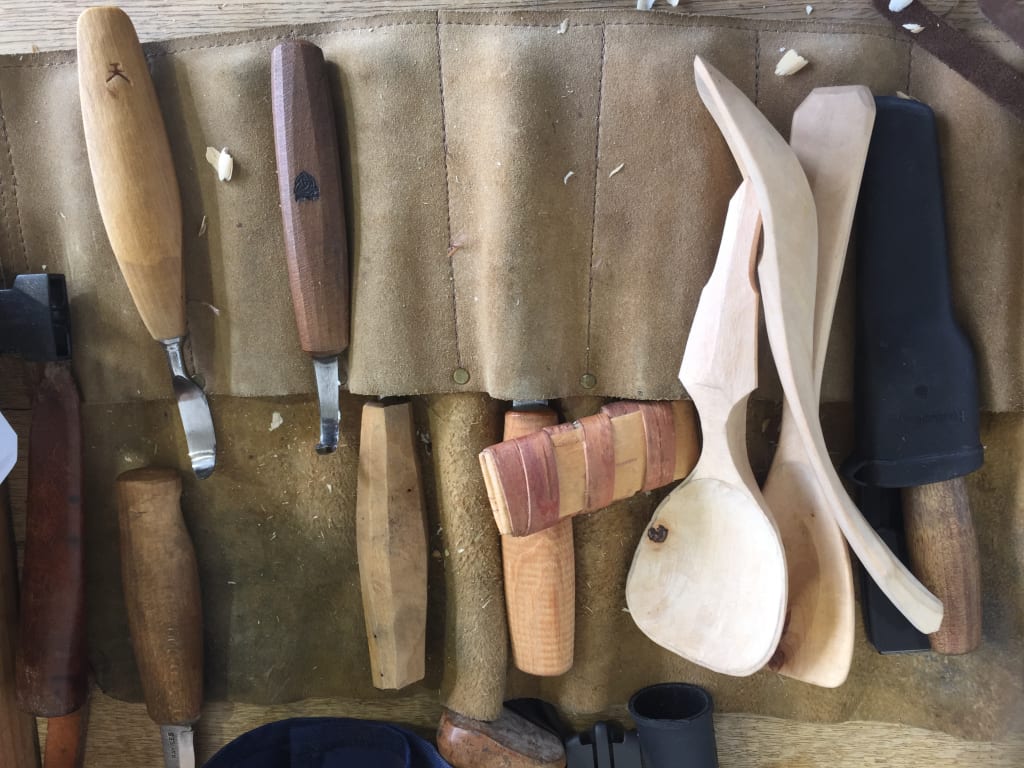
There’s no bar to entry to working with wood but the price of a simple hand axe and a small carving knife. You can get hold of the basic tools for $50 or less. As you develop beyond the most basic projects, you begin to need more tools, you need space and perhaps more importantly, you need instruction from those ahead of you on the path.
I would like to apply to use a parcel of land near me on council-administered land to create a home for the new craft tribe, for those who want to join or just have a go and a place from which to tell the stories of people and their projects. Nobody will own the structure and its contents, and all profits will be re-invested into the project itself. With other greenwood makers, friends, teachers and greenwood acquaintances, I’d build a structure out of greenwood itself and equip the workshop with the necessary range of tools and greenwood appliances like pole lathes, chopping and bowl blocks and securing devices.
‘The Wood Works’ will be a place for practise and tuition, for those who want to learn the skills and for groups who want to try their hand. We’ll draw from the broader community to invite experts in greenwood building, in pole lathe turning, in hand-carving and woodland management. It’ll be self-sustaining, offering paid courses held by those master-makers for those taking their skills further and those wishing to accomplish specific tasks like making chairs, more complex cups and bowls. Those paid courses and the sale of greenwood products will sustain a program of free tuition for younger people, special interest groups and those less materially advantaged. Like those communities of mutually-supporting trees, we’ll work with our own community and environment in a holistic way to help all of us to thrive together.
We’ll use Vocal and social media to foreground the personal stories and passions of our makers, of their projects and their accomplishments. We’ll deliver monthly challenges and video tutorials, tips and tricks to the carving community. Who knows, perhaps it merits a new platform itself ‘Crafty!’ One step at a time, like a tree from a single seed, as T E Lawrence put it in David Lean’s ‘Lawrence of Arabia ‘Big things come from small beginnings...’
About the Creator
M J Tait
M J Tait writes things and makes things with wood.
The CEO of Everything
They say "jack of all trades, master of none," but they forgot to mention the part where the jack of all trades is also the camera woman, the makeup artist, and the person currently yelling at a tangled Wii microphone cable in a her own bathroom while recording herself singing and trying to make it look realistic and professional. (As professional as you can make it with nothing but a cell phone camera and a mic that doesn't work)
By Sara Wilson4 days ago in Humans
My New Book is Finally Here
My poetry collection Beautiful and Brutal Things is done. It's actually done and finally published over 270 pages. Over a year of my life went into this book. More than a year, really. Long days at my computer, sometimes seven days a week because I couldn't stop even when I probably should have. Then two months of editing that felt harder than the writing itself. But it's finished, and I'm still standing, and the book is real.
By Tim Carmichael4 days ago in BookClub




Comments
There are no comments for this story
Be the first to respond and start the conversation.