
Winning Numbers
Little Black Book Challenge

Numbers, Ambrose’s father had drilled into him, never lie.
Numbers unlock the secrets of the universe. They set you on your life’s path. And, if the practitioner is skillful enough, they can be divined in such a way as to lead to one’s fortune.
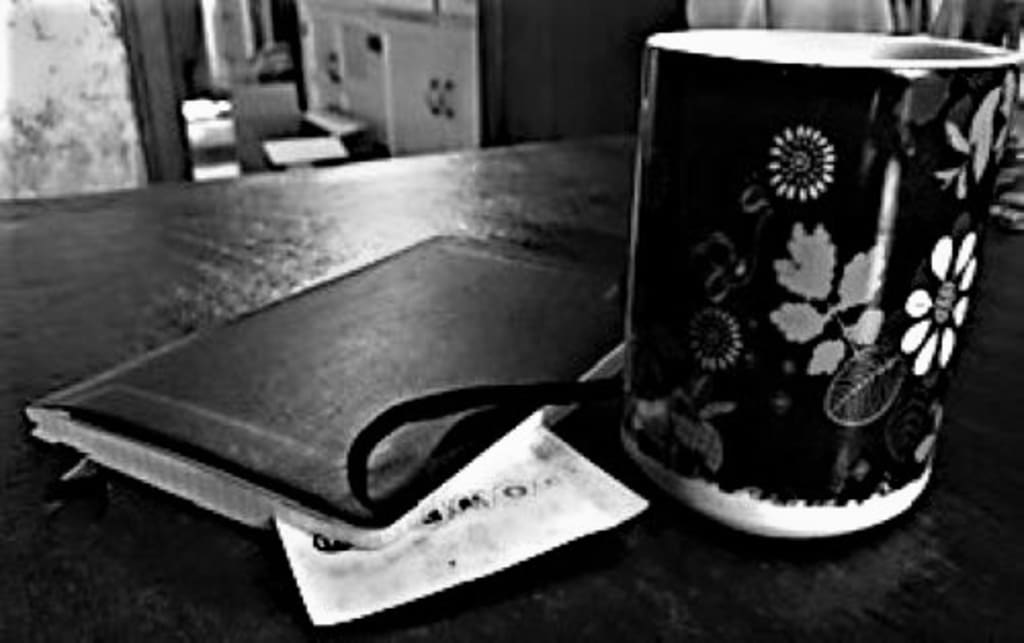
Such was Ambrose’s touchstone and why he spent his waking life—which stretched into his dreaming life—scratching away in his black Moleskin notebook, every page neatly numbered in the right-hand corner, concordant with the principles of numerology to which Ambrose, like a solemn postulant, was dedicated.
“This time we shoot for the stars,” he announced to William, the son Faye had brought into their marriage five years ago, after they’d met at a homeschooling conference. (Faye had been the eleventh person he’d spoken to.) Twenty thousand dollars—the amount Ambrose had won in an essay contest by pretending to be William—was nothing to sniff at, but it would end up covering only a fraction of William’s college costs, at the rate those costs were going. In seven years, when William hopefully flew the coop, who knew how much the college bills would be? As he’d told Faye that morning, “I could buy a Tesla for the amount those buzzards charge for a year’s college education.”
Dutifully, he’d entered the cost of the Tesla Model Y into the notebook: $56,998. The vehicle had 68 cubic feet of cargo space and a range, after charging, of 326 miles. “What to do with that, William, eh? Watch carefully.”
The boy barely said a word at any time, which Ambrose found soothing, if a little troubling. “He can speak,” Faye explained. “But he rarely sees the need.”
“Remember that essay I wrote, or should I say I helped you write? That essay, my boy, won you $20,000. But wouldn’t $50,000 be a more agreeable sum? One million? See how those numbers pile up, William? If we can get the right combination, and we will, that money will grow.”
“Like compound interest.” William spoke as if everything was an absolute fact. Ambrose searched his brain, but he couldn’t remember the boy, even once, asking him a question.
“Indeed. But what I have in mind necessitates some magic. See those numbers in my book, the ones concerning the Tesla? Let’s add them up, shall we?”
The sum didn’t take long. 5+6: 11. 9+9+8: 26. “We have our first winning numbers.”
Six plus eight—the numbers of the Tesla’s cubic feet—was 14. The charging range? 3+2+6. “Another 11! And that is your age, William! Numbers are speaking to us, truly they are.”
Faye slipped into the study. Ambrose glanced up, giddy. “Eleven is coming through, loud and clear again, my dear. Eleven, the enchantress, the one who brings about truly great things. Rarely have things started out so strongly.”
Faye addressed herself to William. “If you’ve had enough, come and join me in the family room for geography.”
“Shoo.” Ambrose would not have Faye mucking up the math. “There’ll be time for that later, the both of you. Numbers have no time for caprice, or even Capri.” He sniggered at his geographical joke. No one else laughed. “I will release William to you,” he glanced at his Fitbit and made a hurried calculation, “at 12:44.”
She turned without a sound and left the room. If she muttered anything, Ambrose didn’t hear. He was already on the hunt for more elevens.
“Now we have choices,” Ambrose said. To his satisfaction, the boy appeared to be paying attention, even though he remained mute. “Let me explain the plan. In what endeavor, William, can one choose numbers and potentially win a grand sum?”
He imagined the boy’s mind churning. It must be difficult to be so slow-witted, but surely some of Ambrose’s own alacrity of mind would rub off, eventually? “Let me give you a hint. There’s a machine in the supermarket in town. You can choose your own numbers, or have the machine choose them for you.”
“The lottery.”
At last! “That’s correct. And right now, the jackpot—the etymology of that word is an interesting one, and one day when there’s time I’ll educate you on it—the current jackpot is a handsome one.”
“Millions.”
“Yes, yes. And the odds of winning are 1 in 292.2 million.” He entered the memorized sum into the notebook. “Add them up for me would you, William?”
William deliberated. Ambrose counted to 10, then to 20. He would be patient. His own father, from whom he’d inherited this interest in numbers, had been testy at any delay and Ambrose had consequently feared him. But, after 30 increasingly agitated seconds, William needed a nudge. “One plus two plus nine plus two plus two is?”
“Sixteen. But there’s the point two.”
“What about it?”
“That would be 14.2, which would be seven, in your way of counting.”
“Ah, I see what you’re getting at. Yes, seven, which some consider a lucky number. I’ll take it on advisement. What do we have so far?”
They had 11, 26, 14, 16, and William’s 7—all circling the large one million Ambrose had written out, the zeroes shimmering like a series of perfectly circular wading pools in the center of the page. “We’ve already decided that our red ball number will be eleven, agreed?” A small nod. “Now, we are left to finalize five numbers from one to sixty-nine. I will put forward the number sixteen, and you can have seven. That is nice of me, isn’t it?”
No nod, this time. Maybe the child’s blood sugar was low? Ambrose himself fancied a snack. “Let’s go to the kitchen. We’ll find our remaining numbers there, I wager.”
While William rummaged in the fruit drawer and picked out an apple, Ambrose went straight for the biscuit tin. (Despite living in America for twenty years—two hundred and forty-five months to be precise, another eleven! —he refused to call it a cookie jar.) I will choose 45 as one of my numbers, however. Only one more number to go.
Where to find it? This was where divination came into play. The kitchen was full of numbers, but which of them was calling out to him at that moment? It could be the temperature in the refrigerator—thirty-four Fahrenheit—or the oven timer currently set, for whatever reason, for 0:47. But maybe that was too close to forty-five? Inspire me. Come, numbers, come!
He grabbed the box of German gingerbread Faye had allowed him for Christmas. “Delicious Gingerbread Shapes” the box announced, produced in Germany by Lambertz, “more than 325 years baking experience.” Good for them, putting their numbers front and center. They even participated in something called a “fairtrade cocoa program,” more to Faye’s liking than to his. The box weighed 17.6 ounces (1 lb 1.6 oz/500g) The poor Germans, having to spell everything out for their gluttonous American customers.
The side of the box held nutrition facts. For example, one cookie (28g). That didn’t speak to him, and neither did the numbers or percentages of total fat, cholesterol, sodium, total carbohydrate, or protein. But there it was, calcium: 30 mg. He would enjoy drinking a glass of milk with the delicious gingerbread shape, to ensure freedom from osteoporosis, or at least the hunched shoulders from which his father had suffered in late age—and celebrate the final number in his grand scheme: 30.
“We have it, William, we have it!”
William tossed his apple core into the trash.
“Interested in some delicious gingerbread?”
“Mom won’t let me.”
“One won’t hurt. Sometimes we need to push against a parent’s arbitrary restrictions.” By the look of things, the child had no idea what he meant. Vocabulary was something they’d have to work on after their big win. As his father had often said, "Two things should matter to a man: numbers, and a large vocabulary."
“No, thank you."
“Suit yourself. More for me, then.” Ambrose nibbled on a second cookie. Shouldn’t his winning number now be 60? A pulse in his stomach told him “yes.”
In the study, Ambrose wrote the sequence out for both tickets. 14, 16 (7 for William), 26, 45, 60. The red Powerball would be 11. “How does that look, William? One jackpot winning ticket, I feel it in my bones.” Your ticket will be off by one, but 50,000 dollars will still be a nice prize for an eleven-year-old.
After lunch, Ambrose wrote the numbers for the two tickets out for Faye, who always went to town with William on a Wednesday afternoon. He himself had an appointment with his Fitbit, which he venerated. Numbers galore! It was a challenge making sure he walked 250 steps per hour for 9 hours straight, and then there was the self-imposed competition of getting in as many steps as possible during the day. His current record was 7,400 steps, which he wrote in the notebook in numerals large enough to fill an entire page. He was not as religious about noting his water consumption—water was not his favorite drink—or counting calories: too many delicious German gingerbread shapes for that.
The evening rolled out much the same as any other. Ambrose expounded on interesting numerological facts, Faye made small talk, and William grunted. After a nightcap, Ambrose took himself to bed. Unlike Faye, he was not a night owl and needed a good eight hours of sleep. Nor did he stay up to watch the winning numbers being drawn. His father had made a point to wait until the next morning to check the tickets, a superstition which had stuck.
He woke refreshed. Sleep had been deep, unusually so, although he had an intimation of Faye sitting on the bed. His hand found the indentation to prove it. From below came the smell of coffee and something freshly baked. Did that woman ever sleep? Ambrose closed his eyes and napped for a further 22 minutes. Time to start William’s schooling. Long division would be challenging, but a great deal of fun.
The house was quiet. Coffee cake sat in a tin atop the stove. Ambrose poured coffee and sat at the table. The Moleskin notebook was there, a lottery ticket sticking out from between the pages. He opened the book and found a hundred-dollar bill.
In William’s writing, the letters looking like twisted wire, he read the message. “Your ticket was a winner.”
“Tremendous,” he shouted, expecting William to appear at the sound of his voice. The boy was taking his time.
He matched the numbers on his ticket with the winning draw. The first blow was that the red ball was not 11. Drat. But he did have four of the five numbers, something he’d never accomplished before: 14, 26, 45, 60.
A hundred-dollar win!
“William, William! Faye, come and have a look at this!”
No creaking doors, no scampering feet. Where were the two of them?
Sipping coffee, he noticed a squiggly arrow at the bottom of the page and turned it. Twisted wiry letters wrote: “My numbers were 7, 14, 26, 45, 60—almost the same as yours. For the Powerball, instead of eleven, I chose one plus one equals two. The winning numbers.”
Ambrose sprayed a mouthful of coffee over the notebook, the ticket, and the table. A grand prize winner! $78 million, which of course was a cash prize of $57.1 million. Still, Teslas, the best college for William, definitely a new house, and the ability to be charitable, if he wished.
“William!” he cried. “You amazing creature.” Of course he’d forgive the boy for tampering with the numbers.
He tore through the house. Car doors had slammed just before he’d woken the second time, he remembered that now. In his damp, coffee-stained notebook he wrote: Missing: two pairs of shoes. Missing: two suitcases. Present: One cell phone. Faye’s phone, snuggled on a sofa cushion.
Stronger than ever it came to him, in his father’s phlegmy voice: numbers never lie.
About the Creator
Michael Gettel-Gilmartin
Born in Panama, educated in England, resides in Portland, Oregon.
Have been hotel porter, carpet cleaner, summer school dean, ESL teacher, writer/editor, and in-home caregiver.
Keep reading
More stories from Michael Gettel-Gilmartin and writers in Humans and other communities.
How I Finally Stopped Feeling Overwhelmed and Took Control of My Time
H2: Feeling Overwhelmed by Daily Responsibilities I’m just gonna be 100% real here—I’ve spent way more time feeling totally "underwater" than I’d ever want to admit. Honestly, it’s just... a lot. Between the job being so demanding and people constantly popping in or sending pings every five seconds, my time management was basically a joke. I would often sit there with my cold coffee and think that there just weren't enough hours in the day. Seriously. I didn't even catch on to how much my own stupid habits were messing me up until I finally sat down and looked.
By Demiana Louis Boshraa day ago in Humans
Miss Persephone's Manual to a Seemingly Ordinary Life
Miss Persephone was found at the dining table, her blue eyes swollen, her tears arriving and retreating like the tides of the ocean. Earlier that day, her family had visited her in the retirement home where she had lived for eight years. It was her eightieth birthday.
By Imola Tóth2 days ago in Fiction


Comments
There are no comments for this story
Be the first to respond and start the conversation.