
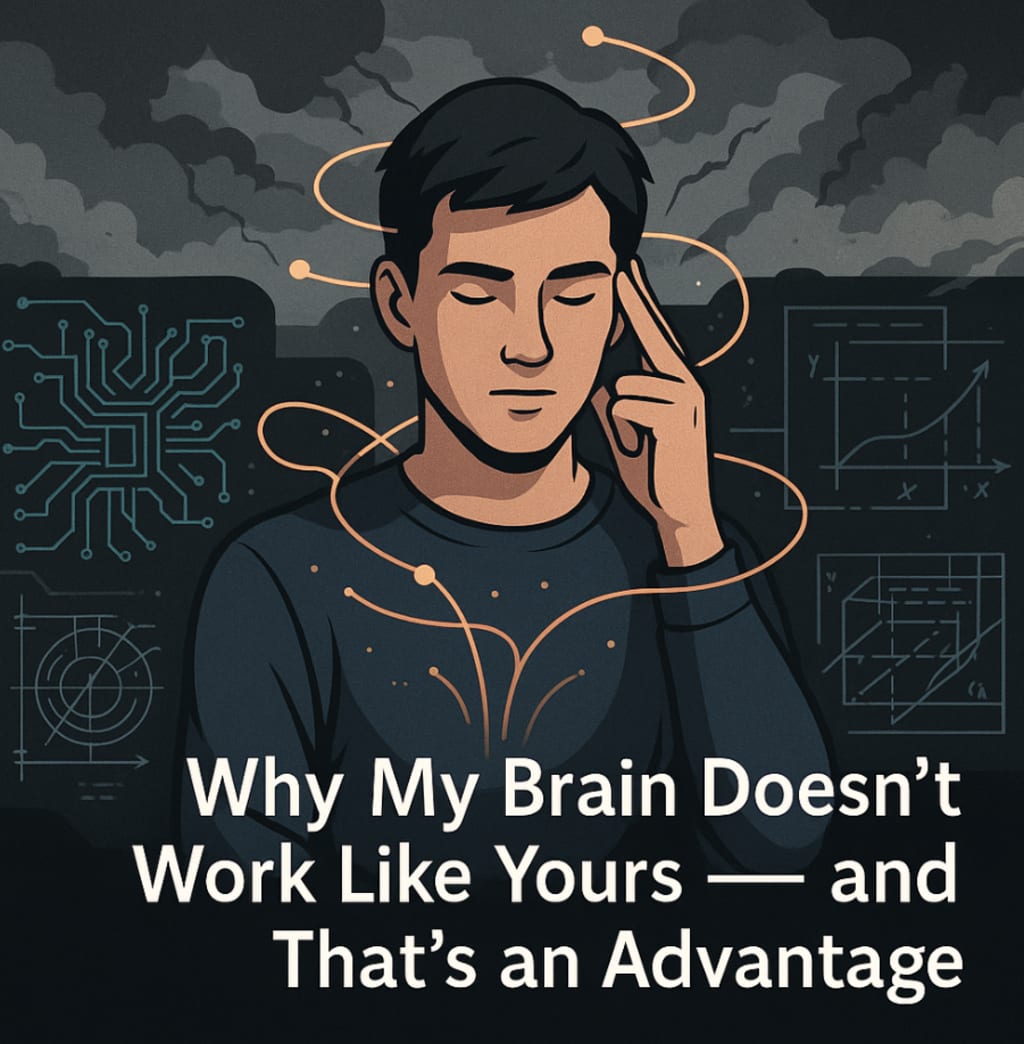
Why My Brain Doesn’t Work Like Yours — and That’s an Advantage
How autism, ADHD, and a brain injury rewired the way I think — and why that’s become my greatest strength in studying for my degree and life.

What Neurodivergence Actually Means (and What It Doesn’t)
I’ve always felt out of sync — like the rest of the world runs on one operating system while I’m coded in something completely different. I’m autistic, I have ADHD, and I live with a frontal lobe brain injury. For a long time, that combination made life difficult — school, social situations, even day-to-day tasks felt harder than they should (and most still do).
But now, as I work through my engineering degree, I’ve come to realise that the same wiring that once made me feel broken is actually my biggest asset.
The word neurodivergent is thrown around a lot lately — often without context. It’s not just a trendy label or excuse for being different. For me, it’s a lived experience.
I have ASD, ADHD, and a frontal lobe brain injury — three neurological conditions that shape how I think, process information, plan tasks, communicate, and regulate emotion. But instead of treating them as faults in the system, I’ve started to see them as features.
Autism gives me the ability to hyper-focus, recognise patterns others overlook, and break problems down into clear, logical components.
ADHD brings creativity, rapid ideation, and a drive to explore unconventional solutions — even if I sometimes struggle to finish before the next idea kicks in.
The brain injury forced me to manually rebuild my executive function — which sounds like a setback, but it gave me insight into how to construct workflows and systems deliberately, like a software patch made for my mind.
These traits have become essential tools in my engineering studies. When I’m tackling circuit design, fluid dynamics, or systems modelling, I often find myself approaching problems in a way that surprises my peers. Sometimes I arrive at the same answer by a completely different route. Other times, I spot inefficiencies that no one else sees. I’m not saying that makes me better — it just makes me different. And in STEM, different often leads to innovation.
That said, the system isn’t always kind to minds like mine. Structured lectures that assume a linear processing style, rigid test conditions that ignore working memory deficits, and collaborative environments where communication styles clash — all of these create barriers. And it’s not just frustrating; it’s exhausting.
Where I Struggled — and Why the System Isn’t Built for Minds Like Mine
I don’t struggle with understanding engineering — I struggle with how it’s taught, tested, and timed.
In lectures, I can get lost within the first five minutes if the delivery lacks structure or clarity. My brain doesn’t absorb fragmented information well — I need systems, context, and patterns. When content is thrown at me out of sequence or without explanation, my mind treats it like corrupted data.
Then there are the module tests — rigid, high-pressure, time-boxed assessments that feel more like speed challenges than actual tests of engineering understanding. I’ve studied hard, built systems, revised over weeks, and walked into tests fully prepared — only to freeze. My brain blanks. I forget formulas I just reviewed. The test conditions override my logic with stress.
That’s not a lack of ability — it’s the clash between a system designed for neurotypical cognition and a brain wired differently.
I’ve had to fight for accommodations that make sense — not just “extra time,” which doesn’t address the root of the issue, but access to reference sheets, consistent formats, or alternative assessments that actually reflect what I know.
And despite how frustrating it’s been, these experiences have made me more resilient, more adaptive, and more aware of how broken the system is for a lot of us — not just me. I'm not asking for the system to be easier. I'm asking for it to be fairer.
Where I Excel — and How I Turn Difference into Design
Despite the hurdles, there are areas where my neurodivergence gives me a clear advantage — especially in the kind of thinking that engineering thrives on.
I don’t just follow formulas — I see systems. I look at a mechanical process or circuit and instinctively break it down into its logical components, tracking the cause-effect relationships like a flowchart in my head. I often spot bottlenecks or design flaws that others miss, not because I’m smarter, but because my mind refuses to accept surface-level explanations. It has to understand — deeply.
In group work, I might struggle with casual collaboration or rapid verbal exchanges, but when it comes to documentation, design logic, systems efficiency, or risk foresight, I shine. I’ve often found myself stepping in to repair disorganised work, restructure a broken group plan, or automate a manual task. To me, inefficiency is like a splinter — I can’t ignore it.
That obsession with improvement doesn’t just help me in class — it’s shaping the way I approach future engineering. I want to build systems that replace the mundane, simplify the complex, and reduce human error. Not to devalue people, but to liberate them. To remove the strain of tasks not designed for our strengths.
Because that’s the thing about being wired differently: you see the cracks in the system. And sometimes, you can fix them — or design something better.
To Those Who Don’t Fit the Mould: You’re Not Broken — You’re Built for Something Bigger
If you’ve ever felt like you’re not wired the way the world expects — like your mind runs too fast, too deep, or just differently — I want you to know something: you are not broken.
The systems around us — in education, work, even daily life — weren’t designed with every mind in mind. They often miss the complexity of invisible challenges. ADHD. Autism. Brain injuries. Executive dysfunction. Sensory processing issues. These aren't always seen, but they’re very real.
And while these differences can make things harder, they also come with powerful capabilities: the ability to see connections others miss, to focus with intensity, to solve problems in unconventional ways, or to feel the weight of things others gloss over.
You may not have found the right environment yet. You may have been told to “try harder” when you were already at your limit. You may have felt invisible, underestimated, or dismissed. But none of that defines you.
The truth is that the world desperately needs the minds that don’t fit neatly. The ones that question, restructure, reimagine.
So, if you’ve ever wondered whether there’s a place for the way you think — maybe that’s because you’re meant to build that place.
What if your struggle has shaped the very mindset needed to fix what’s broken around us?
What if your unseen challenges have made you more empathetic, more systematic, more inventive — not in spite of them, but because of them?
What if the thing that set you apart this whole time was really a signal — a sign that you’re here for something greater than surviving a system not built for you?
Ask yourself:
🧭 What truths do I carry that the world hasn’t yet understood?
🔍 What problems am I uniquely equipped to solve?
🔧 And what would happen if I stopped trying to fix myself — and started building a world where I already belong?
That’s not just a possibility. That’s your blueprint.
— TechHermit
“Sometimes the people no one imagines anything of do the things no one can imagine.”— Alan Turing (as quoted in The Imitation Game)
About the Creator
TechHermit
Driven by critical thought and curiosity, I write non-fiction on tech, neurodivergence, and modern systems. Influenced by Twain, Poe, and Lovecraft, I aim to inform, challenge ideas, and occasionally explore fiction when inspiration strikes
Keep reading
More stories from TechHermit and writers in Humans and other communities.
The Gamer Scapegoat
Introduction There's a pattern we don't talk about nearly enough. Whenever something goes wrong with kids, teenagers, or even young adults — be it violence, gambling, social withdrawal, poor academic performance, or rising mental health concerns — there's a familiar name that gets dragged into the headlines: video games.
By TechHermit8 months ago in Humans




Comments
There are no comments for this story
Be the first to respond and start the conversation.