
When the Moon Went Missing
The night the moon vanished, the world forgot how to dream


No one noticed it at first. The evening sky arrived as usual, painted in indigo, the stars waking one by one. But when people looked for the moon, it wasn’t there. Not behind the clouds. Not beneath the horizon. It was simply… gone.
Astronomers called it an “unexplained optical anomaly.” Children called it “the night the sky forgot its smile.” But for me, it was the night my mother stopped singing.
She used to hum to the moon every evening from our old balcony, her voice floating into the night like a prayer. “She listens,” my mother would whisper, smiling up at that silver light. “The moon always listens.”
When it disappeared, her songs did too.
The Town Without Light
In our small coastal town, tides grew strange without the moon’s pull. Fishermen said the sea lost its rhythm, rising when it shouldn’t, sleeping when it should have danced. Gardens withered, birds flew in circles, and nights grew heavier.
People began lighting candles on rooftops — small offerings to the missing moon. Some prayed, others cursed. A few even claimed they could hear her crying in the waves.
I didn’t believe in that kind of magic — not until the night I found the note.
The Note in the Telescope
My mother’s old telescope sat by the window, covered in dust. She hadn’t touched it since the moon vanished. But one evening, as I cleaned the lens, I found a folded piece of paper tucked inside.
It said:
“When the moon goes missing, look for the girl who never sleeps.”
At first, I thought it was just one of my mother’s poetic phrases. But when I asked her, she turned pale. “I wrote that… years ago,” she whispered. “Before you were born.”
The Girl Who Never Sleeps
That night, I couldn’t rest. Around midnight, I walked to the cliffs overlooking the ocean — the place where my mother used to sing. The waves shimmered faintly under the starlight. And then I saw her.
A figure standing barefoot at the edge of the cliff, wearing a white dress that shimmered like frost. Her hair flowed as though underwater, and her eyes reflected the stars.
“You came,” she said, as if she’d been waiting.
“Who are you?” I asked, my voice trembling.
She smiled sadly. “You wouldn’t believe me if I told you.”
“Try me.”
She looked toward the sea. “I’m the reason the tides listen. The reason dreams glow. I’m the one you call the moon.”
I wanted to laugh — but something in her eyes silenced me. They weren’t human eyes. They carried the calm of centuries, and sorrow older than time.
Why the Moon Left
She told me she had grown tired of watching. “Humans stopped looking up,” she said softly. “They built lights brighter than mine, chased stars made of metal, and forgot to listen to the night. So I left. I wanted to see if anyone would notice.”
I swallowed hard. “We did notice,” I said. “The world isn’t the same.”
Her expression softened. “Not the world,” she said. “You.”
It was then I understood — she wasn’t talking about humanity. She was talking about my mother.
The Song that Called Her Back
The moon turned to face the dark horizon. “Once, your mother sang to me,” she said. “Every night. Her voice kept me company through centuries of silence. But she stopped — and so I did too.”
Tears stung my eyes. “She stopped because you disappeared.”
“Then sing for her,” the moon whispered. “So she remembers how.”
The Night of the Song
I ran home. My mother was sitting by the window, staring into the dark. I told her everything — the cliffs, the girl, the words. She smiled weakly. “You always had your father’s imagination.”
But I took her hand and led her outside anyway. The sea shimmered faintly in the distance, and the stars seemed to lean closer.
Then, for the first time in years, she began to hum.
It was the same melody she used to sing when I was small — soft, slow, full of longing. I joined her, my voice shaking. The sound floated across the cliffs, blending with the wind.
And then it happened.
A faint glow appeared on the horizon. Gentle, silver, growing brighter with every note. The sea sighed. The air shifted. The missing light returned — rising, whole and beautiful, as if it had never left.
The moon was home again.
After the Return
People cheered. Scientists scrambled to explain the impossible. But I didn’t need proof. I knew what I’d seen — and what we had brought back with a song.
My mother sang every night after that. The town’s tides found their rhythm again. And though she never spoke of that night, she always smiled when the moonlight touched her face.
Sometimes, when I look up at the sky, I see the moon blink — just once — as if she’s remembering the song.
And I like to think she still listens.
About the Creator
LUNA EDITH
Writer, storyteller, and lifelong learner. I share thoughts on life, creativity, and everything in between. Here to connect, inspire, and grow — one story at a time.
Keep reading
More stories from LUNA EDITH and writers in Humans and other communities.
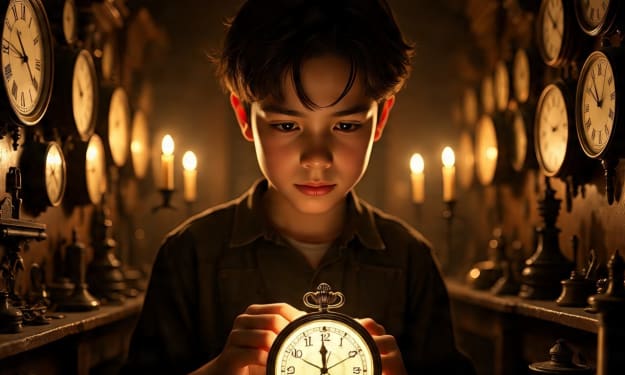
The Clockmaker’s Apprentice Who Could Erase Memories
The first time I met Mr. Alden, the town’s old clockmaker, he was fixing a watch that didn’t belong to anyone anymore. The hands had stopped at 3:17, and he stared at it like it held a secret he wasn’t ready to tell.
By LUNA EDITH3 months ago in Humans
Why We Stare at Slow Drivers
Most drivers perform a strange ritual they never talk about. Someone ahead of them is moving so slowly it stretches patience to its thinnest thread. Once the gap opens and they can finally accelerate past, the same thing happens every time. They look. They turn their head just enough to catch a glimpse inside the other car. It feels automatic and unnecessary, but the body does it without taking a vote. The stare is not rudeness, and it is not about proving a point. It is part of a deeper behavioral process that starts the moment another driver interferes with your rhythm.
By Dr. Mozelle Martin | Ink Profiler2 days ago in Humans


Comments
There are no comments for this story
Be the first to respond and start the conversation.