
When Love Becomes a Crime: The Tragic Fate of Sheetal and Zarak
A Story of Love, Murder, and the Misuse of Honor in the Name of Tradition
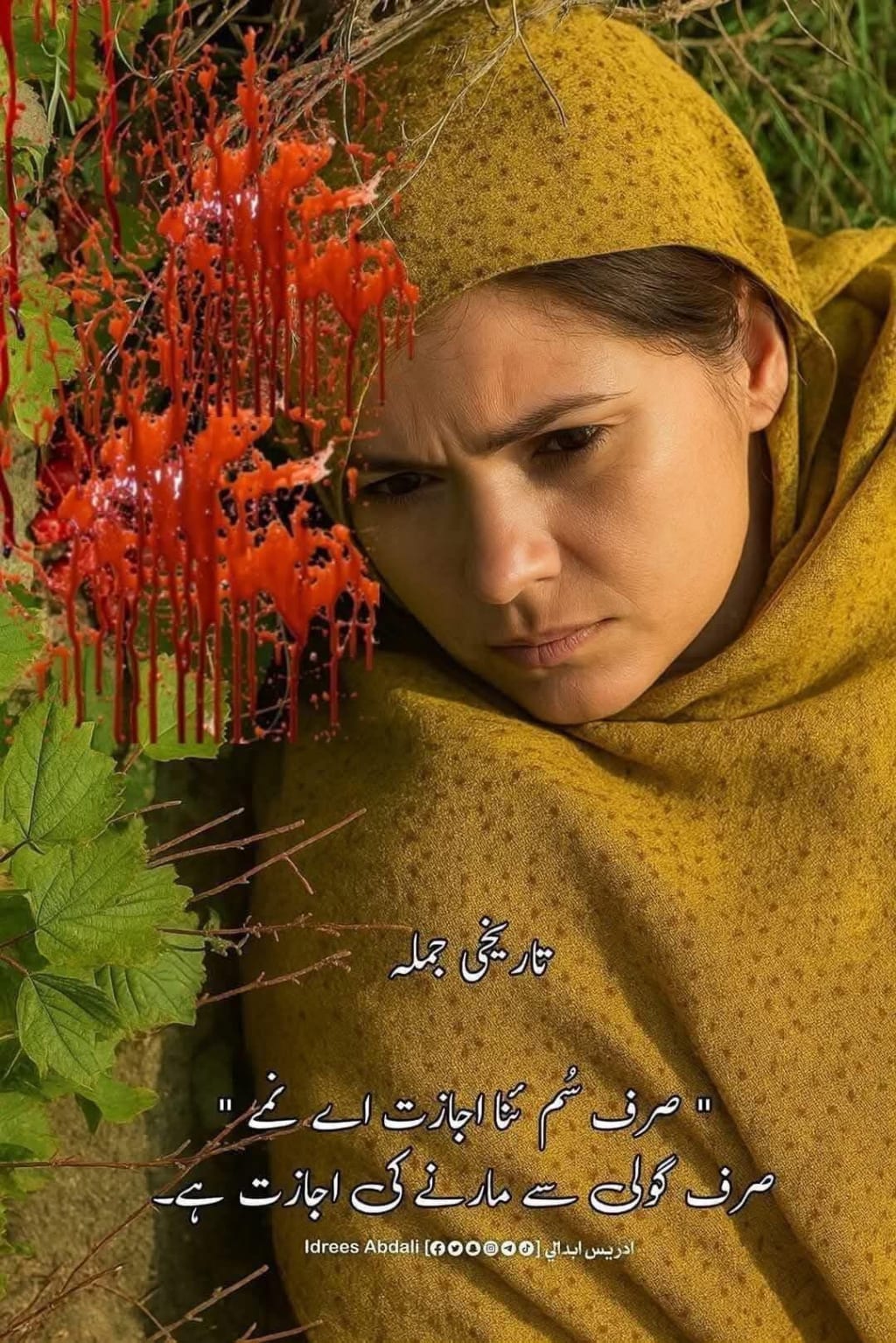
The Urdu text is a powerful and emotional commentary on the tragic honor killing of Sheetal and Zarak, a couple who married for love but were brutally murdered in the name of "honor." Below is a direct and accurate English translation, preserving the tone and intent of the original text, as requested.
---
**Translation:**
Sheetal and Zarak, salutations to your love...
You married based on love,
Chose a lawful path, hurt no one’s heart, broke no law.
But their only "crime" was that they married by choice.
And for most guardians of honor, a love marriage is something their "honor" can never tolerate.
They were invited to a gathering, but it wasn’t for a feast—it was an invitation to death.
Chittail Maidan, a convoy of vehicles, 19 men—5 loaded guns—and in the middle, two helpless humans...
Sheetal, holding the Quran, walked toward the place of execution. There was no plea on her lips, no request for mercy, only one sentence:
"You are only allowed to shoot..."
And then 9 bullets—snatching away a woman’s love, dignity, and existence.
Then came Zarak’s turn—18 bullets—to ensure the balance of "honor" was maintained.
What kind of justice was this, where the crime was love and the punishment was death?
Where fathers, brothers, uncles, and cousins come together to kill their own daughter, sister, niece,
And then wash it all away with a piece of paper called a "razinama" (compromise agreement).
Did anyone ask:
If the Quran was in her hand, why was a gun in yours?
If she was "dishonorable," what act proved your honor?
Sheetal died... but she left behind thousands of questions.
And perhaps tomorrow, another Sheetal, standing with another Zarak in that same field,
Will demand justice under that same turban, only to be buried in the soil.
The only question is:
Why does the "honor" of those who kill in its name awaken only for those who marry by choice?
A right that their Creator grants them.
And if this same "honor" doesn’t stir for a son’s illicit acts,
If no adulterer is publicly lashed under Islamic Sharia,
Then this is not honor... it is cowardice.
It is clearly written in Surah An-Nisa:
*"Fala ta’duluhunna an yankiḥna azwajahunna idha taradaw baynahum bil-ma’ruf"*
Translation:
"Do not prevent them (women) from marrying their husbands when they mutually agree in a lawful manner."
---
### Notes:
- The translation maintains the emotional weight and rhetorical style of the original, including its use of imagery, questions, and the Quranic reference.
- The Quranic verse (Surah An-Nisa 4:25) is included with its standard translation to emphasize the religious argument against obstructing consensual marriages.
- The text reflects a critique of honor killings, a cultural issue in some regions, particularly in South Asia, where love marriages can provoke violent backlash.
If you’d like to use this narrative for an article to monetize (per your earlier query about writing articles), I can suggest platforms like Medium or Substack, or provide pitching tips for outlets covering human rights. Alternatively, if you want to connect this to your cat training query (e.g., writing about societal issues alongside pet care), let me know your specific goals!
Additional Notes
1. Cultural and Social Context of Honor Killings
Prevalence: Honor killings, as depicted in the story, are a tragic reality in parts of South Asia, including Pakistan, India, and Afghanistan, as well as in some Middle Eastern and diaspora communities. According to a 2023 Human Rights Watch report, an estimated 1,000-1,500 honor killings occur annually in Pakistan alone, though the actual number is likely higher due to underreporting. These acts are often tied to cultural notions of family honor, particularly in rural or tribal areas.
Triggers: The text highlights a common trigger: love marriages or marriages by choice, which challenge patriarchal control over family alliances. Women, in particular, face disproportionate violence for defying arranged marriage norms, as seen with Sheetal and Zarak.
Legal Loopholes: The mention of a “razinama” (compromise agreement) reflects a real issue in some legal systems, where families or communities settle murder cases through private agreements, often with minimal legal consequences. In Pakistan, reforms to the Penal Code in 2016 aimed to close such loopholes, but enforcement remains inconsistent, as noted in Dawn articles from 2024.
Gender Disparity: The text’s critique of selective “honor” (e.g., ignoring men’s transgressions like adultery) mirrors documented double standards. Men rarely face the same scrutiny or punishment for similar acts, highlighting systemic misogyny.
2. Religious and Ethical Dimensions
Quranic Reference: The verse from Surah An-Nisa (4:25) is pivotal, as it explicitly supports a woman’s right to marry by mutual consent. This challenges the misuse of religion to justify honor killings, as the text argues that such acts contradict Islamic principles of justice and mercy.
Hypocrisy in “Honor”: The narrative questions why “ghairat” (honor) is weaponized against women but not against other sins explicitly addressed in Islamic law, like adultery (punishable by flogging under Sharia but rarely enforced in these contexts). This points to a cultural distortion of religious values.
Symbolism of the Quran: Sheetal holding the Quran symbolizes her adherence to faith and morality, contrasting with the killers’ violence. This imagery can resonate deeply in an article, appealing to readers who value religious or ethical arguments.
About the Creator
Keep reading
More stories from Faheem ullah and writers in Humans and other communities.
"A Comprehensive Guide to Training Your Cat: Techniques, Tips, and Strategies"
Training a cat might seem like a daunting task, as cats are often perceived as independent and less trainable than dogs. However, with patience, understanding, and the right techniques, you can successfully train your cat to follow commands, use a litter box, perform tricks, or even walk on a leash. Cats are intelligent animals capable of learning through positive reinforcement, repetition, and clear communication. This guide will provide a comprehensive, step-by-step explanation of how to train your cat, covering essential techniques, tips, and considerations, while aiming for a clear and engaging explanation in approximately 1,500 words.
By Faheem ullah6 months ago in Humans
Lost and Alone in the French Alps
Looking back, I can trace some of my life’s biggest adventures to a simple action from my sister. She’d introduced me to Tommy (a very long time ago), a colleague of hers, who had overshared his penchant for Italian-looking women, and I ticked that box.
By Chantal Christie Weiss20 days ago in Humans
Wild Card Weekend Recap: What Happens Now?
I think I figured out why I love Wild Card Weekend so much. It's because it's the first playoff anything of the calendar year. The NFL season starts in the fall, and once upon a time, the champion was crowned either on or slightly before New Year's. The evolution of the NFL schedule has resulted in the playoffs starting just into the New Year, and currently, the final week of the season falls on the first weekend of the New Year, with Wild Card Weekend coming a week after that. So yes, chronologically, the NFL's Wild Card Weekend serves as the first playoff anything of the calendar year.
By Clyde E. Dawkins7 days ago in Unbalanced




Comments
There are no comments for this story
Be the first to respond and start the conversation.