
When Holiday Cheer Meets Hardline Policy: The DHS Christmas Meme Campaign That Sparked a National Outrage
The Department of Homeland Security released Christmas-themed deportation memes featuring Santa hats, sleighs, and “Ho Ho Home” messages and America erupted. Critics say the campaign turns human suffering into holiday humor.

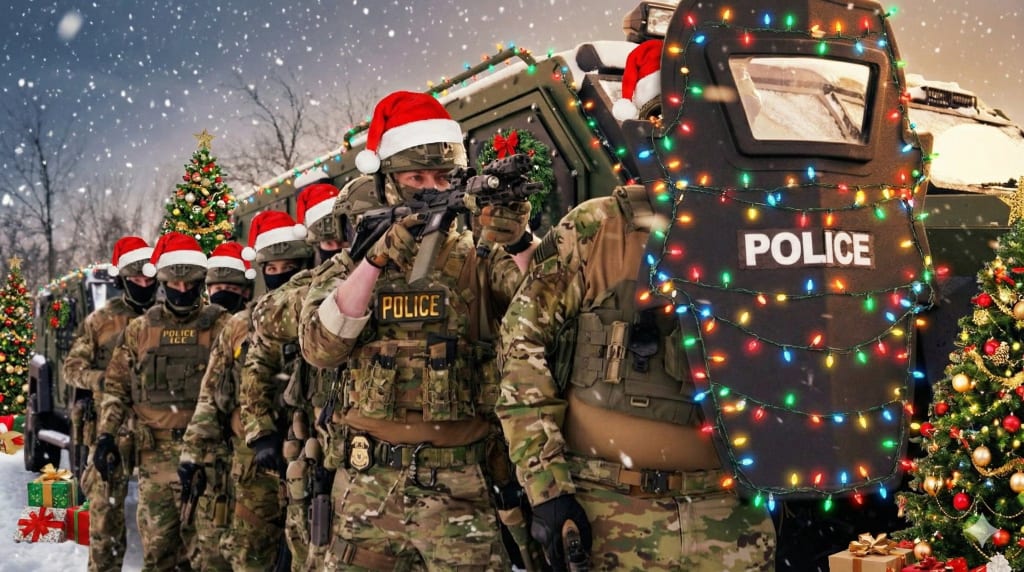
There are moments in American politics that feel so strange, so out-of-step, that people have to ask: “Is this real?”
This December, just as families were decorating trees, lighting candles, and unboxing ornaments that smell like childhood, the U.S. Department of Homeland Security posted something that stopped millions of Americans mid-scroll.
A heavily armed federal agent wearing a bright red Santa hat.
A government-branded graphic reading:
“YOU’RE GOING HO HO HOME.”
Holiday lights wrapped around enforcement vehicles not gently, not playfully, but like props in a dystopian Christmas movie.
It wasn’t satire.
It wasn’t parody.
It wasn’t from a meme page or a political cartoonist.
It was official messaging from one of the most powerful agencies in the United States.
And with one post, America had a new controversy on its hands.
A Meme That Sparked a Firestorm:
Within hmours, screenshots spread across social platforms.
Twitter/X users called it “government meme fascism.”
TikTok creators reacted in split-screen horror.
Immigrant advocacy groups described it as “a punch in the gut.”
Religious leaders denounced it as “anti-Christian and anti-human.”
And people who don’t normally discuss politics online suddenly had something to say.
Because something about this campaign struck a nerve deeper than partisan arguments, deeper than policy disagreements.
It felt personal.
It felt wrong.
It felt like a holiday hijacked for something cold and cruel.
The Intention vs. The Impact:
To government analysts, maybe the campaign looked “clever.”
A creative team probably pitched the idea as:
• “Eye-catching.”
• “Shareable.”
• “Made for the algorithm.”
• “Modern communication.”
But to the communities directly affected by immigration enforcement especially undocumented families, asylum seekers, and mixed-status households the message landed with a thud.
The holiday season is already a painful time for many immigrants.
It’s a time when loneliness intensifies, when fear of raids looms heavier, when family separation feels even sharper.
So when a government agency used twinkling lights to decorate deportation?
When armed officers were framed as Santa’s little helpers?
When “going home” didn’t mean cozy gatherings but forced removal?
For millions of people, the message wasn’t festive.
It was terrifying.
The Emotional Whiplash:
What makes this story so explosive is the emotional clash built into it. Holidays are supposed to bring out the best in us:
• compassion
• generosity
• forgiveness
• warmth
• family
• love
But the DHS memes brought out the opposite:
• fear
• anger
• trauma
• outrage
• confusion
This emotional collision holiday joy weaponized as immigration messaging is why the controversy grew so big, so fast.
The History Behind the Hurt:
To understand the full reaction, you have to remember the backdrop.
Years of tense immigration battles:
From border crises to policy reversals, immigration has been one of America’s most emotional political battlegrounds.
Families separated:
Many immigrants still carry emotional scars from past enforcement actions.
Mixed-status households:
Millions of American families include both citizens and non-citizens. A deportation threat isn’t abstract it’s a daily fear.
Holiday trauma:
Many immigrants can’t travel home for the holidays. Many haven’t seen family in years. A meme about “going home” lands differently when “home” is a place you fled.
So when DHS used holiday cheer as a marketing tool for deportation, the context wasn’t neutral.
It carried years of pain behind it.
The Online Explosion: Who Said What:
One part of the story Vocal readers love is how culture reacts and this controversy gave the internet a lot to react to.
Religious leaders:
Called the campaign “anti-Christian,” pointing out that Christmas is literally about welcoming the stranger.
Immigration advocates:
Described it as state propaganda “disguised as holiday fun.”
Politicians:
Broke out in arguments some applauding the “tough messaging,” others condemning the “mockery of human suffering.”
Celebrities & influencers:
Called it “the weirdest, darkest holiday PR move” they’d ever seen.
Average Americans:
Even those who support strong border enforcement said:
“This is… weird. Why make it cute?”
People disagreed on immigration policy. But most agreed on this:
Deportation isn’t cute.
It isn’t cheerful.
It shouldn’t be festive.
What Makes This Story So Uniquely American?
America is a country of contradictions.
On one hand: patriotic, festive, emotional, nostalgic.
On the other: political, divided, increasingly online.
This controversy revealed a lot about those contradictions:
The government now speaks in memes:
This isn’t your grandfather’s immigration enforcement. This is digital strategy meets political theater.
Culture wars have taken over holidays:
Nothing is sacred not even Christmas.
People care about tone as much as policy:
Even if you support immigration enforcement, the style matters.
America’s immigrant identity is still unresolved:
We are a nation built by immigrants but also a nation struggling with immigration.
The internet decides the narrative now:
A meme can shape national debate faster than any speech.
Voices from the Community:
You can’t tell this story without acknowledging the people at the emotional center of it.
Here are the kinds of reactions that poured in from immigrant communities across the country:
“My kids saw that picture. They asked if Santa is coming to arrest people.”
“I’m a U.S. citizen married to an undocumented spouse. Christmas is already stressful. This made it worse.”
“My mom cried when she saw it. She came to this country as a child.”
“It’s not just a meme. It’s a reminder that our family could be torn apart.”
These aren’t political statements.
They’re human reactions.
And that’s the core of the story.
Why Did DHS Think This Was a Good Idea?
Believe it or not, there is a logic behind the campaign even if many people think it’s flawed.
Visibility:
Anything meme-able spreads fast.
Deterrence:
Some experts argue DHS was trying to discourage unauthorized migration by making deportation “unmissable.”
Digital relevance:
Government agencies increasingly try to communicate the way brands do punchy, viral, graphic-heavy.
Political signaling:
The memes send a message:
“We’re taking a hardline stance, and we’re proud of it.”
But intention ≠ impact.
The backlash shows that even if a message is “effective,” it can still be harmful, disrespectful, or deeply tone-deaf.
The Bigger Question: Has America Lost Its Sense of Empathy?
This controversy isn’t just about one meme campaign.
It’s about the temperature of America right now.
The way we talk about each other.
The way policy becomes performance.
The way pain becomes content.
Every holiday season, there’s at least one cultural flashpoint. But this year, the flashpoint came from the government itself turning Christmas into a weapon in the culture war.
Let’s Talk About the Human Impact:
Put politics aside for a moment.
Imagine this situation:
You’re an undocumented parent.
You work long hours.
You pay taxes.
You’ve lived here for 12 years.
Your children are American citizens.
You’re trying to make the holidays magical even though you’re struggling.
One night, you’re scrolling through your phone when you see a government agent in a Santa hat telling you:
“You’re going Ho Ho Home.”
How would that feel?
The answer isn’t political.
It’s human.
The Two Americas That Appeared That Day:
When the meme went viral, it showed two versions of America:
America #1: The Meme America
A place where humor is everything.
Where irreverence is the norm.
Where nothing is sacred.
Not even Christmas.
Not even deportation.
America #2: The Human America
A place where people still feel things deeply.
Where the holidays still mean something.
Where families still fear losing each other.
These two Americas crashed into each other at full speed.
That collision is the story.
What This Means for the Future?
Whether you think the memes were:
• a clever public-relations strategy
• a cruel joke
• a political tactic
• a government misfire
• a deliberate provocation
…the impact remains the same:
It changed the conversation.
It exposed the emotional fault lines in the country.
And it proved that messaging matters deeply.
Final Thoughts: A Holiday Lesson America Didn’t Ask For
Every December, Americans argue about something red cups at Starbucks, the color of Christmas lights, whether “Merry Christmas” is political.
But this year, the argument wasn’t about a cup or a slogan.
It was about the soul of the country.
The DHS memes reminded us of a simple truth:
A nation can enforce its laws
without losing its humanity.
A government can communicate its message
without mocking the people it impacts.
And the holidays of all times should bring out our compassion, not our cruelty.
Whether you agree or disagree with immigration policy isn’t the point.
The point is the feeling this campaign created.
Because long after the memes fade, the question remains:
What kind of country do we become when we choose to laugh while others live in fear?
And that is the real story.
About the Creator
Zeenat Chauhan
I’m Zeenat Chauhan, a passionate writer who believes in the power of words to inform, inspire, and connect. I love sharing daily informational stories that open doors to new ideas, perspectives, and knowledge.
Keep reading
More stories from Zeenat Chauhan and writers in Humans and other communities.
The Hidden Cost of Hustle Culture: Why America Is Finally Burning Out
For years, America has celebrated the hustle.Wake up at 5 a.m., grind until midnight, sleep when you're dead these became badges of honor, not warning signs. “Busy” became a personality. Productivity became a form of self-worth. And the idea of slowing down was labeled as laziness, weakness, or lack of ambition.
By Zeenat Chauhan2 months ago in Humans
The Girl Who Blinked: How a Sixteen-Year-Old Stopped a Massacre by Trusting the Knot in Her Stomach
The true story of Emily Carson, the Colorado high school student who prevented a school shooting by noticing a subtle detail and reporting it, highlighting the power of situational awareness.
By Frank Massey 5 days ago in Humans



Comments
There are no comments for this story
Be the first to respond and start the conversation.