
What We Call Demons (And Why Integration Feels Impossible)
Reclaiming Shadow, Trauma, and the Language That Shapes Reality

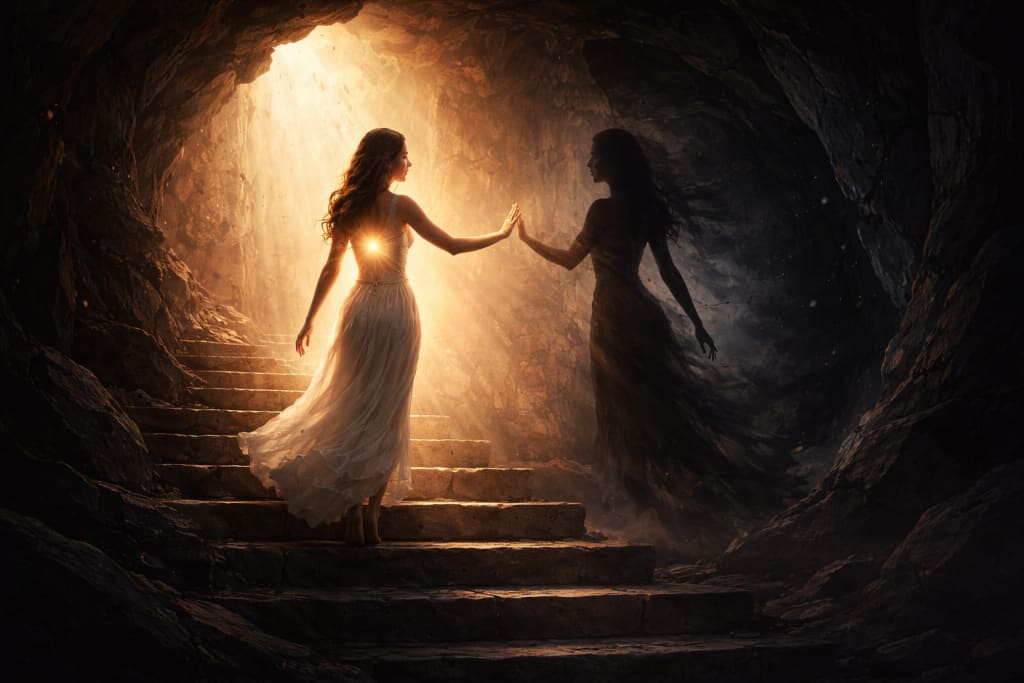
An exploration of how the word “demon” distorts trauma, shadow work, and nervous-system dysregulation — and why integration requires renaming what we fear.
What We Call Demons (And Why Integration Feels Impossible)
Reclaiming Shadow, Trauma, and the Language That Shapes Reality
We give something a name.
Then we give that name a shadow.
Then we pretend we are separate from it.
“Demon.”
The word lands heavy before we even examine it. It carries fire, exile, possession, darkness. It carries blame.
But what if the first distortion is the naming itself?
Throughout history, cultures have used different language for what feels overwhelming inside the human body.
In ancient Greece, a daimon wasn’t evil — it was a guiding spirit, an inner force, a mediator between human and divine. Later, in Christian theology, the term became adversarial — something outside of us, corrupting us.
Somewhere along the line, what was once a force became an enemy.
And we inherited the enemy.
But here is the uncomfortable truth:
What we call demons are often unintegrated parts of ourselves.
Unprocessed grief.
Rage with nowhere to go.
Shame that calcified.
Addiction as a regulator attempt.
Fear that never felt safe enough to soften.
The nervous system does not create evil.
It creates protection.
When trauma lives in the body without language, it behaves.
It distorts perception.
It whispers threats.
It hijacks responses.
And because we do not understand it, we exile it.
We say:
“That’s not me.”
“That’s darkness.”
“That’s a demon.”
But what if it’s a fragment waiting for acknowledgment?
Here’s the paradox:
The more violently we reject the “demon,” the stronger it appears.
Because exile strengthens shadow.
Integration weakens distortion.
You cannot integrate what you have declared evil without first softening your definition of evil.
This does not mean all behavior is acceptable.
It means behavior has roots.
When a person rages uncontrollably, we can call it possession —
or we can recognize dysregulation.
When someone spirals in addiction, we can call it moral failure —
or we can recognize a nervous system attempting to soothe unbearable internal states.
When intrusive thoughts arise, we can call them dark spirits —
or we can recognize a brain scanning for threat.
Language shapes reality.
If we define internal fragmentation as “demonic,”
we make integration impossible.
Because who would willingly sit with a demon?
But what if the “demon” is simply pain without containment?
In many mythologies, the hero does not destroy the monster.
The hero descends into the underworld.
The descent is not about conquest.
It is about retrieval.
Parts retrieval.
You don’t slay what belongs to you.
You learn to hold it.
This is where maturity begins.
Not in pretending we are light.
Not in denying the shadow.
Not in blaming external forces.
But in asking:
What part of me have I named evil because I did not know how to regulate it?
The word “demon” becomes less interesting when you understand the architecture of trauma.
The real danger is not inner darkness.
The real danger is refusing to look at it.
Unintegrated shadow becomes projection.
Projection becomes conflict.
Conflict becomes culture.
And suddenly “demons” are everywhere —
in politics, in religion, in family systems, in online discourse.
We externalize what we refuse to metabolize.
If we want a world with fewer demons,
we must become people who can sit with discomfort.
Sit with rage without acting it out.
Sit with grief without numbing it.
Sit with shame without collapsing into it.
Integration is not indulgence.
It is discipline.
It is nervous-system literacy.
It is shadow maturity.
It is the ability to hold paradox without splitting.
You cannot integrate what you are terrified to name differently.
Maybe the real work is not fighting demons.
Maybe the real work is reclaiming language.
Reclaiming the parts of ourselves that were misnamed.
Reclaiming responsibility.
Because when you stop calling your pain a demon,
you can finally ask what it needs.
And when you ask what it needs,
you begin to integrate.
And when enough people integrate —
the collective stops manufacturing monsters.
We do not transcend shadow by exiling it.
We become sovereign by metabolizing it.
AUTHOR NOTE
Flower InBloom
This piece lives inside my broader exploration of nervous-system architecture and shadow integration. We do not transcend darkness by exiling it. We become sovereign by metabolizing it.
—Flower InBloom 🌿
About the Creator
Flower InBloom
I write from lived truth, where healing meets awareness and spirituality stays grounded in real life. These words are an offering, not instruction — a mirror for those returning to themselves.
— Flower InBloom
Keep reading
More stories from Flower InBloom and writers in Humans and other communities.
I wanted to title this something different, but worried that my chosen title might cause problems entering the United States in the future so this is the new title. It's the greatest title. No one has ever written a title better than this. (All titles unrelated to content).
Let me be honest. I am finding this difficult. Now, I like a challenge, a stretch, a bit of an obstacle course. “Write about the decline of the British Empire in the form of a narrative poem in which your protagonist is an artichoke” I read, and flex my fingers. “Write a haiku to evoke the sensation of sibilance using only the first half of the alphabet.” “Well”, I think to myself, “this should be fun.” But “write about a system that isn’t working”? A system that isn’t working? Now? In 2026? ONE system? My favourite system that isn’t working? The sexiest system that isn’t working? The one giving me the most angst day to day? The one giving me the most existential dread? I am, as I say, finding this difficult. I will own that I have contemplated writing a thousand words on why the steady “all on” setting on my fairy lights is the EIGHTH of seven options which must be sequentially activated to get there, because that is a system that some fool came up with and it definitely doesn’t work, and now who is paying the price, eh? But how can I write about my fairy lights when…. When…. When….
By Hannah Moore5 days ago in Humans
"Scream 7" (2026): Running out of Fresh Screams
This is the seventh time we’ve had a Ghostface crisis. Scream 7 is the latest edition of the Scream franchise. Sydney Prescott and her family are under attack by another anonymous killer dressed in a Ghostface costume. While having issues with her daughter, Tatum, they run from the bloody murders, trying to determine who is behind it all.
By Marielle Sabbag2 days ago in Horror




Comments (2)
RULE 🌄🌠🎇🌇🌇🎆🌠🌆🌆🌆🏙️🌃🏙️🌆🌄🎇🎇
POWER TO YOU FLOWER 🌄🌠🎇🌇🌇🎆🌠🌆🌆🌆🏙️🌃🏙️🌆🌄🎇🎇