
We Bubble-Wrap Everything Except What Actually Matters
How We Became More Afraid of Gluten Than Losing Our Humanity

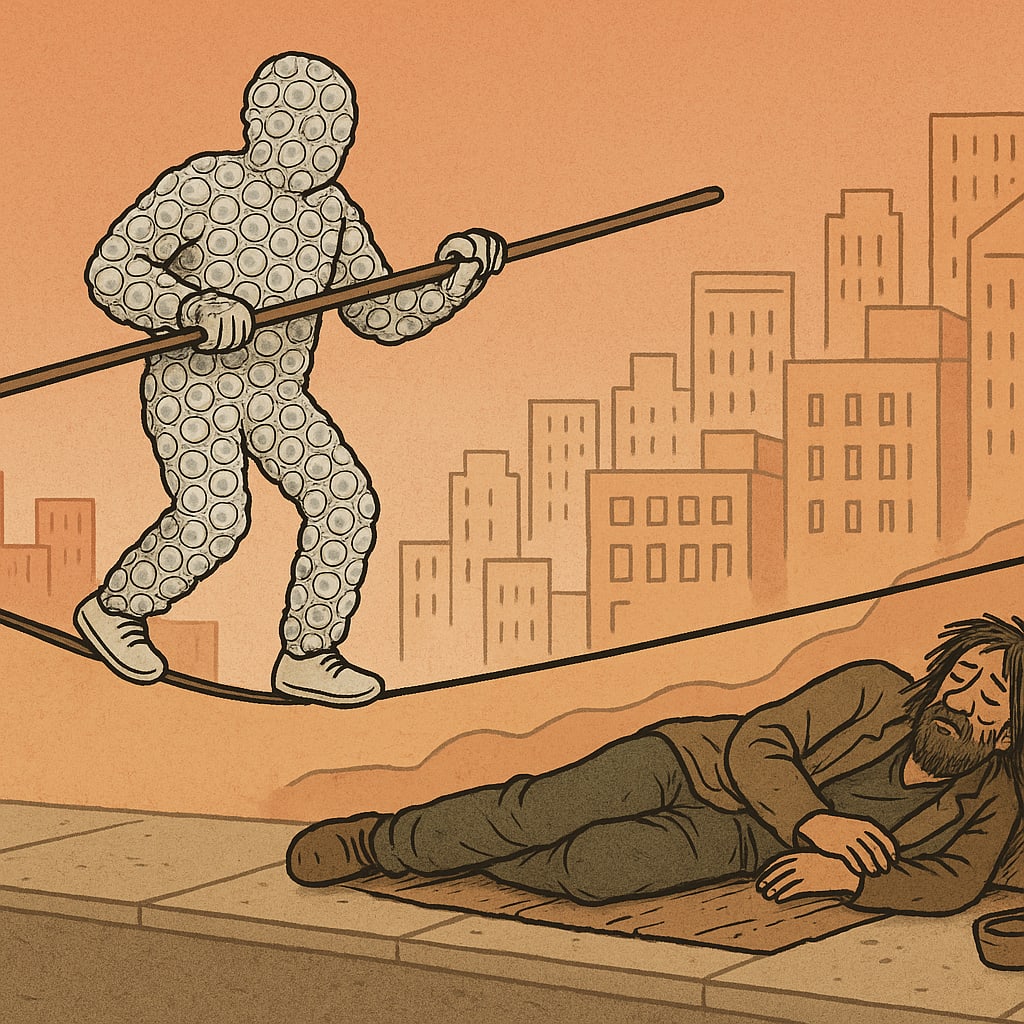
Here's the thing about modern society: we're all walking a tightrope, but we're wearing bubble wrap while doing it. On one side, we've developed an almost pathological aversion to risk. We bubble-wrap our kids, sanitize our hands to the point of desiccation, and treat gluten like it's radioactive. We've become so risk-averse that we've practically turned our homes into fortresses, our cars into tanks, and our diets into a bland parade of quinoa and kale. Safety regulations have safety regulations, and warning labels appear on everything from coffee cups to toothpicks. It's as if we're trying to childproof the entire world, forgetting that life is inherently risky.
I mean, we live in a world where playgrounds look like they were designed by NASA engineers afraid of lawsuits, where kids can't walk to school alone until they're practically teenagers, and where we've convinced ourselves that everything from wifi signals to playground mulch is a mortal threat. An entire generation has grown up so afraid of scraped knees that they've never learned how to fall properly.
Yet paradoxically, we've become rather cavalier about the value of human life itself. It's a contradiction that would give even Schrödinger's cat a headache. People get more upset about a dented car than a homeless person sleeping in it. They'll sooner step over a man lying on the sidewalk than miss their bus. We seem to value life only when it's hashtagged on social media or when it's being used as a political pawn in the never-ending game of partisan chess.
Watch how this plays out online. We'll spend three hours arguing about whether a celebrity's tweet was problematic, but scroll past a GoFundMe for someone's cancer treatment without a second thought. We'll share outrage about a dog being mistreated while ignoring stories about actual human suffering happening in our own neighborhoods. We've turned empathy into performance art, complete with the right hashtags and virtue-signaling emoji.
Don't get me wrong; I'm not suggesting we've all become heartless misanthropes. But we've developed a peculiar knack for devaluing life, and I'm not just talking about the price of a kidney on the black market. It's not just the homeless or the unborn. It's the elderly, the disabled, and the mentally ill. It's anyone who fits outside our narrow definition of "productive" or "useful." We've become a society that values efficiency over empathy, convenience over compassion. We've turned life into a commodity, something to be bought and sold, used and discarded.
The Blame Game Bonanza
Now, how did we get here? Well, it's a little thing I like to call the "Blame Game Bonanza." We've become masters at pointing fingers, and I'm not just talking about the ones we use to swipe right.
We've developed a strain of collective guilt that's as contagious as the common cold and twice as miserable. We blame entire groups for the actions of a few, and then we wonder why society is more divided than a pizza at a Weight Watchers meeting.
Our obsession with guilt has turned it into a national pastime. There's guilt for things we've done, things we haven't done, and things we didn't even know we could do. Rich guilt, poor guilt, white guilt, guilt for eating meat, guilt for not recycling, guilt for driving gas-guzzling cars. We've got more flavors of guilt than Baskin-Robbins has ice cream, and it's tearing us apart just as quickly.
And here's the kicker: we've weaponized this guilt. It's become our favorite tool for shutting down conversations and avoiding real solutions. Can't afford organic food? Well, you obviously don't care about your family's health. Drive an older car? You're destroying the planet. Don't post the right black square on Instagram? You're clearly a racist. We've created a guilt economy where the currency is shame and the interest rate is isolation.
The internet has turned this into a spectacle worthy of the worst reality TV show. People dig through decades-old tweets looking for something, anything, to justify their righteous indignation. We've created a world where a poorly worded joke from 2009 can end someone's career in 2025. It's like we're all living in a glass house, but instead of putting down the stones, we've started manufacturing bigger ones.
This blame game has led to a phenomenon I call "othering" (it's like a high school clique but with more dire consequences). We've started to see people who are not "us" as less than human. Political rivals? They're not just wrong; they're subhuman. Those facing unplanned pregnancies? Their choices become our moral battlegrounds. It's a slippery slope, and we're not just talking about a buttered linoleum floor.
You see this everywhere now. We've divided ourselves into tribes so rigid that we can't even share a meal without checking each other's political credentials first. I know families who won't speak to each other because of how they voted. I know people who've ended friendships over vaccine status. There are neighbors who would literally rather let someone's house burn down than help someone with the wrong bumper sticker.
And it's not just politics. We other people based on their job (looking at you, anyone who's ever sneered at "essential workers"), their education level, their zip code, whether they shop at Whole Foods or Walmart. A caste system so subtle that we don't even notice we're doing it, but so pervasive that it affects every interaction we have.
But othering isn't just about dehumanizing others; it's about dehumanizing ourselves. When we see others as less than human, we lose a part of our own humanity. We become less empathetic, less compassionate, and less understanding. We become more capable of hate and less capable of love. In the process, we lose sight of what it means to be human.
Which brings us to the elephant in the room, or should I say, the algorithm in the feed.
The Algorithm Made Me Do It
Let's be honest about what's really driving this train wreck: technology has turned our worst impulses into a business model. Social media algorithms don't care about your mental health or the fabric of society; they care about engagement. And nothing drives engagement quite like outrage, fear, and tribal warfare.
These platforms have figured out that the fastest way to keep you scrolling is to show you content that makes your blood boil. They've turned anger into advertising dollars and polarization into profit margins. We're basically lab rats hitting the outrage button for our next dopamine hit, except the lab rats don't think they're saving democracy while they do it.
The result? Echo chambers so airtight that we've forgotten other perspectives even exist. We live in information bubbles where our biases are constantly confirmed and our prejudices are continuously reinforced. People get their news exclusively from sources that already agree with them, then act shocked when they discover other people think differently.
I watched this happen to my own uncle. Smart guy, ran a successful business for thirty years, could fix anything with duct tape and ingenuity. But somewhere along the way, he started getting his news from one source, then joined a few Facebook groups that reinforced those views, and now family dinners feel like navigating a minefield. He's not a bad person; he's just living in a completely different information universe than the rest of us.
So how do we break out of this cycle? How do we start valuing actual human life over our digital dopamine hits?
Here's a Crazy Thought
What if we actually put the value of individual life above our grievances against whatever group we're mad at this week? I know, it's an idea as foreign as a well-behaved politician. But picture a world where we value each life not because it's useful or convenient, but because it's a life. Where we actually practice what we preach about human rights instead of just putting them on bumper stickers.
Look, this isn't just about saying nice things about life. It's about actually meaning it. Every person you meet is carrying around their own story, complete with dreams that keep them up at night and fears that wake them up in the morning. Maybe we should start acting like those stories matter, even when they're not our own.
Individualism vs. Selfishness
This all boils down to understanding the difference between selfishness and individualism. Selfishness is like hogging the safety net while someone else is falling. Individualism, on the other hand, is recognizing that we're all up here on the wire together, and maybe we should help each other keep our balance. True individualism means recognizing not only our own worth but also the worth of others. It's understanding that we're all part of this crazy tightrope act, trying to make it across as best we can.
Real individualism isn't about putting yourself first; it's about respecting the inherent dignity of every person. It's understanding that we're all individuals with our own thoughts, feelings, and experiences. It's realizing that our differences are what make us human and that those differences should be celebrated, not feared or hated.
So let's try something different. Let's put down the blame, step away from the othering, and start treating life like it actually matters. Let's embrace real individualism, the kind that says "I matter, and so do you, and so does that guy over there who votes differently than me."
But what does this actually look like in practice? It's not as simple as a bumper sticker slogan, I'll give you that.
It means getting comfortable with being uncomfortable. It means having conversations with people who disagree with us without immediately reaching for the block button or preparing our comeback while they're still talking. It means listening to understand rather than listening to win.
It means recognizing that the homeless guy on the corner has a story that's probably more complex than "he should just get a job." Maybe he's a veteran with PTSD. Maybe he lost his job when his company moved overseas. Maybe he's dealing with medical bills that bankrupted him. Or maybe he made some bad choices. Either way, he's still a human being whose life has value.
It means acknowledging that the person with the annoying political bumper sticker might actually be a decent human being who loves their kids, volunteers at the animal shelter, and brings soup to sick neighbors. Their political opinions don't define their entire worth as a person, any more than ours do.
It means turning off the outrage machine every once in a while and remembering that most people are doing their best with what they've got. It means choosing empathy over efficiency, understanding over judgment, and grace over gotcha moments. It means admitting that maybe, just maybe, none of us have all the answers.
Here's a radical thought: what if we treated disagreement as an opportunity for growth rather than a declaration of war? What if we approached difficult conversations with curiosity instead of certainty? What if we gave people the benefit of the doubt instead of assuming the worst possible interpretation of their words?
Maybe we can turn this whole mess into something worth celebrating. Not the fake, Instagram-perfect version of life, but the real thing. Messy, complicated, and absolutely worth protecting. The kind of life where we make room for failure, allow for growth, and remember that everyone you meet is fighting a battle you know nothing about.
The next time you're walking your own tightrope, remember: it's not about not falling. It's about making the walk count. And maybe, if we all start walking with a little more respect for life and a little less certainty about everything else, we'll find the whole thing isn't so terrifying after all.
Because here's the truth nobody wants to admit: we're all just winging it. Every single one of us. The sooner we admit that, the sooner we can start treating each other like fellow travelers instead of enemies. The sooner we can stop bubble-wrapping everything except what actually matters.
And maybe, just maybe, we can figure out how to build a society that's actually worth the tightrope walk.
***
Want more commentary like this, minus the filters and institutional disclaimers?
Follow The Cogitating Ceviché — Conrad’s quiet corner for loud ideas.
About the Creator
Conrad Hannon
Conrad Hannon, a pseudonym, is a satirist, humorist, and commentator. He's stricken with a peculiar malady, a dual infection of technophilia and bibliophilia. To add to this, he harbors an unsettling fondness for history and civics.
Keep reading
More stories from Conrad Hannon and writers in Humans and other communities.
Cry Me a Discourse:
It started with a simple, heartfelt post — a man honoring his late father on Father's Day. No political jab, no campaign message, just a brief, sincere note about love and loss. Within minutes, the comment section erupted. One prominent critic sneered that the man's father would be "ashamed of him" — not because of anything he said, but because of who he voted for.
By Conrad Hannon9 months ago in Humans
Regulation at the Threshold
Author’s Note — Flower InBloom This series is part of my ongoing work exploring personal sovereignty through nervous system awareness and structural alignment. I write not to dramatize change, but to understand how the body organizes through it. When we learn to regulate at the threshold, endings stop feeling like collapse and begin revealing architecture.
By Flower InBloom2 days ago in Humans
Flower Bloom 369
FLOWER Bloom 2/25/26 Wednesday By Mariann Carroll Karen had been with Tony for 7 years. Tony started acting strangely after her surgery. He would mow the lawn in the rain and be on his cellphone. He started pushing Karen away. Tony came clean about seeing someone. Karen moved out two months later. Karen moved in with a friend. She felt betrayed.
By Mariann Carroll3 days ago in Fiction




Comments
There are no comments for this story
Be the first to respond and start the conversation.