
Universal Design Saves Lives
Personal essay in honour of the IDPwD

Content Warning: Medical Assistance in Dying
A month ago, on November 2nd, the Montreal mayoral race was concluded with as a winner Soraya Martinez Ferada. A key issue the main four parties discussed at length during their campaign was related to the housing crisis which has for many Quebecers gotten worse over the last few years. Whether that be on the news or at the Quebec Assembly, housing is discussed quite a lot, however, rarely do those conversations include the specific preoccupations of disabled renters.
It’s hard to know what percentage of renting units are accessible in Montreal, especially when for some, accessibility related terms are not known or are confusing, making search for information complex. FECHIMM’s Resource Guide on Universal Accessibility for Housing Cooperatives differentiates universally accessible housing from adaptable housing and adapted housing; whereas the Régie du Batiment du Québec defines adaptability, minimally accessible units and universal accessibility. However, their document Accessibility Inside Housing Units, doesn’t mention how this latter concept can concretely be applied to housing. It is clear that the people in charge of advertising housing on the private market or in social, non-profit or cooperative housing are uneducated about these differences, making the disclosure of the adequate information close to impossible.
According to Société Logique, universal design as a concept is meant to be inclusive of all, allowing an identic, similar, simultaneous and autonomous usage for all, and require less physical effort. This is made easier by barrier-free environments as opposed to features requiring additional adaptive tools to address said barriers.
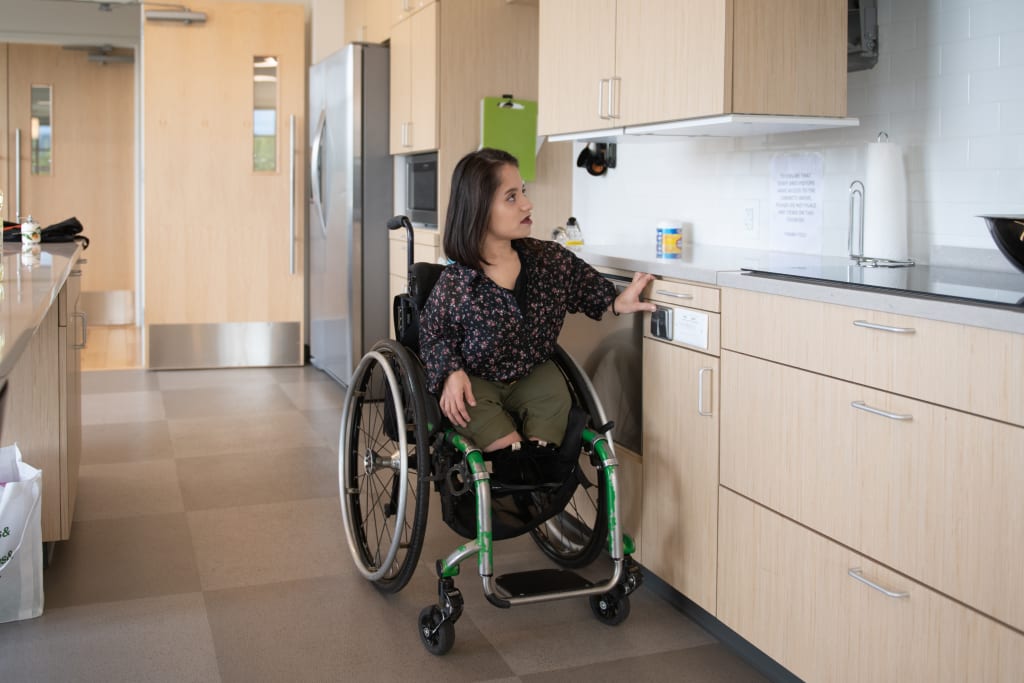
Universally accessible housing (often following universal design) is described by FECHIMM as responding to the majority of the needs of a disabled person while also being welcoming to non-disabled people. These types of units can also welcome small tools such as grab bars and automatic door mechanisms if needed. They more easily allow the presence of disabled visitors and overall make easier the living space for all.
Adaptable housing units are defined as units that are “seemingly ordinary” and that be more easily adapted for a low cost, usually according to a renter’s changing needs. Features include strengthened wall structures that allow later on the installation of grab bars or ramps and cupboards that are movable. However, it is stated that larger accommodations such as wider hallways and door frames, street level entrances and wheelchair lifts are cheaper (and sometimes only possible) when built in at the start of the construction which is not always the case.
Finally, adapted housing would be the type that is made to accommodate more specific needs. The FECHIMM document describes adapted housing as “too specific to satisfy other occupants” (p.15) which is one of the issues with the way we frame accessible housing in general. The flawed framework framing adapted housing as inconvenient, combined with the rarity of universal design, the burden of accessibility is then put on disabled tenants by asking them to take on the renovation process on their own, alongside the Home Adaptation Program (which has been suspended for over a year now). Ironically, a lot of this adaptation work ends up following closely universal design features or are adaptations that would have been less numerous was the apartment universally accessible to begin with.
Inconsistency and marginalizing language
First, the reluctance to invest in more adapted housing and to revise how universal design is applied to housing units, alongside referring to adaptable housing as “ordinary” frames the needs of physically disabled people as too complex and inconvenient. This is exacerbated by Quebec’s lack of commitment to attaching some of those terms with specific accessibility features and obviously the overall lack of housing options for disabled people. While the FECHIMM provides examples of tools and features that can be seen in universally accessible and adaptable housing units, they do not provide examples of such features in their definition of adapted housing. Further down in the resource guide, examples of possible adaptations are mentioned but they are not associated to any specific category, once again showing a clear lack in information.
Secondly, the insistence on this reticence to build adapted housing due to its “unwelcomeness” of non-disabled occupants is troubling. Roll-in showers, roll-in sinks, automatic doors and sliding doors can be used by all people without limitations, and the space used for a hoyer lift is never lost was the lift to be removed from the home. Furthermore, looking at bathrooms alone, Canda’s Accessible Housing by Design document created in 2016 affirms that curbless wheel-in showers “were the best design to accommodated as many people as possible” (p.6), they are often not more expensive than designs with a bathtub and they can more easily accommodate a mobility aid, children and carers. And yet, they are not the norm even in newer constructions in Quebec, even in projects that claim caring about accessibility. This wet room design can also accommodate other types of tools that might be used for transfer such as shower benches and a hoyer lift more easily. Nonetheless, the rare existence of these types of showers can make them seem more medical, and thus less enjoyable aesthetically to some, however, we must choose our priorities when talking about housing meant for people with disabilities, and access should remain the priority, especially in opposition to aesthetics alone.
Furthermore, it seems quite ironic to me that all throughout the FECHIMM guide there are mentions of the ability of able-bodied people to use every feature and room in housing meant for disabled people when the inability of disabled people to simply enter the front door of any other apartment, restaurant, dentist office or store is rarely discussed, let alone seen as an important matter. Able-bodied people being able to shower easily in an apartment meant to be rented by a disabled person who requires a specific type of design should not be a pressing issue if that unit is truly meant for a disabled tenant. Of course, some exceptions exist such as disabled parents living with able-bodied children and vice versa, and roommates, however, once again, the reluctance to build according to universal design shows to me that these concerns are more so a question of revenue (meaning believing disabled people do not have the means to pay rent and so why bother build apartments just for them) and of aesthetics (meaning worrying that an apartment complex with universally accessible units will attract disabled renters which will then put off able-bodied ones and ultimately also lead to a loss in revenue).
Moreover, to expand upon this clear inconsistency in definition and information, when looking at Société Logique’s definition of universal design, accessibility and adaptation, the examples given are of the main entrances of two libraries and a community centre. They associate adaptation to a separate entrance with a ramp also requiring a separate door, accessibility with manual wheelchairs and a very long separate ramp leading to the same door as the path with the stairs, and universal design with a single barrier-free street level entrance meant for all. Following that same logic and applying it to bathroom design, shouldn’t universal design/universal accessibility be a barrier-free roll-in shower? Does Société Logique differentiates accessibility from universal accessibility, if so on what grounds? How come units are being advertised as being “accessible” but do not have barrier-free bathrooms? And more importantly: if Quebec agrees that universal design is the most accessible, how come we are not using it as the standard in new constructions and instead only build adaptable units with smaller accessibility features and delegate the rest of the needed “adaptations” to tenants? The RBQ consider that both bathtubs and roll-in showers can adhere to adaptable housing requirements, simply suggesting the bathtub height be between 400 and 460 mm which is actually even higher than the average bathtub height (between 355 and 406 mm), making this recommendation likely to be more inaccessible for some folks with reduced mobility. This is quite contradictory and unclear, yet it perfectly explains how disabled people with reduced mobility (and especially those who are also in a precarious financial situation) ended up in the most difficult situation regarding the housing crisis.
With that said, it is not lost on me that the roll-in/walk-in shower design that some seem to believe is medical and non-welcoming is often seen in some of the most luxurious hotels in North America, once again bringing forward this question I have tackled in my past work which is: are physical limitations and accessibility truly the problem, or is our association of disability with ugliness the issue? Why is it that a roll-in shower is chic and luxurious when in a five-star hotel so expensive some would hope it would be outside the budget of most disabled people, but becomes medical and inconvenient when in a one-bedroom apartment in a residential neighbourhood?
What about housing cooperatives?
As a leftist and as someone who has lived in a housing cooperative before, I was shocked when my progressive access needs forced me to re-enter the renting market. The housing cooperative world is not the well-intentioned leftist utopia I thought it was. From ignored emails, ableist micro-aggressions and lies about the selection process, it was clear that some people who live in these cooperatives and thus are in charge of the selection of new tenants are not interested in making the entry of new tenants, especially the disabled ones, easy. The complete disregard for accessibility (or even to educate themselves about it) and treating it as a luxury as opposed to a need, shows there is not only a crisis of accessibility in the private housing market (as it is practically inexistant) but also in subsidized housing. It was not uncommon during my search to be met with people from housing cooperatives categorically refusing to disclose accessibility information, even after explaining to them that I was disabled and thus needed access to this information to further continue the process.
With that said, I want to state that I am by no means insinuating that renters-led housing cooperatives are a bad idea. I believe they have a lot of potential and can facilitate community for folks who otherwise might have a hard time finding it on their own. However, it is clear that issues related to misinformation, negligence in the transmission of information and discrimination are deeply installed in this system and its tenants who are managing the selection process, and it is unclear what can be done about it.
Moreover, as earlier stated, the framework used is fundamentally flawed when in our construction of housing for disabled people we prioritize the creation of adaptable units as opposed to universally accessible ones due to able-bodied people’s aesthetic concerns and desires. This is particularly problematic because often, non-disabled people end up habiting these units, first because the selection committee (and the potential tenant) did not know or notice the unit was adaptable in the first place but even more so because many disabled people cannot safely live in them anyway and so they are then rented by able-bodied people with no limitations for whom the few accessibility features go unnoticed and unappreciated. It is thus hard to rejoice in the “visitability” aspect of these units, (the concept referring to a unit with a barrier-free entrance, a larger doorframe and a larger ground floor restroom a disabled guest can use), when that same disabled guest is seen as not worthy of having a home of their own where they can independently use all the features. A lot of people involved in their cooperative’s selection committee do not hold the knowledge necessary to fully grasp the severity of the situation when it comes to the accessibility crisis in the renting market or to address these concerns, and they are inadvertently worsening the hardships of disabled renters.
Earlier this year, Le Devoir published multiple articles (1,2 and 3) about certain housing cooperatives being under scrutiny for some of these very issues; internal tensions, issues relating to gestion and selection being mentioned. Ableist biases are deeply engrained in our society and thus deeply engrained in us. Ableism is an intrinsic part of our housing market but also of how we view the simple right to housing. In other words, if we believe safe housing for disabled people must take the backseat to able-bodied aesthetics, opinions and potential occupation, or if we would rather support the mass institutionalization of disabled people, our fight against the housing crisis will fail as it will leave some of our population’s most vulnerable people behind. If according to the Canada Human Rights Commission, housing is a human right, this must include housing for disabled people. Otherwise, fatal issues are doomed to arrive.
In 2024, the Associated Press was already writing about cases of medically assisted death being linked to fear of homelessness and isolation, which should be alarming to all. The slippery slope towards MAiD in Canada for disabled people whose death is not imminent has been discussed within Canadian disability circles since 2020, when Bill-C7 was first introduced, conversations that I have been a part of as a disability activist (1, 2 and 3). In 2023, Quebec was the jurisdiction with the highest number of assisted suicides in the world, the toll being at 5,601 and representing 7% of all death recorded in the province, 4.5 time more than in Switzerland and two times more than in Ontario. When looking at MAiD recipients whose death was nor foreseeable, in Canada, 58.3% self identified as having a disability, the most numerous being mobility related. Disabled people with mobility related disability requesting MAiD to such numbers should not be separated from the housing crisis and the accessibility crisis. Examples of disabled people who have reached for MAiD due to lack of resources are being documented in our news cycles, including Sathya Dhara Kovac in Winnipeg and Sean Tagert in British Columbia, or Christine Gauthier a woman from Québec who was offered MAiD by an employee of the Department of Veterans Affairs when asking for support.
As a 27-year woman living with an untreatable form of muscular dystrophy, I found myself looking up the steps to make a formal demand for MAiD last summer, going as far as making an appointment for a phone consultation with my family doctor in the midst of such soul breaking issues finding housing. As my friends were enjoying their summer, I was at home, wondering how I was supposed to survive such deep depression and fear due to the inaccessibility of my current apartment. Wondering which one of those friends I would ask to be my independent witness in order to complete the third step of my application. As I was begging for help, I was met with the clear and undeniable barriers that target physically disabled people in the housing market, including in the social and cooperative owned sphere. The lack of options for young disabled people in particular are very dangerous and I worry that it is putting them in harms way physically and mentally.
As I am writing this, I will be signing a lease for an apartment built according to universal design tomorrow and that will be life changing for me at this point in my life. My heart aches for all the other young, dynamic, curious, social and ambitious disabled people who won’t have the chance I had in time and who will make it to the last step of this process. It is imperative to tackle this housing crisis which in itself includes an affordability and an accessibility crisis. This crisis has many faces; including ableism on the interpersonal level and systemic level, as well as a lack of care for adequately and efficiently communicating information related to accessibility, and finally a disinterest to truly build according to universal design. Furthermore, it is unacceptable to have resource documentation framing adapted housing as a disadvantage and as a burden when waitlists for units with maximum accessibility features are years long already and the demand is likely to keep growing with the aging of the population. Moreover, if the tendency to defund resource programs targeting disabled people is maintained, the construction of truly barrier-free housing units is beyond pressing. In 2022, Canada reported that 22% of people 15 years and older had at least one disability, meaning almost 1 in 4 people. Universal design could benefit to all those people and more which is why, in my view, it should be used to build at least 30% of all new constructions. The change we want to see in the future must start now and we are failing each other when we do not truly value each other’s future.
About the Creator
Allie Pauld
Sociology and sexuality graduate trying to change the world. Nothing more, Nothing less.
Montreal based disabled, LG[B]TQ+, Pro-Black Feminist.
You can find me at @allie.pauld on Instagram.
Keep reading
More stories from Allie Pauld and writers in Humans and other communities.
5 things not to say to a disabled person
Being disabled and vocal about it brings people to respond to you differently. Non-disabled people, able-bodied people, usually have those things they say in hopes that they will make us feel better but very often, they miss they miss the point, completely. This text will bring up 5 things you should not say to disabled people. While I know I am not the only one because I have heard disabled people bring up some of those points before, feel free to take this with a grain of salt if that makes you feel better. Overall, I want you to think about the reasons why you say these things, what are your true intentions and hopefully you will understand why they are ableist.
By Allie Pauld5 years ago in Humans
A Knight of the Seven Kingdoms Series Review (Season 1)
As one of the biggest properties in fantasy, A Song of Ice and Fire remains immensely popular with audiences. After reaching far into the past with House of the Dragon, a second spin-off was on the cards. A Knight of the Seven Kingdoms serves up a bite-sized slice of action and drama, but it still claims a spot among the best small-screen titles.
By Robert Caina day ago in Geeks




Comments
There are no comments for this story
Be the first to respond and start the conversation.