
Understand Our Obedience Bias to Avoid Manipulation
All those times I agreed to be robbed.


Back Story 📖
Last week I went to a bar with friends. I remember being checked by the security man before entering. In retrospect, I had no proof that this man was from the security staff. What scares me now is that I am sure that I could give him my backpack if he asked me to do so.
Other than his size and muscles (or the size of his muscles), this person could very well have been an ordinary bar customer. I would never have accepted the kind of request he asked me in any other context, but at that moment, for him, it happened.
I was so sure he was from security that I was willing to accept a wide variety of requests without thinking twice. My brain was on autopilot, disconnected from reality.
Trusting the Trustworthy 🔐
Fortunately, we tend to give more credit to people that know their thing. We trust more a physician than the first person telling us we will die of cancer in 6 months. We are more likely to entrust our child’s education to a teacher, our electrical installation to an electrician, the maintenance of our car to a mechanic, etc.
Whether we admit it or not, there is a hierarchy in the way of perceiving jobs. The saying that there are no sub-trades is partially false. The best-paid jobs have meaning. Money thanks and returns a part of the service given to society. More money equals more usefulness in the eyes of society. More money reflects a higher social status.
In the same way, jobs that give power or are considered honorable also increase a person’s social status.
Lawyer, cop, engineer, doctor, fireman, president are all high-status jobs for a reason; they are complex, require years of study, intervene in areas of high responsibility. They give power. They give money. They give honors.
For that matter, would you be ready to torture someone if a person from one of these categories asked you?
Would You Torture a Stranger? 🩸
It is the question that the social psychologist Stanley Milgram wanted to answer.
We are in the sixties, you enter the room where the experiment will take place. You were told that you were going to participate in “a scientific study on memory and learning.” The purpose of the study is to see what effect punishment has on a subject’s ability to remember a list of words.
There is someone in front of you, behind a tinted glass that has to remember a list of words, who will then try to recite it. At the time of questioning, If the person is wrong, you must punish him with a shock. The more he is wrong, the more intense the shock.
The experimentation often leads to the following situation: You, watching the man writhing in pain with each increasing electric shock. How did it happen? Even though it was an experiment, how did you end up consciously harming someone?
Well, firstly, you’re not alone in the command room, you are with a scientist who will make sure that the experience runs smoothly and will not fail to make remarks if hesitation appears on your face. Ah, and the man you shock is an actor. In fact, the goal of this experimentation is to show obedience to authority figures, not a study on memory.
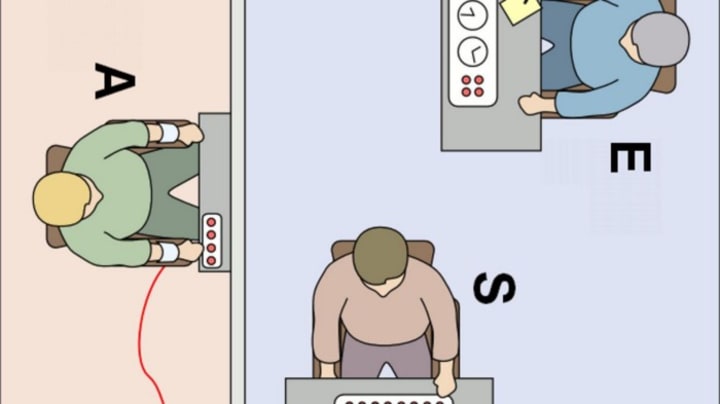
Milgram showed that ordinary people could torture if an authority asked them to do so.
Authority Is Everywhere! 🚨
From the point of view of social organization, a hierarchical system of authority is paramount to maintaining complex production structures. The problem is when it overrides common sense.
For instance, in another experimentation, nurses were willing to apply a rectal treatment to treat earaches because a doctor told them to. As I said above, high-status jobs or those giving you power over people are considered this way for a reason. However, with power, honor, money, gratitude, and all things that make children dream of becoming scientists, actors, or astronauts come something else, authority.
No need to mention that you should listen to and apply the advice of professionals, but this being said, you should not follow them blindly!
Marketing understood it, they just have to put M.X, an expert on Y, to talk you about this new product, and here we go, without being sure that M.X is an expert and what the new product does, you will have a positive opinion on it. Sanka coffee commercial with Robert Young is a great example!
Any sign showing a higher status than yours will have the effect of subjugating you unconsciously.
The suit was the basic element used by Frank Abagnale to make it looks like an airline pilot in the 1970s. Frank, which inspired the film “Catch Me If You Can” (starring Leonardo DiCaprio) claims cashed $2.5 million in bad checks thanks to his false status airline pilot’s status.
Furthermore, in a 1949 advertisement, a doctor smokes and states that to the question: “What cigarette do you smoke doctor?”, he answers “Camel.” Asking a doctor shows American citizens that it is ok to smoke. After all, even health specialists do it!
There are countless examples, in the end, what does this show?
Takeaways 📦
Life is built on power relationships. We are not so different than 2 billion years ago. As animals, the dominant dominated scheme is still relevant today. We might not need to protect our tribes from cold, hunger, and predators, but from inflation, wars, silly governments, etc.
People will seek to take power over you. Sometimes it won’t be direct but rather subtle and insidious. That’s why being aware of this phenomenon is crucial according to me. Don’t be a fool listening and believing any person showing signs of authority over you. Be skeptical and question your common sense, especially when it comes to important decisions.
I mean, with all the noises (which is also a characteristic of the 21st century) that surround us constantly, we’ve evolved to make shortcuts. We reason by analogy all the time, and that’s ok. It’s useless to reinvent the wheel all the time. However, there are some specific cases intimately linked to human psychology for which shortcuts could lead us to undesired situations. Our natural obedience to authority is one of them.
About the Creator
Julien Fichet
I'm Anti-conformism. I write about stuff I found surprising. I love neuroscience, psychology, humans.
Keep reading
More stories from writers in Humans and other communities.
I Don't Need My Phone... Wait, Is That Actually True?
My parents gave me my first cell phone when I was twelve years old. It wasn't a fancy iPhone or anything, not even close. Just a simple black flip phone for when I needed to call or text them after school.
By Madison "Maddy" Newtona day ago in Humans
Part 2 Interview With Joe Patterson, Author Of Melanin Memoirs
This is my second interview with Joe Patterson. His 4th anniversary writing on Vocal will be in March 2026. He has one achievement on Vocal, The Other Foot. He has over 17,000 reads on Vocal since he started on Vocal in 2022. Joe Patterson is very creative poet and rapper. Joe is deep thinker and I feel it is reflected in his latest published book, Melanin Memoirs.
By Mariann Carrolla day ago in Interview




Comments
There are no comments for this story
Be the first to respond and start the conversation.