
Uncovering the Enigmas of Egypt's Pyramids
The Most Fascinating Historical Riddles.

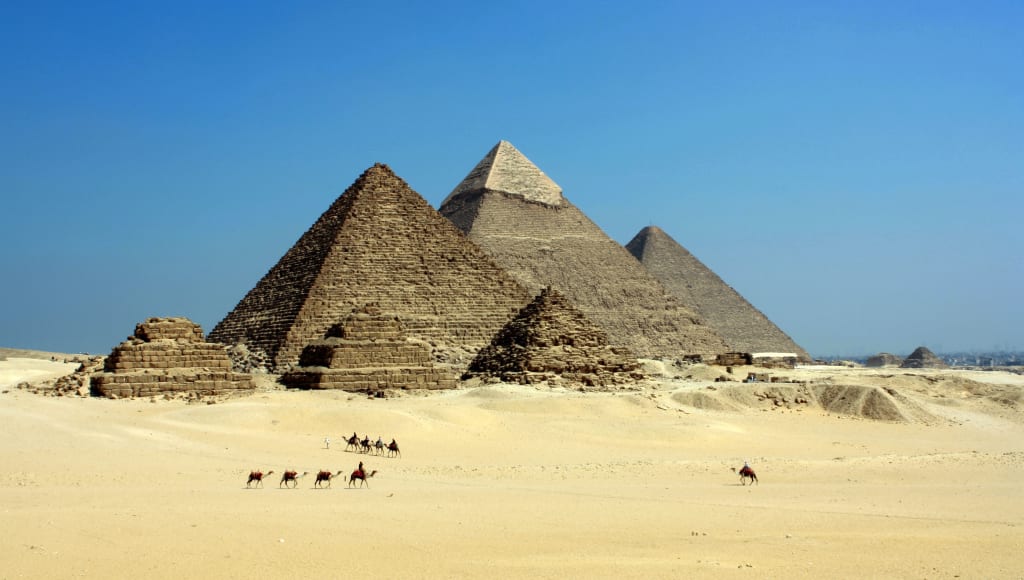
Around 2650 BC, workers who were under the rule of Pharaoh Joser were nearing the completion of one of the most significant construction projects in the ancient world: a pyramid located in Sakara, Egypt. While it's unclear which Egyptian pyramid was the first to be built, Joser's is considered to be one of the earliest, standing at a height of 205 feet with a base measuring 358 feet by 397 feet - roughly the size of two football fields side by side. It's a remarkable display of engineering and technology.
Many other pyramids were constructed in the same area, with at least 118 Egyptian pyramids still standing today - most of which have been remarkably preserved over time, including the largest of them all, the Great Pyramid of Giza. Standing at 480 feet tall, it was the tallest man-made structure in the world for about 4,000 years until it was surpassed by England's Lincoln Cathedral in 1311.
The Great Pyramid of Giza is composed of an estimated 2.3 million blocks of stones, weighing a total of 6 million tons. Some of these stones weigh between 50 to 80 tons, indicating that a massive workforce was needed to lift them. According to ancient Greek and Roman historians, it's believed that around 100,000 enslaved people were forced to work on the pyramid's construction.
Aside from its immense size, the Great Pyramid is also unique and precise. It's aligned to True North within one-twentieth of a degree, a remarkable feat considering the time period it was built in. Its base is nearly a perfect square, with the western side being only 5.5 inches longer than the eastern side - a difference of only 0.01 percent. This level of accuracy is impressive for a structure of this size and age.
When hieroglyphics were first translated in the 1820s, new information about the pyramids and why they were built was revealed. While they were originally believed to be tombs for Pharaohs, the hieroglyphics confirmed this belief but also suggested that the pyramids had another function. The Subterranean chambers of the pyramids at Sakara are lined with hieroglyphics dating back to around 2300-2400 BC, which have become known as the pyramid texts.
The walls of almost every single room of the pyramids are covered in vertical lines of Egyptian hieroglyphics. These hieroglyphics offer names, dates, and legacies of the Pharaohs, as well as information about the afterlife. However, the reason why these pyramids were built remains a mystery. Some hieroglyphics suggest a potential purpose for the pyramids that starts with a fundamental ancient Egyptian belief in an eternal soul, called the KA. The hieroglyphics suggest that the pharaoh's KA travels to the starry heavens where he'll live in eternity amongst the gods. To some, this means that the pyramids could have been built to provide a roadmap to paradise.
In 1994, Belgian engineer Robert Bauval and British historian Adrian Gilbert published their book, "The Orion Mystery," which became an international bestseller. The central idea of the book is the Orion Correlation Theory, which proposes that the pyramids of Giza are designed to match a star alignment in the belt constellation of Orion. However, some suggest that the builders of the pyramids may have aimed their pyramid shafts directly at Orion to transport the physical bodies of the pharaohs, rather than just their souls, to the heavens. While this idea seems fantastical and raises questions about how the bodies could have levitated and stayed up in the sky, Belgian author Phillip Coppens supports this theory and cites examples of empty sarcophagi inside the pyramids that could indicate the bodies were somehow transported.
The pyramids are the most famous and remarkable aspect of the Kingdom of Egypt, but they were only being built for a relatively short time. Although the civilization lasted around 2,000 years, they only spent about 300-400 years designing these magnificent structures. Thus, one important question among the many mysteries surrounding the pyramids is why they stopped being built.
In the late 1990s and early 2000s, a new theory emerged to explain the purpose of the pyramids. According to this theory, the pyramids were built with a specific purpose in mind, and once that purpose was fulfilled, the Egyptians did not need to make any more. Engineer Christopher Dunn published a book in 1998 positing that the pyramids served the everyday life of the people of Egypt by providing electrical power, rather than being used for the afterlife as traditionally believed. Dunn's theory begins with the word "pyramid," which consists of "Pi," meaning fire, and "mid," meaning middle. He proposes that the Great Pyramid was an energetic environment rather than a combustion pie.
Dunn and other modern-day engineers examined the layout of the pyramid's internal structures, which include three chambers: the Subterranean chamber, the Queen's chamber, and the King's chamber. Traditional Egyptologists believe that the pharaoh's body was placed in the King's chamber, and the other two chambers were used if the pharaoh died before the pyramid was finished. However, no human remains or funerary objects have ever been found inside the Great Pyramid of Giza, leading engineers to believe that the chambers served a different function.
American engineer John Cadman also supported this theory and believed that the pyramid served as a water pump. Cadman hypothesized that water would flow in from an ancient lake at a higher elevation via tunnels, then flow through a duct up to the Queen's chamber and exit through an outflow tunnel to the Nile River. To study the fluid dynamics happening inside the chambers, Cadman made his own model of the pyramid's subterranean chambers using a 500-pound block of cement in 2000. When he ran water through the block, it started shaking with long and short pulses. If scaled up to the full size of the pyramid, Cadman believed the system would have created a heartbeat-like vibration that shook the entire structure.
Dunn's idea about the Great Pyramid being a coupled oscillator that transforms vibrations into energy and generates power is further explained in his hypothesis. He believes that this could also explain the purpose of the twin shafts extending upwards from the Queen's chamber, which have long been a mystery. While some believed they were air ducts or were targeted towards specific stars in the night sky, Dunn's theory suggests that they were used to deliver dilute hydrochloric acid and a hydrated zinc solution to the chamber. These chemicals would react with the chamber's limestone, causing a chemical reaction that generates hydrogen and explains the presence of salt and gypsum. Dunn argues that this reaction compounds the pyramid's vibrations exponentially, creating a significant amount of power. The vibrations charge up the quartz and granite stones in the center of the pyramid, which act like batteries.
Some researchers, such as Peter Krasa and Raynor Habeck, have suggested that the ancient Egyptians may have had electric lights based on a relief sculpture found in the Temple of Hathor in Dandera, Egypt. Krasa and Habeck also reference an experiment conducted by Austrian engineer Walter Garn in 1982, where he successfully created a working model of the "Dendara light" using traditional electricity. While the idea of the Egyptians having electricity is controversial, this theory suggests that if they had built enough pyramids to generate power, they could have had the technology to create electric lights.
About the Creator
Bob Oliver
Bob is a versatile writer & communicator passionate about exploring diverse topics & perspectives. I have written for various media outlets. And I believes in using words to inspire positive change. #writing #communication #passion
Keep reading
More stories from Bob Oliver and writers in Humans and other communities.
Did enormous and frightening creatures once inhabit the Earth, as speculated in the Ancient Aliens theory?
This site, located in ancient Mesopotamia and considered the birthplace of human civilization, contains the ruins of the once-great city of Nineveh. Among the artifacts discovered here are Sumerian Tablets dating as far back as 1800 BC, which tell the tale of King Gilgamesh. This epic poem features Gilgamesh and his companion Enkidu, a wild, hairy man who lives apart from human society. What makes the Epic of Gilgamesh so intriguing is that it portrays Enkidu as a giant and suggests that he may have had extraterrestrial origins, according to ancient Sumerian texts. Enkidu is described as a hairy, monster-like creature with immense strength, akin to Bigfoot or Sasquatch. The Sumerian texts claim that Enkidu was created by the gods as a new being, genetically marked to serve as their slave. This raises the question: is it possible, as some ancient astronaut theorists propose, that the Epic of Gilgamesh describes a hominid created by extraterrestrial beings? The Sumerian texts also mention ancient sky gods known as the Anunnaki who visited Earth.
By Bob Oliver3 years ago in Humans
Simple Solutions For Singles Experiencing Repeated Ghosting In Modern Dating
Ghosting is used when the other partner suddenly stops communicating without any reason. In the case of singles, ghosting repeatedly has the effect of causing rejection, confusion, and lowered self-esteem. It is essential to learn to be emotionally resilient by understanding that ghosting is more likely to mirror the other person (their problems) instead of your value.
By Robert Smith4 days ago in Humans


Comments
There are no comments for this story
Be the first to respond and start the conversation.