

TIMELINE
4:00 p.m. Saturday. She was on top, twerking. My hands cupped her large bare breasts; afraid that if I let go she'd disappear and I'd wake from my dream. Zeinab was from western Somalia and dark as a raven. My grandfather relocated to the U.S. from Lubeck, Germany. I was the color of a Wisconsin snowbank. I held on, though my hands were like snow balls melting on hot chocolate cupcakes and I was bouncing on top of the world. Her long braids dangled inches above my chest. She obeyed and clawed me. I’d met my lioness. Her tongue wove mysterious dirty words in a jazzy rhythm. For some reason she kept her stocking cap on while she made love to me, driving her powerful pelvis into my hips. The cap was a soft gray knit with yellow fuzz ball on top. It was adorable. I got horny the moment I saw it bobbing on her head. When I say, she made love to me, I mean this rendezvous was unexpected. It was her initiative that got us together. I met her for the first and only time a month earlier when she came to my law office with her husband, Qassim, my client. He was being deported. I accepted the challenge and he accepted the retainer and I vowed to fight for his freedom and safety in America, at a reduced rate, regardless of the outcome. At least that was the initial prevailing agreement. Sex with his wife was never part of the retainer. Zeinab called and wanted to talk and I assumed it was about her husband's case. My wife was out of town. A short time passed in the house but the case never came up as a topic. Instead, we started making out and I steered her to our son’s bedroom. She peeped like a robin when she came. I hollered like a drowning sailor in a perfect storm. Not more than two minutes passed from the moment we came together and the door closed behind her, and she was gone.
6:30 a.m. Tuesday. I am driving to my office to pick up the file on Qassim Suleiman, Somali Muslim, husband of Zeinab scheduled for an asylum interview with the Department of Homeland Security (DHS) in Arlington, Virginia. I passed a group of seven or eight men shooting baskets on an outdoor court. Their swift strides softened in the hazy morning shadows and their grunts echoed in an empty world. A blonde woman in brown shorts worked quickly behind an Entenmann’s truck, stacking boxes of pastries on a dolly. Vapors rose round her feet. What do empty stores and sidewalks dream? How were any of us to know that by the end of the day our lives would be forever changed?
The interview was scheduled for 8:15 a.m. As I had instructed, Qassim arrived fifteen minutes early. We met at the elevator and sat together in the windowless waiting room, deep in the building’s belly, secluded from the world above, no sound of rush hour traffic or news of the day’s unfolding events. We handed our phones to the security guard upon entry. There was a flat screen TV mounted on the waiting room wall, showing cartoons. Qassim sat for a few moments in prayer, Quran in hand, bobbing back and forth. Then he put his nose in front of his Affidavit, the story of his tortured life, a few pages of Calibri font. Entire years of fulfillment edited out for persecution’s sake. The merit of his case cared not about love, but the manner of death. It had to, to prevail. Blood stains were removed. One learns to type the shallow grave of a four-year-old without the bold emphasis. Nervously he scribbled notes in the margins, whispering to himself, reliving each sequence of tragic events that he’d tell the officer in sordid but calm detail. Time passed. We sat and waited for our turn.
9:20 a.m. The 8:00 a.m. appointments haven’t been called. Waiting was expected but this was an exceptionally long wait. I approached the security guard to inquire about a reason for the long delay. Zeinab came to mind. She was a security guard at the Pentagon. Her first job in America. I imagined her in a starched uniform, tall and gorgeous but less than powerful. Qassim was to meet her for lunch. The security guard whispered, “We think an airplane has flown into one of the World Trade Center towers. We don’t know whether it was an accident or not.” The security guard’s lips grew larger like mine do when I lie. There must be something dreadful happening on the ground above and he’s not telling me. After a moment of awkward silence between us I asked for my phone. Once in the lobby I saw the three missed calls from Zeinab. I called her back.
“Hi,” I said.
“Hey, Adam, I was thinking of you. I miss you,” she said.
“I miss you too. I’m with your husband. We’re waiting for his interview.”
“I’m bored. I want to I see you again,” she said.
“Soon. I have to go now, though.” I imagined her long black legs, pythons around my torso squeezing the fear out of me. I felt confident Qassim would win his case.
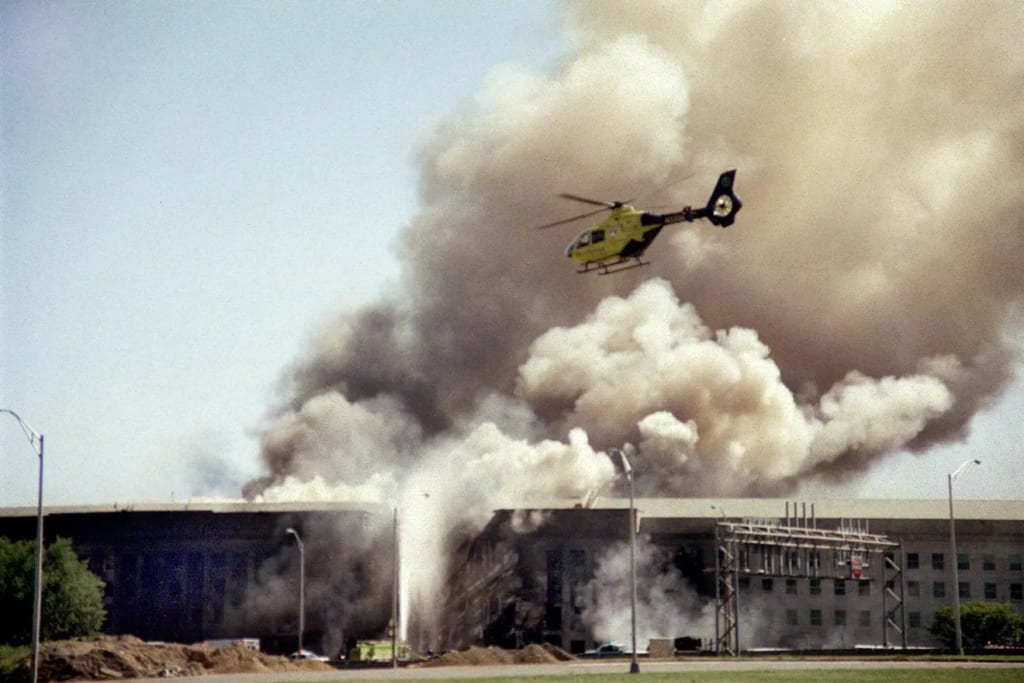
9:37 a.m. American Airlines Flight 77 flew into the Pentagon, killing 64 on the plane and 125 in the Pentagon, virtually upon impact. Deep in the bowels of the building we had no idea what was happening outside, having complied with DHS policy: ‘No Phones’ in the government building. The TV monitor only displayed cartoons. The security guard was no longer in position. We were only a mile from the Pentagon and unaware the United States was under attack, learning everything later.
9:40 a.m. A DHS interviewing officer asked for Qassim. Within ten minutes of the start of the interview, before he could describe the disappearance of his younger sister, a DHS supervisor stuck his head into the room and in no uncertain terms, ordered us to evacuate. “Let’s go! This is a government building. We’re under attack! Everyone out!” The interviewing officer, Qassim and I, rapidly exited. She went her way and we went ours, first to the hallway, then into the elevator which was still operating, and down to the parking garage. Qassim got into my car. Slowly we proceeded through the snarled traffic of dazed motorists maneuvering in la-la land on blocked streets, onto Roosevelt Bridge, McLean Boulevard, Fairfax Drive, anywhere, nowhere, it didn’t matter. I imagined Dali painting melting clocks on the bridge. Time could no longer deprive us of sorrow. Of accountability. “What’s happening?” Qassim asked me. I had no idea. We had no idea. It was too early to know about the crash at the Pentagon. The dead at the Pentagon. It was too early to know if Zeinab was alive. Try your phone, I hollered at him, panicked and desperate to know her fate, disregarding my shame. He looked at me in total bewilderment. “I did. There’s no signal. I need to speak with my wife.” He started to cry. I told him to turn the radio dial to WTOP.
10:50 a.m.. Crossing Roosevelt Bridge for DC.. Only a few vehicles are heading back into DC. Thousands are fleeing the capital of the free world. WTOP reported that the mayor of New York has ordered the evacuation of lower Manhattan. American Airlines Flight 11, then United Airlines Flight 175 hit their targets - the World Trade Center north and south towers. Scared faces were crossing the bridge on foot, to our left and to our right. It was a colossal parade of lost souls, zombies walking back to their suburban homes in Virginia, experiencing naked vulnerability for perhaps the first time, evacuating the capital, eerily in formation, two-by-two or four-by-four, incredulous. I was moving at a crawl. Mass transit had been shut down.
10:54 a.m. To my right the grim grey plumes of smoke billowing from the Pentagon. We both smelled lighter fluid and burning tires. Magically, concurrently, we had second thoughts. We weren’t smelling lighter fluid or burning tires but the odor of burnt fuel from Flight 77 and the torched flesh of men and women burned alive. Zeinab, I thought. My wife, I’m sure Qassim thought.
One cannot pray away uncertainty and vulnerability. Neither Muslim, Jew or Christian. 9/11 demanded that we always remember the heartache but also demanded we forget the rules and codes of conduct we live by, question how the world works, who's really in command. The power of the U.S. to control the future is illusory. We fantasize our power. We believe we, the United States, is superior, but we have to face reality, we are worthless if we don’t lie.
5:33 p.m. The twin towers collapsed. Qassim and Zeinab disappeared from my life that day. He was entitled to have his asylum interview rescheduled. I received a notice in the mail from DHS that it had in fact been rescheduled. The notice to reschedule the interview arrived in March 2002.
I tried to contact Qassim for months after receiving the notice, without success. I saved Zeinab's messages but never tried to call her again. I was afraid someone might pick up and ask how I got her number? At some point in time I heard that Zeinab was killed in the attack. My letters to Qassim were always returned, stamped Return To Sender. After eleven attempts to find him, to find forgiveness, I discontinued the craziness. The price of postage was bleeding my guilt. Did he attend another interview? Was he successful, granted asylum, or blamed for the attack because of his faith and deported? Did he remain an "illegal alien"? What does that even mean, "illegal alien"? He was from Somalia, not Mars.
8:30 p.m. Tuesday, 9/11/2001. Prime time in America. The U.S. President appeared on all of the television networks to make formal remarks: “Today…our way of life, our very freedom, came under attack…”
9/11/2001 to present. Will I ever see another stocking cap like Zeinab's?
About the Creator
Allan Ebert
Find your own voice is good advice. Salvador Dali once said that the first person to compare the cheeks of a girl to a rose was obviously a poet; the first person to repeat it was possibly an idiot. I hope I'm not the idiot.
Keep reading
More stories from Allan Ebert and writers in Humans and other communities.
You Can Live Without Love
Back and forth I paced our small bathroom, biting my nails while the water ran hot. Anticipation goosed my skin; blood sped through my veins. The tub filled. It could have been Christmas morning, my excitement was breathtaking. I quickly got undressed and jumped into the bathtub. The hot water embraced me, completely. I imagined drowning. My pores opened, singing praises, tingling. Eventually, no other embrace was required to be graced and blessed. It was Love. It was Saturday night - bath night! My greatest nightly adventure. Once in the water, I heard the murmur, "I love you."
By Allan Ebert4 years ago in Families
First Date Mistakes Everyone Should Avoid For Better Connection
The overthinking of all the details and putting too much pressure on the result is one of the most frequent first date errors. When one goes on a first date, people are hopeful that the first date should result in an ideal relationship, or a lasting relationship. Such attitude usually builds anxiety and makes the conversation forced and unnatural. As opposed to living in the moment, one might be too concerned about the actual things to say or the ideal impression to give.
By Robert Smith6 days ago in Humans


Comments
There are no comments for this story
Be the first to respond and start the conversation.