
This Bus Is For Members Only
Re: Members - All Participants

He was on the bus when he got the book. A thin lined binding of 53 pages. The woman he got it from handed it to him after they exchanged glances that looked like they knew each other. She held it out; he took it like a reflex of property being returned.
She said, “Thank you,” and stepped off the bus.
He said, “Thank you,” as if rehearsed. He watched her mix into the crowd. He held the book, and she disappeared.
First analysis revealed that the notebook was black with thin leather covers about the size of a deck of bridge cards, but only a third of the thickness. The pages had Bates-stamped numbering starting with "1" in 14 point type on the 17th sheet opposing the binding. The numbering quit at 23, forty pages deep; there were an additional 13 blank pages. The pages were lined, and psychologically inviting of expectation of participation. The covers did not count as part of the numbering.
He paged through the book, counting, measuring, analyzing; miles later he didn’t know where he was, though everything felt familiar. The first numbered page was reassuring, but the apparent loss of memory made him uneasy in the idea of why did he even believe there was lost memory? Reminder. Remained Her. Remind her. Remainder. Each of the numbered pages contained images or notes carefully written in delicate cursive.
Page 1: You are safe again. Live free.
Page 2: You can remember. Look around; it comes back new and different.
Page 3: One day you collect, one day others collect.
Page 4: Look in and look in again.
Page 5: connect the connected the with unconnected.
Page 6: The numbers are obvious, except to others.
The thing about this book is that the page numbers and brief “reminders” aggravated and disturbed. The calm and connected become disturbed and aggravated. Otherwise, they are what they are, aggravated, disturbed. The city passed through the window as the bus passed through the city, beneath a bright cloudless sky. His reflection appeared in a mirror near the door of the bus, used by the obviously forward-looking bus driver to check on passengers. He could see his own familiar, well-worn clothes, now new with dirt - transformative in suggestions.
Page 7: Everyone thanks you, there is more left to do right even if only slightly more.
Page 8: He had this vague realization of waking; isn’t it so? Imagine that.
Who had been writing in this little book? Was it my little book? How so, if I just now got it?
Page 9: Never for everyone, but always for someone. Patience and careful waiting. Find room and ways slow-ly.
Careful waiting and seeing some room in the leeway. Sure.
Page 10: Tell no one except the ones you tell.
Certainly, that means carefully select who to tell. I should cross through that line. He noted there was a fingernail scratch pressed into the line. Was she careful? The woman who handed him the book? Error and correction are married through little books similar to this one. She hands out justice and suffering in pairs – she just gives it away
Page 11: Keep remembering even as it falls apart. Remember to remember,
Page 12: [check mark] Intentionally left blank. Because of Christmas.
Oh, yeah, No “L” – “blank” check transforms to “bank check.” Presents, in abundance, circle high, hidden behind the clouds of a cold winter sky. He had no business on the bus, or except, he wanted to take the bus ride. He had forgotten every thing; he knew he had forgotten everything. That bit of knowing was pleasant and made him happy. He got off, one of two, at the current stop, and he sat on the bus stop bench as the other one hurried away. He waited with the remainders, also waiting there now but for different reasons. Some got on the bus when he had stepped off; others looked down the street. Anticipation. Expectation. Where are the lines? Cars passed. It was mid-afternoon and now cloudy bright.
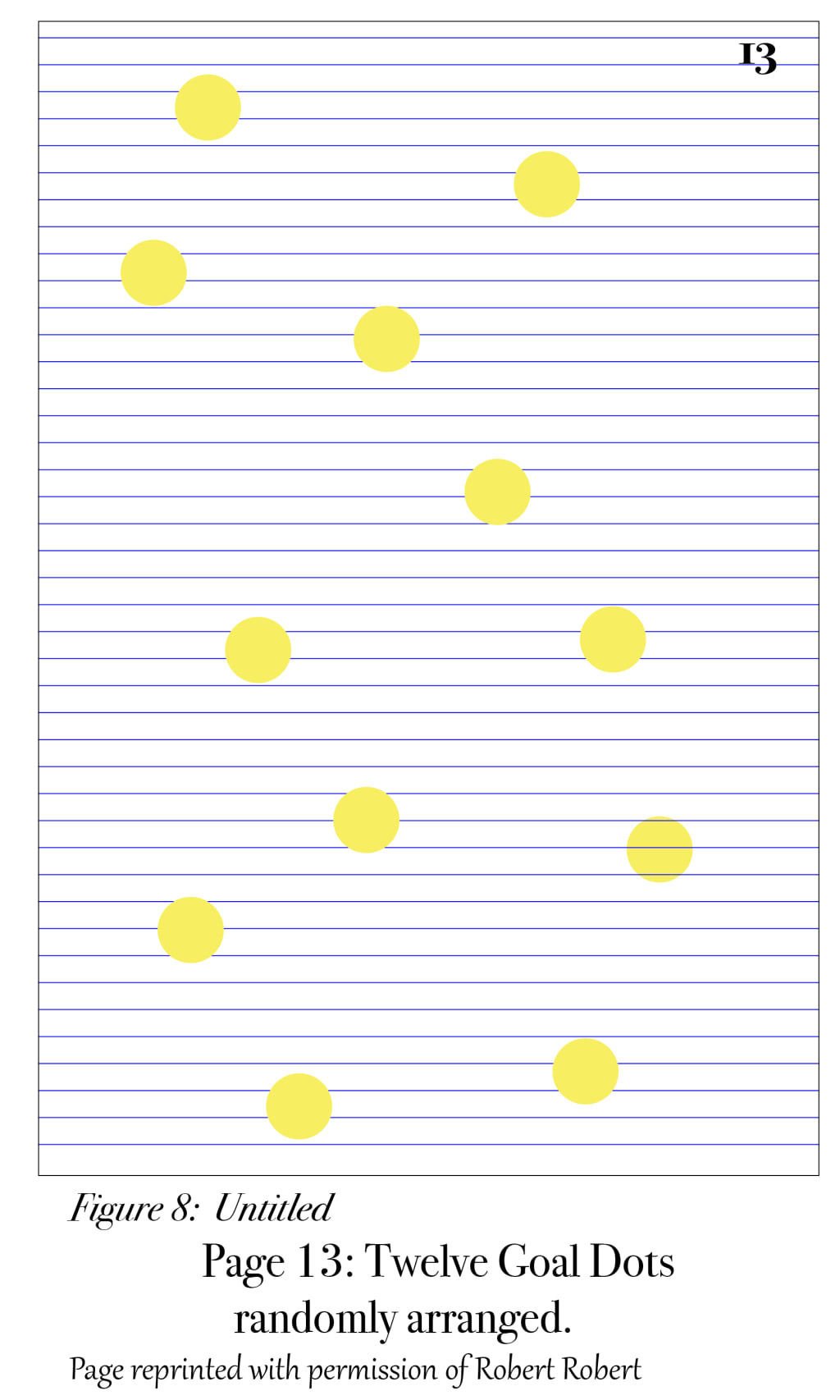
Page 13: [page 13 had twelve gold dots randomly arranged]
Page 14: [a complex line drawing of a tree and leaves]
He remembered a tree in a yard of a house where windows reflected the sun in a pleasant way and glowed with warm light at night. There were people living there you couldn’t see. Yes. Of the tree, each leaf appeared different, and yet the same, and all were needed, and even more were needed if that tree were to be that tree. It didn’t seem possible.
Page 15: This book is being returned to you, in multiples.
Page 16: Really, think, here now. Who else would know?
Page 17: Your name here. Remember a name. It will be a way.
There was this very long moment when he started walking. He kept walking, but now it was growing dark. How could that have taken this long and yet seem so short? Where was he to sleep? Of course, a coffee shop, virtually empty, except for the service. Waiter. Wait her. Waitress. Wait rest. In the mirror by the door again he looked passable, if grimy. He sat at a secluded booth, and he ordered coffee and toast. Honey and butter was also there in little packages.
Page 18: There’s a little room for notes and figuring in the before and after. So go figure sum. Figure here, where there are always befores and afters.
Meaning, he figured, the pages of the book he was holding. But then there was also the inexplicable, existential, paradoxical reality of the truth, and it might have also meant that.
Page 19: Certainly by now, after this, and having this, you should come to.
Who? Come to who? Come to his senses? Come to a party? Or was the word “to” Miss Spelled and Miss-Ing an “O” or a double U? Come also? But everyone knew that he didn’t like parties. Well, some parties you’ve got to like. Some parties you are in anyway. U. r. n. n. e. Way. Re: member.
Page 20: It was as if he were being watched to ensure the journey. It’s real enough to cause suffering, but in an all-calm and all-mild way.
Page 21: Unloved, forsaken. Unknown-loved and accepted. Those are the givens. Mr. and Mrs. Givens who are always there in a crisis; yet they are never suspected.
Page 22: You are not the only one carefully and patiently waiting. Say it to anyone.
He said it to the waitress, who was usually carefully and patiently waiting. She touched his head. They watched each other a moment.
“I am waiting for the bus,” she said.
“I just got off the bus,” he said, while also wanting to explain what “just” meant. “Not everyone waits.”
“I have about ten minutes of waiting,” she said, “until I stop serving.”
Page 23: Go ahead.
He said, “Go ahead,” and he handed her the book; she took it from him, as reflex in knowing what to take was hers, too.
He said, “Thank you.”
She said, “Thank you,” it was needed but awkward.
He left a twenty-dollar bill as he left the table like he had them by thousands, like he needed to give away money, like a tip. And he wondered if it was offence among professionals who always wanted and needed something for something in a world of free abundance. She watched him disappear into a crowded street wanting a thousand more. She had minutes to spare after ending her shift for her bus ride to begin.
When he was outside, he saw a car waiting close, at the corner, three doors down.
He got to the car; he looked inside the car. He saw the driver, and he got into the car.
The familiar voice said, “Home?”
More realization flooded his mind, “Yes, home Lee.”
Robert was his close friend and a brother by adoption who drove the car. Robert had the same name. He had come to pick him up; and he was there to ensure their work was established, permanent, ongoing, transferable, and sustainable for others. He read into things. But “Lee” was what they often called each other as “slowly,” “quickly,” “namely.” Or in this case, “homely.”
They both laughed. “My name isn’t Lee; are you sure about home?”
“It was a figure of speech, Robert; humor in a funny time of remembering. You? The driver home. Real-lee? Worry not. Speed on.”
“You appear homeless and derelict, worry not to.”
“Worriless, I’m here, too.”
He remembered his wife, and children, and the home they had. He had come to, amid the remembered.
“How long did this one take?” he asked Robert.
“It was as if you just now left and now you are here.”
“Feels longer. Did anyone Miss Me?”
“No one even… knew you… were gone. Or at least they appeared patient. Which page was it; witch words made it start,” said Robert.
“I don’t, I mean I, no words; it was the page with twelve goal dots. I started to remember until now. But I can’t remember past now.”
“’Gold dots’? Can’t you just live without wanting gold?”
“What? I am living. They’re just dots on a page. I like what counts.”
There was a small wooden box that used to hold dominoes on the console.
“Remember this?” said Robert.
“Oh? Do these count as presents? Are they mine?”
“I don’t know how to answer that. It belongs to someone else exactly when it is used by whoever has it.”
He opened it. The little box held four packs of 50 bank-banded 100 dollar bills stacked on top of a little black book just like the one he gave away - except different.
“Wow. Is this real?”
“You are asking me if money and books are real?”
“I’m asking you if this is real money.”
“Page 24 is no longer blank,” said Robert. “Does that answer your question? Try to keep up.”
They turned another corner onto the street of where he lived. He remembered everything. And for a while all of his questions had answers.
About the Creator
Charles Edwards
I am told this story by reputable people: First there were billions and billions of years then in one instant (relatively speaking), as if suddenly, I'm here. And that's how it happened.
Keep reading
More stories from Charles Edwards and writers in Humans and other communities.
On Mystery Box Revealed
On Mystery Box Revealed His wife didn’t think he was a hoarder. He was not a hoarder. Besides, she was there too, helping. The boxes kept piling on their front porch. Every day, week after week, ten to fifteen new deliveries came by drone or by truck. Often they came in the morning, mostly in the morning, but also throughout the day.
By Charles Edwards3 years ago in Humans
Whiskey At Dusk
Guess the whiskey was more important to you in the end, wasn’t it? It was more than the well-being of your friends; more vital than showing up to the places you promised you would and could come to; more critical of a matter than fulfilling your damn responsibilities and getting the press off your back.
By Snarky Lisa3 days ago in Humans
The Banality of Evil
We often imagine crime as the work of monsters—people so different from us that we can safely put them in another category. Serial killers, corrupt officials, war criminals: they’re “other,” right? But history and psychology tell a more unsettling story. Ordinary people, people who look like us, who live next door, who go to work and pay bills, can and do commit extraordinary crimes.
By The Crime Canvasabout 3 hours ago in Humans
The Duelist
The rays of a dying red sun flashed against the onrushing blade. The grey beards say the key to dueling lies in size, speed, reach, righteous fury, whatever the person in front of them pays them to say. Matteo knew better than any it was none of these and had an undefeated record on these sands to prove it.
By Matthew J. Fromm3 days ago in Fiction


Comments
There are no comments for this story
Be the first to respond and start the conversation.