
They Die Alone, Surrounded by People
A Quiet Crisis in Modern End-of-Life Care


The corridor breathes even when no one walks through it.
A light hums faintly. A trolley brushes against the wall. Somewhere, a door sighs shut.
Night speaks its own language here.
In room 214, an elderly woman lies awake.
Her eyes stay open, staring at nothing in particular. The ceiling has become a familiar stranger, one she never chose to know. The clock ticks with relentless patience, each second landing softly, cruelly, on her chest.
She is not truly alone.
There are people behind the walls. Footsteps pass her door. A nurse will come, eventually.
Yet loneliness sits beside her, heavy and silent, like an unseen companion.
This is how many people die today.
Not abandoned.
Not forgotten.
Simply alone.
These care homes were built to protect.
White walls. Spotless floors. Schedules posted by the doors. Everything in its place. Even grief, when it surfaces, is expected to stay quiet.
There is constant movement.
Hands that lift. Hands that wash. Hands that check vitals and adjust medications.
But rarely hands that linger.
Presence has become transactional.
It enters, completes its task, and leaves.
No one stays long enough for silence to become conversation.
Some residents still rehearse old sentences in their minds.
Stories once shared freely, when someone listened. A childhood by the sea. A love that faded. A regret that lingers after decades.
The words rise to their lips, then fall back.
Questions about death hang unspoken in the air. It feels rude to ask. Inconvenient. Too heavy for a place meant to keep things light, orderly, manageable.
So the words stay inside.
And the nights stretch longer.
The caregivers see it all.
They recognize the moment someone stops mentioning tomorrow.
They feel the subtle shift—almost invisible—when a resident begins silent goodbyes.
They hurry because they must.
Pausing would mean falling behind. Listening would mean prioritizing one life over others.
They carry faces home with them.
Names they won’t forget.
A quiet guilt—not for what they did wrong, but for what they never had time to do.
Sometimes, all that care requires is sitting down for a while.
Sometimes, that’s impossible.
Death no longer arrives with ritual.
It slips in between rounds. Between a signature and a checked box.
A body is found.
A sheet is drawn up.
A report is filed.
By morning, the room is empty again.
Efficient. Discreet. Almost gentle.
The system keeps running.
Once, dying was communal.
In rooms filled with voices, with hands that held on until the end.
Now it belongs to institutions.
To protocols.
To silence.
We call it dignity.
We call it professionalism.
We call it necessity.
But necessity is no substitute for human warmth.
This is not a tale of cruelty.
It is a story of forgetting what cannot be quantified.
We built systems to care for aging bodies, but overlooked the weight of aging souls.
We optimized time and lost presence.
We solved one problem and created another, quieter one.
Loneliness at life’s end is not accidental.
It is a consequence.
One day, many of us will lie in rooms like these.
Listening to footsteps that never stop.
Waiting for a voice that isn’t hurried.
The true measure of a society lies not in its progress or efficiency.
It lies in how it accompanies those who are leaving.
They do not die alone because no one is there.
They die alone because no one is truly with them.
And in that silence, something essential is lost—
not by them,
but by us.
JLP
About the Creator
Laurenceau Porte
Chroniqueur indépendant. J’écris sur l’actualité, la société, l’environnement et les angles oubliés. Des textes littéraires, engagés, sans dogme, pour comprendre plutôt que consommer l’information.
Keep reading
More stories from Laurenceau Porte and writers in Humans and other communities.
Time Does Not Restart Chronicle of a Year Without Promises
The first morning of the year looks like any other, and perhaps that is where its small cruelty lies. The light is nothing new, it is no kinder, and the air retains that same grey consistency. Yet, one feels this light but persistent pressure, a moral obligation to feel different. We call this "the beginning," but it is a practical illusion, a collective invention that humans tell themselves to keep from drowning in the incessant flow of hours. The calendar is not a measurement tool; it is a way of storytelling. It does not point to real changes; it simply marks the moment we finally decide to look them in the face.
By Laurenceau Porte2 months ago in Humans
A Historic Declaration
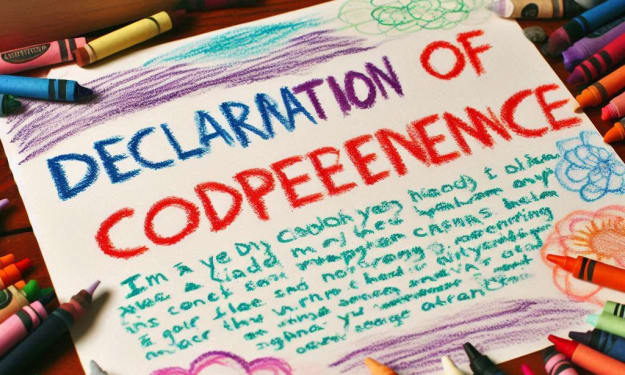
We the People of the Husbands of the United States of America, in Order to form a more perfect Union, and I mean you...with me...establish Justice, insure domestic Tranquility, provide for the common defence, promote the general Welfare, and secure the Blessings of Liberty to ourselves, after Puberty, do ordain and establish this Declaration of Co-Dependence.
By Gerard DiLeo6 days ago in Humans



Comments
There are no comments for this story
Be the first to respond and start the conversation.