
“The World Is Watching: Why Iran’s Crown Prince Says Tehran’s Survival Sends a Message to Every Bully”
Reza Pahlavi’s call for global action confronts a brutal crackdown, inspiring a movement that refuses to be ignored.

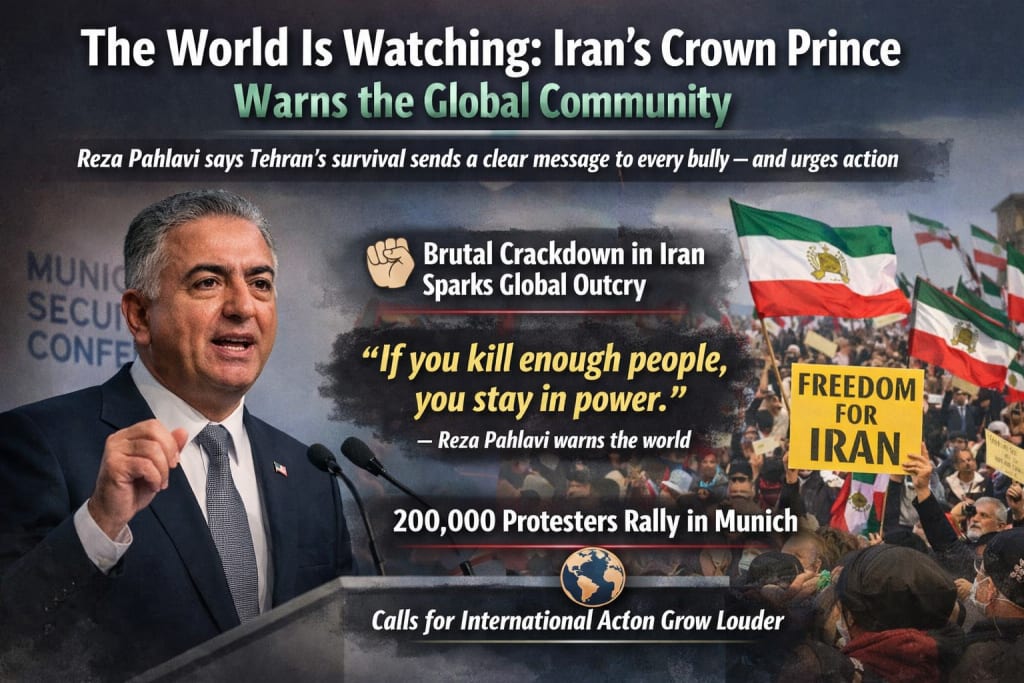
On a chilly February afternoon in Munich, against the backdrop of one of Europe’s largest security gatherings, a message echoed far beyond conference halls and diplomatic lounges. It came not from a sitting head of state, but from a man whose title evokes Iran’s past — Reza Pahlavi, the Crown Prince in exile. His words were blunt, driven by grief and urgency: If the government in Tehran continues to survive amid widespread protest and repression, it will send a clear signal to tyrants everywhere — that you can kill enough people and remain in power.
This declaration — seemingly simple — carries profound implications. It captures the anger of millions of Iranians, the frustration of human rights advocates, and the moral dilemma facing democracies that have so far hesitated to take decisive action. In a world already tense with geopolitical conflict and rising authoritarianism, his statement challenges the global community to confront not just Iran’s leadership, but the very principles that govern international response to oppression.
The Roots of Iran’s Struggle
Iran has been in a state of deep unrest for over a year, sparked by the September 2022 death of Mahsa Amini, a young woman detained by Iran’s morality police. Her death ignited protests across the country — protests that were met with a violent crackdown. Security forces killed and injured thousands of demonstrators, detained tens of thousands more, and suppressed dissent with brutal force. Yet, rather than ending the movement, the repression fueled it.
What began as anger over restricted freedoms and arbitrary enforcement of dress codes evolved into a broader outcry against systemic oppression, economic hardship, and lack of political freedoms. Iranians from all walks of life — students, workers, women’s rights activists, artists — joined the streets demanding change.
Amid this turmoil, Reza Pahlavi emerged as a symbolic leader for the opposition, especially among expatriates and the diaspora. Though he holds no official power in Iran, his voice resonates with those who see in him a reminder of the country’s pre‑1979 existence, when monarchy and modernity coexisted — imperfectly, but with far greater personal freedoms than what millions experience today.
Munich Security Conference: A Stage for a Global Message
At the prestigious Munich Security Conference, Pahlavi’s words captured attention. While many world leaders discussed nuclear proliferation, regional conflicts, and strategic alliances, Pahlavi’s address was profoundly personal and moral. He argued that what happens in Iran is not just an internal matter; it tests the resolve“If governments around the world allow the Iranian regime to crush its own people with impunity,” he said, “then the message is clear: cruelty pays, and those who wish to silence dissent will endure.”
His message underscores a deep fear: that what happens in Tehran does not stay in Tehran. In an interconnected world, when an authoritarian regime survives mass protests through violence and intimidation, its example can embolden similar regimes elsewhere.
A Global Movement, Not Just a Local Protest
Since his Munich address, tens of thousands of Iranians and supporters rallied across cities in Europe and North America. Organizers reported huge turnout in Munich itself — estimates ranging up to 200,000 protesters — while parallel demonstrations appeared in Los Angeles, Toronto, and other major cities.
These protests are not merely symbolic. They demonstrate the widespread support for a cause that has outlived its earliest, spontaneous moments and transformed into an organized expression of resistance. Social media amplifies every moment, every chant, every tear and triumph, reaching viewers inside Iran who risk severe punishment merely by watching.
For many protesters, the demand isn’t just reform — it’s a new social contract: one where women and minorities are free, citizens’ voices matter, and basic rights are protected. Their banners read simple truths: “Freedom for Iran,” “Women, Life, Freedom,” and “No more violence.”
The International Response — Or Lack Thereof
Despite global awareness, international response has been cautious. Some Western nations have condemned the Iranian government’s violence and imposed targeted sanctions. Yet many critics argue that these measures are largely symbolic and do little to change the situation on the ground.
Diplomats face a familiar dilemma: how to balance geopolitical strategy, economic interests, and human rights advocacy. Iran’s strategic importance, complex relationships with global powers, and its role in regional conflicts — particularly in the Middle East — complicate unified international pressure.
Pahlavi didn’t shy away from this reality. Instead, he called on world leaders to act with moral clarity. “Will the world stand with the people of Iran?” he asked — not as a question of politics, but of conscience. For him, the eyes of history are watching, and the cost of inaction will echo far beyond one nation’s borders.
Why This Matters Beyond Iran
In recent years, global politics has seen the rise of authoritarian governments that hold onto power through fear and force. When such regimes withstand internal opposition without significant global intervention, authoritarian rulers elsewhere take note. Pahlavi’s warning reflects a fear shared by human rights advocates: that the endurance of one oppressive government, unchecked, becomes justification for another.
History offers sobering examples. The collapse of Yugoslavia’s federation in the 1990s led to brutal conflicts when international actors hesitated to intervene. The Arab Spring showed how quickly hope for change could be met with ruthless crackdowns, with varying degrees of foreign engagement.
Today’s Iran is part of that continuum — a flashpoint where courage and cruelty collide, and where the decisions of world leaders and ordinary citizens alike will shape the future of global human rights advocacy.
A Moment of Reckoning
As the protests continue and calls for justice grow louder, the story of Iran stands as both a cautionary tale and a testament to the resilience of the human spirit. Whether Pahlavi’s words lead to meaningful international action or become another chapter in a cycle of rhetoric and repression depends not only on policymakers, but on each of us who hears them.
For those watching from afar, the question remains: will the world choose to stand with a people fighting for freedom — or will it let fear and diplomacy outweigh the call for justice?
What happens next in Iran may very well set a precedent for how the global community responds to tyranny in the 21st century. And for millions of Iranians, their struggle continues — not just against a government, but against a future that has yet to be written.
If you’d like, I can tailor this further for a specific tone (more emotional, more analytical, more personal narrative) or format it for publication on a platform like Vocal Media
About the Creator
sehzeen fatima
Sehzeeen Fatima is a writer with a Master’s in Science who shares inspiring stories about sports, life, and people. She writes in simple, clear language to connect with readers and spark meaningful thought.
Keep reading
More stories from sehzeen fatima and writers in Humans and other communities.
Isabelle Tate: Grace, Strength, and the Beauty of Modesty
The world recently lost a rising star — Isabelle Tate, a young actress whose story touched many hearts. She was more than a talented performer; she was a symbol of courage, confidence, and natural beauty. Her fans admired her acting, but they also admired the way she carried herself — always smiling, always gentle, and full of life.
By sehzeen fatima4 months ago in Humans
Think for Me
"How do you calculate the circumference of a circle? Submit your answer when ready." [Pause] "Excellent! Every student was able to call up the answer electronically very quickly. If I, as a robot had feelings, I would express pride. You may break for lunch. Return to this cyber room in 45 minutes."
By Julie Lacksonen3 days ago in Humans
The Next Big Thing After ChatGPT
When ChatGPT burst into the mainstream, it felt like a turning point. Suddenly, artificial intelligence wasn’t just a background technology powering ads or recommendations—it was something you could talk to. It could write essays, explain complex ideas, help with coding, and even sound surprisingly human.
By Mind Meets Machine7 days ago in Humans




Comments
There are no comments for this story
Be the first to respond and start the conversation.