
The Weight of Wings
The Weight of Wings: A Tale of Soaring Minds and Fragile Dreams


In the quiet town of Elmwood, where the river bent around a sagging mill and the air smelled of damp pine, Elias Tanner lived a life of small joys. At 42, he swept floors at the local library, a job he’d held since he was 19. His hands moved with a rhythm born of habit, and his smile—wide and unguarded—greeted every patron who crossed his path. Elias wasn’t quick with words or numbers; his thoughts stumbled where others danced. But he loved the library’s hush, the way books stood like sentinels on the shelves, guarding secrets he couldn’t unlock.
“Morning, Elias!” Mrs. Harrow, the head librarian, would call each day, her voice warm as she handed him his broom. She’d known him since he was a boy, back when his mother would coax him through picture books, her patience a lifeline. Now, Elias nodded back, muttering a shy “Mornin’,” and got to work. He didn’t read the books—he couldn’t, not really—but he liked tracing their spines, imagining the worlds inside.
One crisp October day, a stranger arrived. Dr. Lena Voss wasn’t from Elmwood. Her coat was too sharp, her eyes too bright, like she’d stepped out of a city Elias had only seen on the library’s flickering TV. She carried a leather case and a question: “Elias Tanner? I’ve heard about you.” Her voice was smooth, deliberate. “I’m with the Neurospire Institute. We’re testing a procedure—a way to help people think faster, know more. You’d be perfect for it.”
Elias blinked, clutching his broom. “Me? I ain’t smart, ma’am. Never been.” His words came slow, each one a stone he had to lift.
“That’s why,” Dr. Voss said, her smile softening. “You’ve got heart, Elias. And we’ve got a sparrow named Pip who’s already tried it. She’s solving puzzles no bird should solve. We think it could work for you too.”
He didn’t understand half of what she said, but “sparrow” caught his ear. He liked birds—watched them flit through the pines on his walks home. And the idea of being “smart” tugged at something deep, a longing he’d carried since childhood, when kids snickered at his stumbles in school. “Would it hurt?” he asked.
“A little,” she admitted. “It’s surgery—on your brain. But you’d recover fast. And then… Elias, you could read those books you dust every day.”
That night, he sat on his sagging porch, the river murmuring beyond the trees. His mother’s old Bible lay beside him, its pages a mystery he’d never cracked. He thought of Pip, the sparrow, and whispered, “Okay.”
The surgery happened in a sterile room two towns over, where machines hummed and Dr. Voss’s team hovered like ghosts. Elias clutched a feather he’d found by the river—a talisman against the fear curling in his gut. When he woke, bandages swaddled his head, but the pain was dull, distant. Dr. Voss stood over him, holding a mirror. “It’s done,” she said. “Give it time.”
Time moved strangely after that. At first, nothing changed. Elias swept the library floors, raced Pip through mazes Dr. Voss brought—simple wooden twists he lost every time—and wrote clumsy notes in a journal she’d given him: Day 3. Pip fast. Me slow. Head hurts. But then, like a dam breaking, it began.
Words started to stick. He’d glance at a book title—The Wind in the Willows—and sound it out, letter by letter, until it sang in his mind. Mrs. Harrow caught him one morning, hunched over a children’s encyclopedia, his lips moving silently. “Elias?” she said, startled. He looked up, grinning. “It’s about birds, ma’am. Did you know sparrows can fly fifty miles an hour?”
Soon, he didn’t just read—he devoured. History unfolded like a map: wars, kings, rivers carving the earth. Math clicked into place, numbers aligning like stars. He taught himself to write properly, his scrawl smoothing into loops and lines. “I’m flying,” he told Dr. Voss during a checkup, laughing as he sketched Pip’s maze from memory. She nodded, but her eyes flickered with something he couldn’t name.
Elmwood noticed. Mrs. Harrow beamed when he fixed the library’s ancient computer, his fingers dancing over keys he’d once feared. Neighbors stopped to chat, awed by his tales of ancient Rome or the mechanics of flight. Even sullen Tommy Reese, who’d once tripped him for laughs, lingered to hear Elias explain why the mill’s gears jammed. For the first time, Elias felt seen—not as the slow man with the broom, but as someone who mattered.
He grew close to Dr. Voss too. She’d sit with him by the river, her crisp demeanor softening as they watched Pip flutter in her cage. “You’re my sparrow now,” she said once, her voice catching. Elias blushed, his heart lifting like wings.
But wings can falter. It started with Pip. One gray morning, Elias found her listless, her tiny beak pecking weakly at the maze she’d once conquered. “She’s tired,” he told Dr. Voss, panic rising. She frowned, scribbling notes. “We’ll run tests.”
That night, Elias pored over the institute’s research papers—files he’d begged Dr. Voss to share. His mind, now a blade, sliced through jargon: Neural enhancement. Temporary synaptic boost. Degradation curve. His breath hitched as he graphed it out, numbers whispering a truth he didn’t want to hear. The higher you soared, the faster you fell.
Pip died two days later, her small body still in Elias’s hands. He buried her by the river, a stone marking her grave. Then he turned inward, watching himself. The first sign was a word—velocity—slipping from his grasp mid-sentence. Then a tremble in his hands as he shelved books. By week’s end, he forgot the river’s name, staring blankly at its shimmer.
Dr. Voss came when he stopped answering calls. “Elias, I’m sorry,” she said, her voice breaking. “We didn’t know how short it’d be.” He shook his head, pushing her away. “I flew,” he rasped. “That’s enough.”
The descent was swift. He quit the library—Mrs. Harrow’s pitying eyes too much to bear—and hid in his shack, scribbling what he could: Day 49. Can’t read no more. Pip gone. Me next. The books mocked him now, their secrets locked again. One night, he wandered to the river, lost, until a fisherman guided him home.
In July, Elias packed a bag. He left a note for Dr. Voss: Don’t feel bad. I saw the sky. Put a feather on Pip’s stone if you can. With his last coins, he bought a bus ticket north, to a town where no one knew the man he’d been—or briefly became.
Years later, a hiker found a weathered journal by the Elmwood river, its pages brittle but legible. It told of a man who’d touched the stars, if only for a moment, and a sparrow who’d led the way. Beside a small grave, a single feather gleamed in the sun.
This story mirrors the emotional arc of "Flowers for Algernon"—a rise to brilliance, a fall to loss—while weaving a new tale of Elias and Pip. It explores intelligence, identity, and the bittersweet cost of transformation, all in a voice that’s vivid, heartfelt, and distinctly human.
About the Creator
KWAO LEARNER WINFRED
History is my passion. Ever since I was a child, I've been fascinated by the stories of the past. I eagerly soaked up tales of ancient civilizations, heroic adventures.
https://waynefredlearner47.wixsite.com/my-site-3
Keep reading
More stories from KWAO LEARNER WINFRED and writers in Humans and other communities.
Death Came Knocking Seven Times—Frayne Salac Answered with Luck
Some people coast through life with barely a scratch. Others, like Frayne Salac, seem to dance with danger at every turn. Over decades, Frayne survived not one, not two, but seven brushes with death—each more harrowing than the last. His story reads like a Hollywood thriller, yet it’s all too real. From derailed trains to fiery car wrecks, here’s the extraordinary account of a man who’s either blessed with luck or cursed with chaos.
By KWAO LEARNER WINFRED12 months ago in Humans
A Historic Declaration
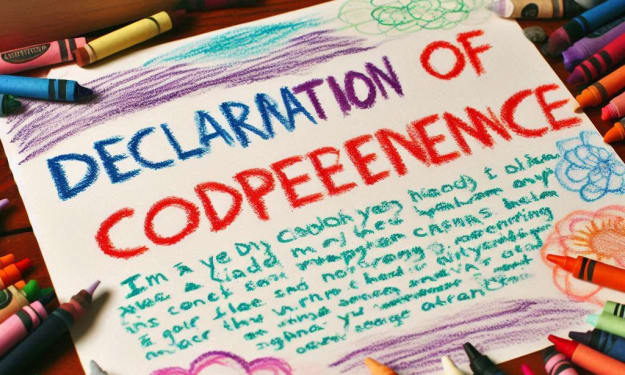
We the People of the Husbands of the United States of America, in Order to form a more perfect Union, and I mean you...with me...establish Justice, insure domestic Tranquility, provide for the common defence, promote the general Welfare, and secure the Blessings of Liberty to ourselves, after Puberty, do ordain and establish this Declaration of Co-Dependence.
By Gerard DiLeo6 days ago in Humans
Review of 'Man on the Run'
My wife and I saw Man on the Run, a nearly 2-hour documentary on Amazon Prime, about Wings, Paul McCartney's group that flew around the world from shortly after The Beatles broke up in early 1970 to shortly after John Lennon was murdered at the end of 1980, making a Beatles reunion forever impossible.
By Paul Levinson4 days ago in Beat



Comments
There are no comments for this story
Be the first to respond and start the conversation.