
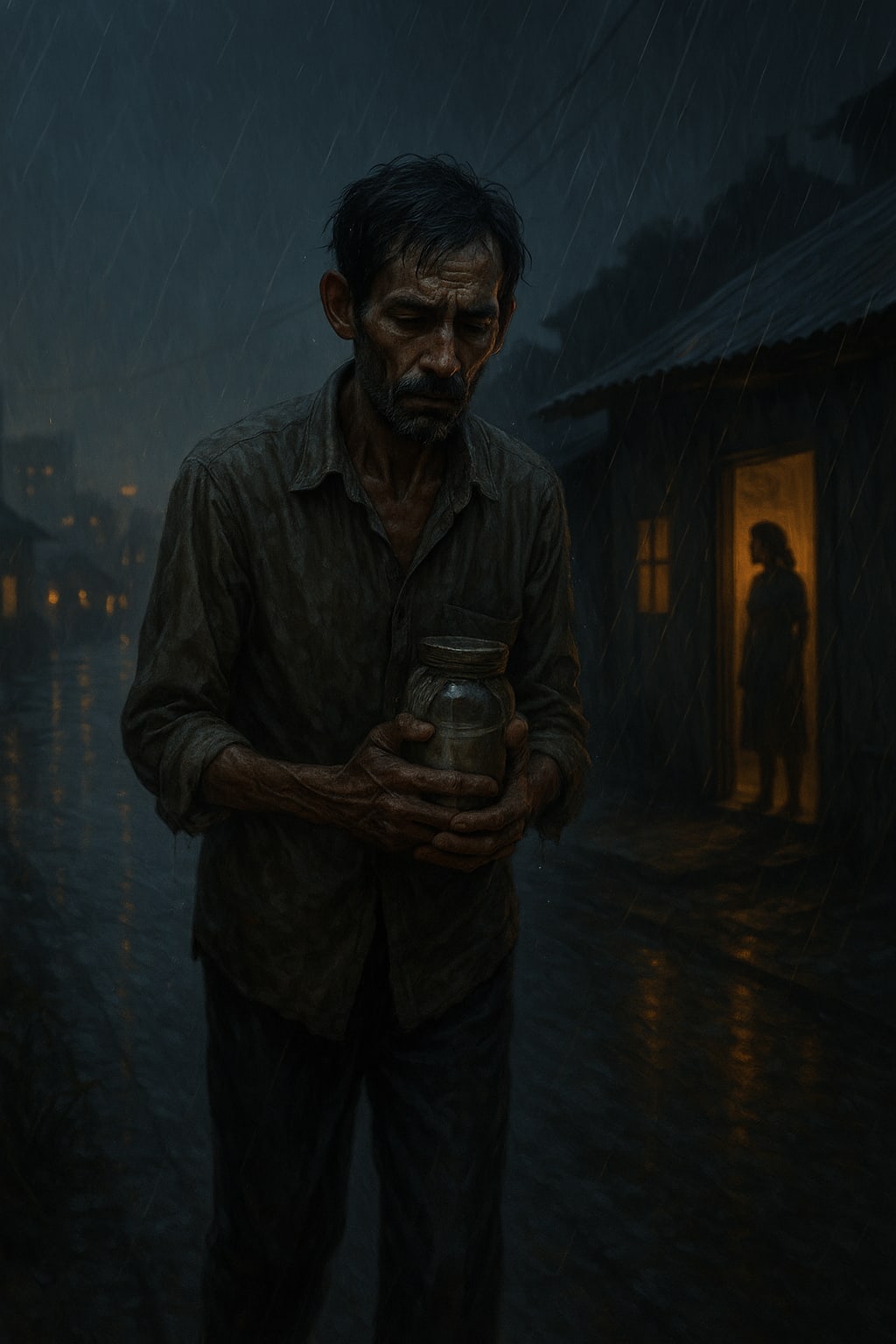
**"The Weight of Bread"**
Every morning before dawn, Arun walked out of his tin-roofed house with silent steps, careful not to wake his children. The door creaked slightly, as if protesting his daily departure, and he’d glance back at the dim outline of his family asleep on a shared mat.
Five mouths to feed. One life to give.
Arun had once been a schoolteacher. Proud, clean-shirted, carrying a red pen like it meant something. That was before the factory closure, before the rains ruined their crops two years in a row, before the debts piled up faster than the coins in his pocket.
Now, he was a laborer at the construction site in the city—a job he had never imagined for himself. The hours were long, the pay meager, and the work brutal. His hands, once soft from holding chalk, were now calloused and cracked from lifting bricks under a punishing sun.
But every rupee counted.
He never told his family the truth of what he did. To his wife, Meera, he said he worked at a nearby office as a guard. To his children, he was a man who had important things to do every day. And he kept it that way. Let them dream. Let them look at him with pride.
His son, Raju, was nine and wanted to become a doctor. Arun kept a small glass jar hidden behind the rice tin, where he dropped in coins—bit by bit, day by day. It wasn’t much. But he hoped it would grow into something. A future, maybe. A chance.
One evening, after a particularly harsh day hauling cement up five flights of stairs, Arun’s body gave out. He collapsed just outside the worksite, clutching his chest, breath ragged and shallow. The foreman called a tuk-tuk and sent him to the government hospital.
He lay there, weak but conscious, refusing admission because he couldn’t afford the bed.
So he walked home.
That night, he smiled at his children as they ate the simple lentil stew Meera had made. He told a made-up story about a rich man who got lost in a village and found happiness among poor but kind people. His children laughed. He coughed blood into his sleeve when they weren’t looking.
Meera knew something was wrong.
"You’re not well," she said quietly after the kids had gone to sleep. "Let me take you to the doctor."
Arun shook his head. "We can’t afford it."
"You think we can afford to lose you?" she whispered, angry tears falling.
He had no answer. Only silence.
The next morning, he left even earlier than usual. This time, not to the construction site. He went to the rich side of the city. There, he stood outside a row of bungalows until someone opened a gate. A middle-aged woman with tired eyes and a clipboard in her hand.
“Can you cook and clean?” she asked.
“I can try,” Arun replied.
And so he scrubbed tiles and peeled vegetables and washed clothes with detergent that hurt his fingers. The pay was slightly better. Less heavy on his body, but heavier on his dignity. But he smiled and kept going, because Raju had just asked if he could go to school early for extra science classes.
Weeks passed.
Arun aged more in those weeks than in the years before. His back was bent, and his breathing never fully recovered. But the jar behind the rice tin grew heavier. Meera noticed. She stopped asking questions, but her eyes followed him every morning like they were memorizing him—just in case.
One monsoon night, the rains came in heavy sheets. The roof leaked, and the lights flickered. Raju woke up crying from a fever. Meera panicked. They had no money for medicine.
Arun didn’t say a word. He reached behind the rice tin and took out the jar. He wrapped it in an old cloth and ran through the storm to the local pharmacy. He didn’t care about the soaked money or the mud on his feet. He just wanted his son to be okay.
When the fever broke at dawn, Arun sat beside his son and kissed his forehead.
"You’ll be alright now," he said softly.
Two days later, Arun didn’t wake up.
A silent heart attack, the doctor said.
They found a letter under his pillow. In it, he wrote:
*"If I could give my breath to keep yours going, I would. If you remember me, don’t remember the work I did—remember the dreams I had for you. Live them. Be better than I ever could."*
They buried him under a mango tree outside the village.
And every year, when Raju brought his children to visit, he would say:
"My father gave up everything so I could stand here. He never left me anything but love—and that was more than enough."
Don't Forget To Give A Like ❤️ 😍
About the Creator
A Knight of the Seven Kingdoms Series Review (Season 1)
As one of the biggest properties in fantasy, A Song of Ice and Fire remains immensely popular with audiences. After reaching far into the past with House of the Dragon, a second spin-off was on the cards. A Knight of the Seven Kingdoms serves up a bite-sized slice of action and drama, but it still claims a spot among the best small-screen titles.
By Robert Cain3 days ago in Geeks



Comments
There are no comments for this story
Be the first to respond and start the conversation.