
The Voucher Program
Tennessee Promised Poor Families a Way Out. It Delivered a Discount to Families Who Never Needed One.
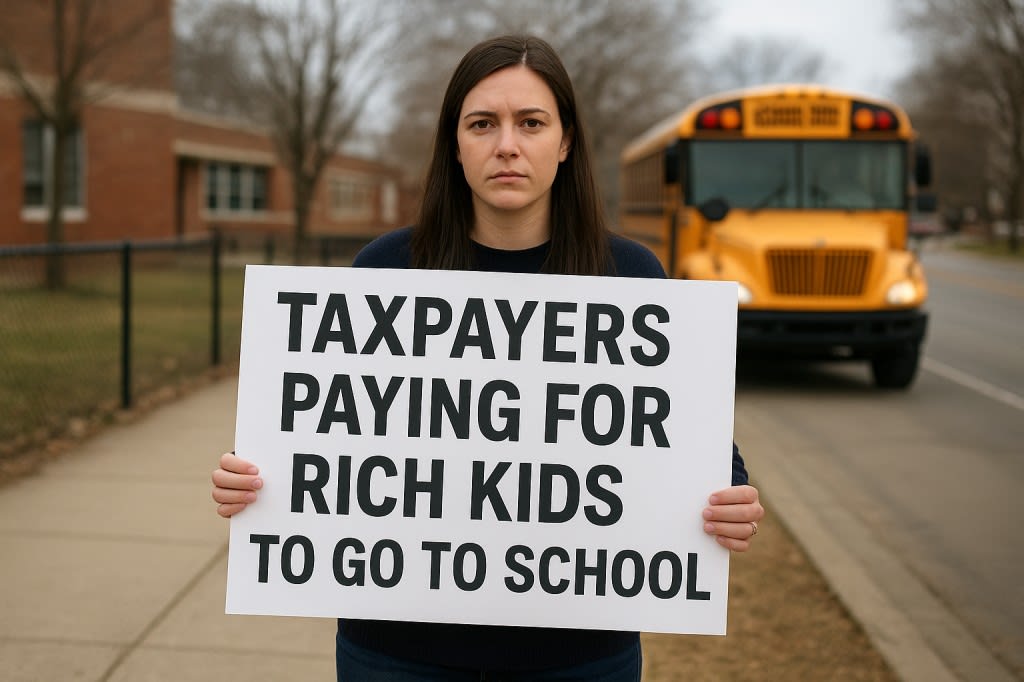
Tennessee's Education Savings Account program was introduced to the legislature in 2023 with a specific image attached to it. A poor child in a failing school whose parents finally have the power to do something about it. That image did most of the political work. The bill passed. The program launched. And then the data started coming in, and the data described a different child entirely.
In Arizona, which ran a similar universal voucher expansion ahead of Tennessee, researchers found that seventy-five percent of the families who claimed vouchers in the first year had never enrolled their children in public school. They were already in private institutions. They had already made the choice the program claimed to be enabling. What the program actually did for them was send a check, funded by the public education budget, to reimburse a private decision they had made years earlier without any assistance from the state. The program did not move a single one of those children from a worse school to a better one. It moved money.
Tennessee's program offers families $7,200 annually. The average private school tuition in the state runs closer to $11,000. The gap between those two numbers is where the promise of the program meets the geometry of actual income, and the gap functions as a filter so effective it could have been designed on purpose. A family with sufficient income bridges $3,800 without much difficulty. A family at or near the poverty line does not experience $3,800 as a gap to bridge. They experience it as the end of the conversation.
Then there is the question of where private schools actually exist in Tennessee. Forty-two percent of rural counties in the state have no private school. Of the counties that do, many have a single institution, often religious, often selective in its admissions, often located on a road that a family without reliable transportation cannot treat as a daily commute. Ninety-two percent of urban families live within five miles of a private school. Thirty-four percent of rural families do. The voucher does not come with a school attached. It comes with the assumption that a school is available, which is an assumption that holds in Nashville and dissolves somewhere around the Cumberland Plateau.
In Pickett County, the public school is the largest employer. It runs the food pantry. It houses the only pediatric dental screening program families can access without driving to another county. It employs people whose salaries circulate through the local economy in the way that institutional payrolls do in places with no other institutions. The state funds this school through a formula tied to enrollment. Enrollment falls when students leave. Students leave when families use vouchers. Families in Pickett County cannot use vouchers because there is nowhere to use them, so enrollment in Pickett County falls for a different reason. Families leave the county entirely because the county has nothing to offer them, and the county has nothing to offer them in part because the school that anchors it is underfunded, and it is underfunded in part because the funding formula was designed for a state that distributes its population and its private school infrastructure evenly, which Tennessee does not.
What the voucher program does to a county like Pickett is indirect and therefore easy to describe as unintentional. A wealthy family in Nashville uses a voucher. The Nashville public school district loses the per-pupil dollars attached to that student. The Nashville public school district has forty-three thousand other students and a tax base capable of absorbing the loss without closing a program. The funding that left the Nashville district did not go to Pickett County. It went to the private academy, which does not serve Pickett County and has no obligation to. The rural school loses nothing in this specific transaction. What it loses is slower and harder to point to. The aggregate political and financial momentum that public education depends on when it needs the legislature to care about its budget. Every dollar that moves from public to private carries with it an implicit argument that private is working and public is not. That argument is most damaging in places where public education is the only education and the only institution large enough to hold a community together.
In Oklahoma, rural superintendents have been saying this for two years in language considerably less diplomatic than anything a policy brief would use. They call the voucher program welfare for wealthy parents in Oklahoma City. The description is factually supportable. A family in a metropolitan area uses public funds to attend a school they chose before the program existed. A family in a rural county watches the school that employs their neighbors lose the funding it needs to keep a music teacher, a school counselor, a bus route. The rural family does not gain a choice. They fund someone else's.
The program's architects would say this misunderstands the design. The design is meant to create market pressure on public schools, to force improvement through competition. This is a coherent theory. It requires, for its coherence, that public schools can respond to competition the way businesses respond to competition, which requires that they can shed costs, change models, and attract a different customer when the existing one leaves. A public school in a rural county with one school cannot do any of those things. It cannot attract a different student population because the population is the population. It cannot cut costs below a certain floor without ceasing to function. It cannot compete with a private school forty miles away for families who cannot drive forty miles. The market logic applies to a geography that does not describe forty-two percent of Tennessee's rural counties, and the program applies to all of them equally.
North Carolina's data showed the same pattern. Voucher uptake concentrated in suburban and urban counties. Rural counties saw little to no private school enrollment change. What they saw was the funding conversation shift, the political energy around public education dilute, and the administrative burden of tracking and processing voucher applications land on district offices already running on reduced staff. The program cost rural districts money they did not receive, in the form of staff time spent on compliance with a program delivering them no benefit.
The word the legislature used most often when passing the bill was opportunity. It appears thirty-one times in the bill's text. Opportunity for whom is the question the text does not answer directly, though the data, arriving now from Arizona, from North Carolina, from the early Tennessee numbers, is answering it with some consistency. The opportunity has gone where opportunity tends to go in systems designed without accounting for the geography of poverty. Toward the families already positioned to use it, in the places already equipped to offer it, along the paths of least resistance that happen to run straight through the parts of the state that needed the least help.
In Pickett County the school is still open. The portable classrooms behind the gymnasium have been there since 1987. The food pantry runs on the last Friday of the month. The dental screening happens twice a year. The funding formula calculates enrollment and produces a number and the number is smaller than it was six years ago and will be smaller still next year, for reasons that have nothing to do with vouchers and everything to do with what happens to a rural community when the institutions holding it together are asked to do more with less until less becomes the answer to every question the community tries to ask about its own future.
The brochure went to every county. The program did not.
About the Creator
Tim Carmichael
Tim is an Appalachian poet and cookbook author. He writes about rural life, family, and the places he grew up around. His poetry and essays have appeared in Beautiful and Brutal Things, his latest book.
Keep reading
More stories from Tim Carmichael and writers in Humans and other communities.
The Legible Child
A particular kind of exhaustion accumulates not from overwork but from performing work that cannot be seen. It settles slowly, over months or years, until one day a teacher stands at a photocopier early in the morning, watching pages collate, and notices she no longer knows why she chose this profession. She gathers her papers, walks to her classroom, and begins another day of documentation.
By Tim Carmichaela day ago in Humans
Emotional Intelligence Practices That Help Singles Navigate Modern Love
Emotional intelligence is based on self-awareness and is essential in dating these days. Single people who are able to comprehend their feelings, triggers and approach to relationships make more considerate choices. Looking back at the past experiences aids in determining what worked, what did not and why some circumstances made one feel uncomfortable. The consciousness helps to avoid repeated harmful cycles and promote purposeful decisions. Once they become aware of how they feel, singles will be in a position to wait and respond at the moment of their reaction. Self awareness also enables one to know what he or she needs and wants and this enables the person to know how to relate well in a relationship and have confidence and a better sense of personal orientation.
By Olivia Smith7 days ago in Humans
Unofficial Challenge: What would you do if you were rich?
I love the kind of work I get to do in my career, but as I job search and browse apartments again due to another understaffed and unsustainable work environment that I did not intend to get into, my daydreams of better days consistently lean into the same question: What would I do if I didn't have to worry about my basic needs being met?
By Kay Husnick7 days ago in Writers


Comments (1)
Thank you for addressing this issue that's been pissing me off since it started. Well done, as always.