
The Voice That Melted Stone
How One Kind Word Changed a Ruthless Man’s Life Forever

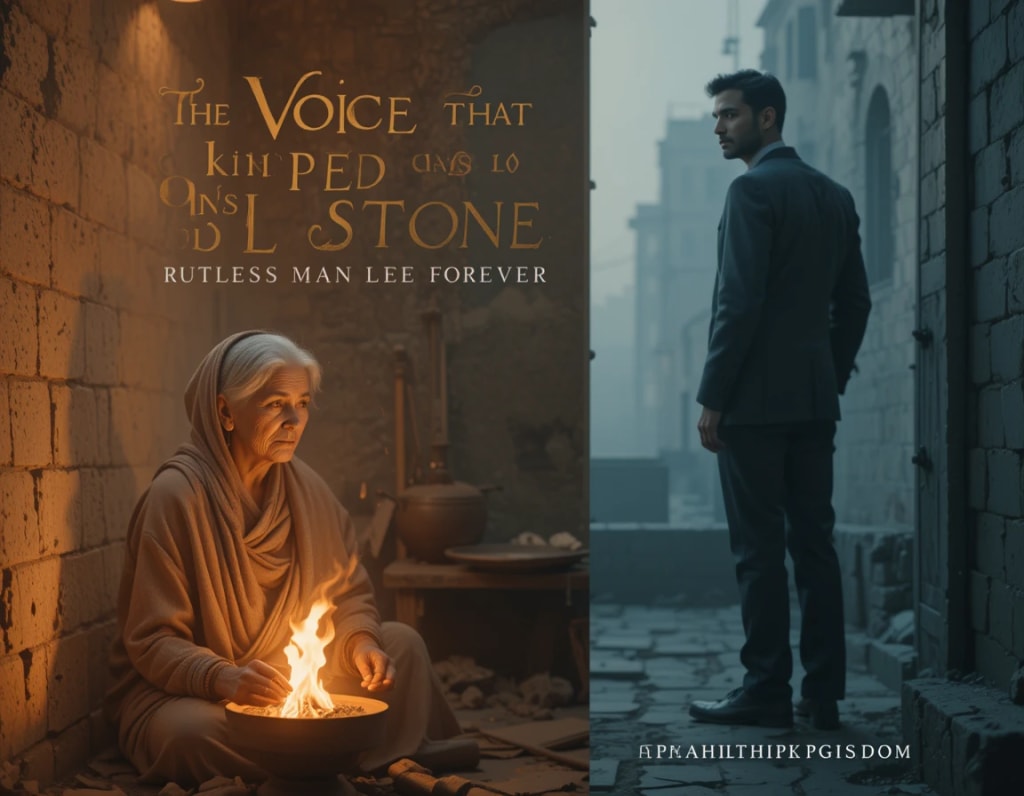
There was a time when I was not a man of compassion. My heart, though beating, was colder than the iron gates that guarded the house I called home. I was feared more than I was respected. In the city of Qazim, they whispered my name—Arman—with unease. Not because I ruled with wisdom, but because I never hesitated to raise my voice or hand to get my way.
I had earned wealth in dishonest ways and power through manipulation. To me, people were tools, not companions. The poor? Just obstacles on the road. The needy? Unseen shadows.
But life, I have come to learn, has a strange way of humbling even the proudest.
It was a chilly afternoon in December. I was walking through one of the older alleys in the southern quarter of the city—a place I normally avoided. The buildings leaned like tired old men, and the streets smelled of smoke and dust. I was there to inspect a plot I wanted to purchase and turn into yet another luxury apartment building.
As I passed a broken brick wall, I heard a soft voice—fragile, like the rustle of dry leaves. I turned and saw an elderly woman sitting beside a small clay stove, her hands trembling as she blew on the dying embers.
She looked up at me. Her face was lined not just by age but by pain, sorrow, and a lifetime of quiet endurance. She was covered in a shawl that barely protected her from the wind. Her stall had only a few sweet potatoes, and she sat there with a patience I could not understand.
“Son,” she said gently, “would you like to warm your hands? It’s cold.”
I stared at her. No one had called me “son” in decades. Not since my mother passed away.
I scoffed. “Why would I warm my hands at the fire of someone who cannot even afford a proper coat?”
Her smile didn’t waver. “Because warmth is not in the fire, but in the intention.”
Her words struck me like a silent thunderclap.
For a moment, I stood there, confused, embarrassed even. I didn’t know what to say. There was no fear in her eyes—just a simple, unshakable kindness. She wasn’t begging, wasn’t selling, wasn’t hoping to gain anything.
I hesitated, then sat on the small wooden crate across from her. She added a piece of coal to the fire. The flames flickered brighter.
“I’ve seen you before,” she said, as if speaking to the wind. “Your face carries the weight of many decisions. But your eyes—they are tired.”
I didn’t reply.
She continued, “There’s a saying from long ago. A man who loses his soul often forgets it until a mirror shows him not his face, but his emptiness.”
I don’t know why I stayed. Maybe it was her voice, or maybe something inside me longed for someone to see past the walls I’d built. I asked her name.
“Zahira,” she said. “It means ‘bright,’ though I’ve lived most of my life in shadows.”
That night, I couldn’t sleep. Her words, her voice, her eyes—they followed me. They were not haunting, but awakening. For the first time in years, I felt a crack in the armor I had worn for so long.
Over the next few weeks, I began visiting that alley more frequently. At first, it was curiosity. Then, it became something else.
Zahira never asked me about my past, never questioned my presence. She only shared stories—of her late husband who died in the textile riots, of her son who left and never returned, of a time when the alley was filled with laughter and children playing in the streets.
Each visit, I brought her something small—a blanket, a few more potatoes, warm tea. And each time, she offered me her fire, her stories, and something I had never known I craved: peace.
One day, I asked her, “How do you still smile after all you’ve lost?”
She looked at me, her eyes clear. “Because I never let the world decide the weight of my heart. Pain is loud, but peace is louder if you choose to listen.”
I was silent.
That day, I went home and looked in the mirror. For the first time, I didn’t see a powerful man. I saw a man haunted by his own emptiness, by the bridges he had burned, the people he had stepped on, the humanity he had lost.
That winter, I changed.
I sold my shares in the companies that exploited the poor. I opened a shelter in Zahira’s alley, hiring women and men to cook, teach, and care for the children of the neighborhood. I paid the debts of the vendors, restored the broken buildings, and rebuilt the playground Zahira once described from her youth.
But Zahira never saw the full change.
She passed away in her sleep, wrapped in the warm shawl I gave her, just a week after I opened the community kitchen. The last thing she said to me, a day before she left this world, was, “It only takes one voice, Arman, to awaken a sleeping soul. Now you must become that voice for others.”
And I did.
I wrote her story in newspapers. I gave lectures—not as a man of wealth, but as a man humbled by kindness. I started a foundation in her name: “Zahira’s Light,” which still works to empower the forgotten souls of the city.
It has been ten years since I met her. I walk the streets now with a different kind of power—not one drawn from fear, but from love. Her words echo in everything I do.
It is strange, isn’t it?
One soft voice.
One kind gesture.
One old woman.
She changed the course of my entire life.
About the Creator
Keep reading
More stories from Taslim Ullah and writers in Humans and other communities.
Between the Doctor and the Patient
The hospital corridor smelled of antiseptic and quiet fear. Dr. Ayaan Malik stood outside Room 307, holding a file that felt heavier than paper should. It wasn’t the diagnosis that burdened him—he had delivered difficult news many times before—it was the name written on the first page.
By Taslim Ullah2 months ago in Humans
Courage of the Heart
Calvin’s grandmother had always called his ability to see the future a “gift from the heart,” something passed down through her family. To Calvin, it felt more like a burden. People either feared him or relied on him too much. He couldn’t enjoy simple friendships without someone eventually asking about their destiny.
By imtiazalam3 days ago in Humans
Review of 'Man on the Run'
My wife and I saw Man on the Run, a nearly 2-hour documentary on Amazon Prime, about Wings, Paul McCartney's group that flew around the world from shortly after The Beatles broke up in early 1970 to shortly after John Lennon was murdered at the end of 1980, making a Beatles reunion forever impossible.
By Paul Levinson6 days ago in Beat


Comments
There are no comments for this story
Be the first to respond and start the conversation.