
The Vanishing Art of Ordinary Kindness: Why We Stopped Seeing the Strangers Beside Us
In a World of Performative Compassion, We've Forgotten How to Simply Be Good to One Another
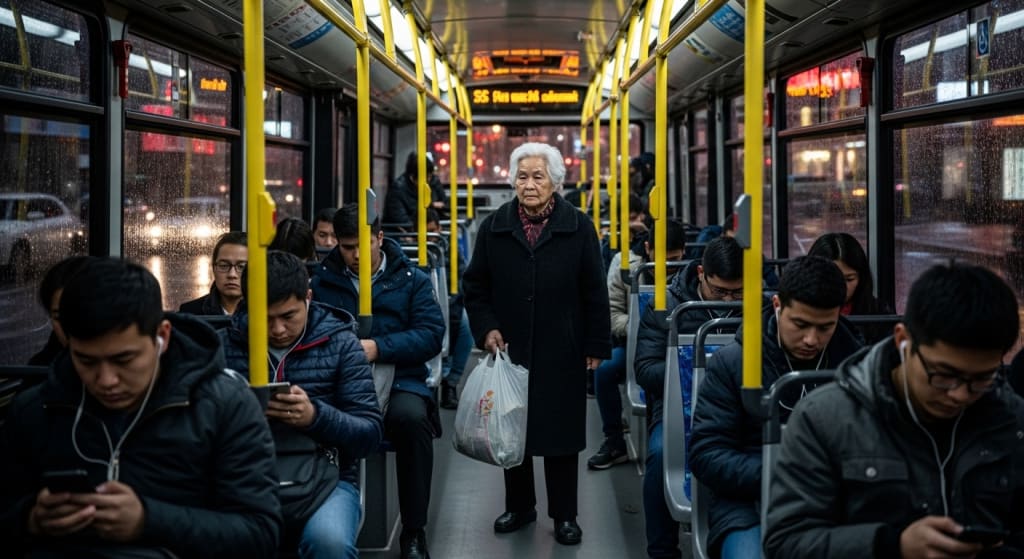
There was a time when kindness was ordinary. Not the grand, performative kind that seeks recognition, not the calculated kind that expects return, but the small, unremarkable kindness that simply assumed we belong to one another. It was the stranger who stopped to help with directions. The neighbor who brought soup when someone was sick. The person on the bus who gave up their seat without being asked. These moments were the invisible threads that wove a community into something stronger than a collection of individuals occupying the same geography.
Those threads are fraying. In their place, we have constructed a world of remarkable efficiency and stunning isolation—a world where we can conduct entire transactions without speaking, navigate entire cities without meeting a single eye, experience entire days without any genuine human encounter. We have not become monsters. We have simply become absent, moving through crowded spaces as though the people around us were furniture rather than fellow travelers on a difficult journey.
The irony is that we have never been more aware of distant suffering. We donate to causes, share petitions, signal our virtue on social media. We care passionately about injustice on other continents while remaining curiously indifferent to the person struggling with groceries in front of us. Our compassion has gone global while our kindness has gone local—and in that inversion, something essential has been lost. The ability to see the person immediately before us, to recognize their humanity, to offer the small assistance that costs us nothing but means everything—this is a muscle that atrophies when not exercised.
Consider the ordinary spaces of modern life. The supermarket checkout, where we stare at our phones rather than acknowledge the cashier who will scan hundreds of items today and be seen by almost no one. The elevator, where we fix our eyes on the changing numbers rather than risk the momentary connection of a shared smile. The coffee shop, where we bark our orders into the void and receive our cups without gratitude. These are not neutral absences. Each one is a small failure of recognition, a tiny death of community, a message sent and received that the people around us are not quite real.
The cost of this erosion is carried most heavily by those who were already invisible. The elderly, who move more slowly and need more help, find none offered. The poor, whose struggles are hidden behind the polite facade of public spaces, navigate a world that has trained itself not to see them. The lonely, who populate every city in vast numbers, move through crowds that have forgotten how to acknowledge a fellow human being. We have built a world that functions efficiently for the privileged and functions not at all for those who most need the ordinary kindness of strangers.
And yet, the capacity for such kindness has not vanished. It surfaces in moments of crisis—when disaster strikes, when a community is threatened, when the usual barriers fall away and we remember, suddenly and urgently, that we need one another. The same neighbors who never spoke will show up with shovels after a blizzard. The same commuters who avoided eye contact will form human chains to rescue strangers from floodwaters. The kindness is still there, buried beneath layers of habit and fear and the constant static of digital distraction. It waits for permission to emerge.
The question is why we require catastrophe to access it. Why must the ground shake or the waters rise before we remember that the person next to us is not an obstacle but a companion? What would it take to restore ordinary kindness to its rightful place in the fabric of daily life—not as exception but as expectation, not as heroism but as habit?
The answer may be simpler than we imagine. It begins with looking up. It begins with putting away the device that promises connection and delivers distraction, long enough to actually see the person in front of us. It begins with the small, courageous act of meeting a stranger's eyes and offering a smile that expects nothing in return. It begins with holding the door, offering the seat, giving directions, carrying a bag—not because these acts will be remembered or rewarded, but because they affirm something essential about what it means to be human together.
There is a woman I pass sometimes on my morning walk. She is old and slow and carries her groceries in a cloth bag that looks heavy. For weeks, I nodded and kept walking. Then one day, for no reason I can name, I stopped and asked if she needed help. She looked at me for a long moment, as though weighing whether I could be trusted, and then she nodded. We walked together for three blocks, she leaning on my arm, and she told me about her husband who died last year and her daughter who lives too far away and the cat who is the only reason she gets out of bed in the morning. At her door, she squeezed my hand and said, "You don't know what this meant." But I did. I knew exactly.
That moment changed something in me. Not because I was good or kind or virtuous, but because I had been reminded of something I already knew: that we are surrounded by people carrying invisible weights, that loneliness is the great hidden epidemic of our time, that the smallest gesture can be a lifeline to someone drowning in plain sight. I had forgotten, and then I remembered. The remembering is what matters.
The restoration of ordinary kindness does not require policy changes or funding or institutional reform. It requires only that we show up, that we pay attention, that we resist the gravitational pull of our own concerns long enough to notice that we are not alone. It requires that we treat the people we encounter not as extras in our personal drama but as protagonists of their own, with stories we cannot imagine and struggles we cannot see and needs we might, in some small way, be able to meet.
There is a movement waiting to be born, and it is not grandiose. It is the movement of the held door, the offered seat, the asked question, the listened-to answer. It is the movement of people who have decided that efficiency is not the highest value, that convenience is not the only goal, that the human beings around them are not obstacles to be navigated but gifts to be received. It is the movement of those who have looked up from their screens and discovered, to their surprise and relief, that they are not alone.
The world will not be saved by grand gestures. It will be saved, if it is saved at all, by the accumulation of small ones—by millions of ordinary people, in millions of ordinary moments, choosing to see one another. The cashier will be thanked. The confused tourist will be helped. The elderly woman with heavy bags will find an arm to lean on. And in those moments, something will be restored that no policy can mandate and no technology can replace: the quiet, durable knowledge that we belong to one another, that we are not separate, that the stranger beside us is, in ways we cannot fully understand, ourselves.
The invitation is simple and always present. Look up. See. Offer. Receive. The kindness you give will return to you not from the person you helped but from the person you become in the helping. And one day, when you are the one carrying heavy bags through a crowded world, someone will stop. Someone will see you. Someone will remember that this is what people do for one another, have always done, will always do, as long as we keep the memory alive in the only place it can survive: in the small, brave, ordinary choices of our daily lives.
About the Creator
HAADI
Dark Side Of Our Society
Think for Me
"How do you calculate the circumference of a circle? Submit your answer when ready." [Pause] "Excellent! Every student was able to call up the answer electronically very quickly. If I, as a robot had feelings, I would express pride. You may break for lunch. Return to this cyber room in 45 minutes."
By Julie Lacksonen7 days ago in Humans
Problem Solving Strategies For Local Singles Experiencing Heartbreak
The initial process towards healing a heartbreak is to accept feelings. Strong emotions such as sadness, anger, or disappointment should be suppressed; otherwise, recovery may take a long time and result in unhealthy coping mechanisms. Singles in the area ought to grant themselves the ability to grieve and understand that heartbreak is a natural and temporary dating process. Embracing emotions forms the basis of solving problems logically and self-development.
By Tiana Alexandra7 days ago in Humans
Valentine's Dates Over the Years
Colin grinned as Brooklyn slipped into the living room. “Is it all set?” he asked. The twenty-one year old grinned. She was in her last year of college and Colin knew that Lincoln was proud of her. Although she had been away at college, she’d eagerly helped Colin plan his surprise for Lincoln. “I’m so glad you’re finally doing this,” she said.
By Reb Kreyling8 days ago in Chapters


Comments
There are no comments for this story
Be the first to respond and start the conversation.