
The Trials of Thomas Edison
A Journey Through Darkness and Determination
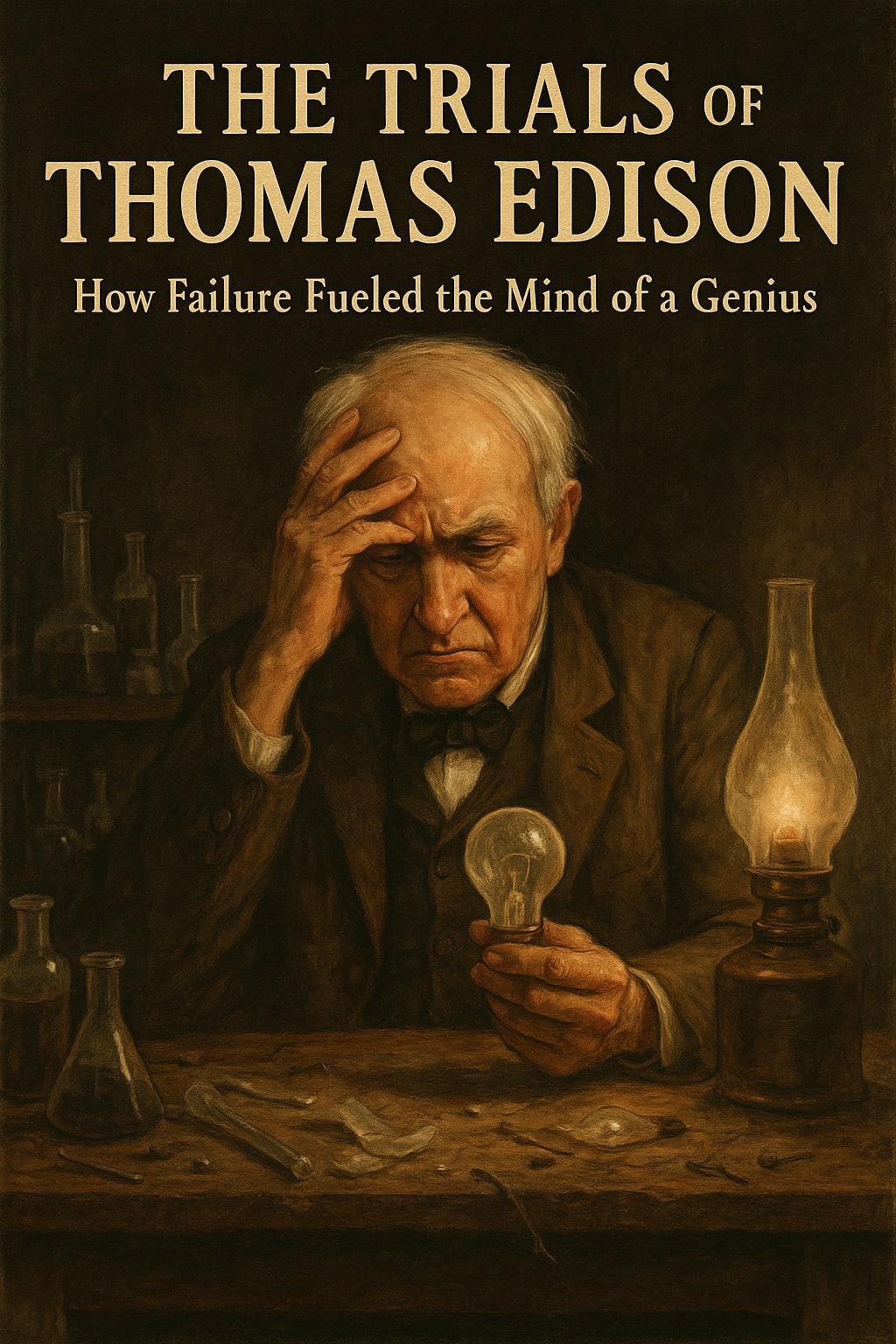
The faint flicker of an oil lamp cast long, dancing shadows across the cluttered workshop. Glass beakers glinted beside scorched filaments and worn notebooks. In the dim light sat Thomas Edison—eyes tired, fingers stained, mind relentless. He held a bulb in one hand, staring into its cold emptiness like a man looking for answers in a void.
It had been his thousandth attempt. Or maybe more—he’d stopped counting. Outside, the world called him a genius. Inside this room, he felt like a prisoner of his own ambition.
Edison had never claimed to be naturally brilliant. His teachers had dismissed him early in life, calling him “addled.” But what he lacked in formal education, he made up for with an unquenchable curiosity and a refusal to accept failure as final. Every defeat, every explosion, every failed experiment was a lesson. “I have not failed,” he once told a reporter. “I've just found 10,000 ways that won't work.”
But that night, the weight of failure pressed heavier than usual.
It was the late 1870s. Gas lamps lit the streets, casting eerie glows that barely pierced the darkness. Fires claimed lives every year from overturned lanterns. Edison believed in a better way—a safer, steadier light source powered by electricity. But the path to that vision was littered with broken glass, burned fingers, and sleepless nights.
His team at Menlo Park—dubbed “The Invention Factory”—worked tirelessly, their efforts orbiting Edison’s single-minded drive. Yet with each new prototype, the filaments either burned too fast or failed to glow at all. Bamboo, platinum, carbonized paper—nothing endured. Investors grew impatient. The press mocked him. Rivals like Nikola Tesla and George Westinghouse surged ahead with their alternating current systems, while Edison clung to his direct current dream, stubborn and unmoving.
One evening, after another failed filament shattered in the bulb, a young assistant dared to ask, “Mr. Edison, do you think it’s even possible?”
Edison looked up from his workbench, eyes bloodshot but burning. “Possible?” he echoed. He rose, walking slowly to the window, the bulb still clutched in his hand. “Everything’s impossible,” he said, “until someone does it.”
There was silence. Then, as if sparked by his own conviction, he returned to his bench with renewed focus. It wasn’t just about light anymore. It was about proving that resilience mattered. That persistence, not genius, was the true spark of innovation.
Weeks passed. The air grew colder. Edison became a ghostly figure haunting his lab, his meals often untouched, his conversations reduced to mutters about resistance and filament thickness.
Then came the breakthrough—an unlikely one. An assistant suggested a different type of carbonized material, derived from a specific type of Japanese bamboo. It was long-fibered and durable. They processed it, shaped it, placed it in the bulb.
Edison, hands trembling, screwed the bulb into the socket and flipped the switch.
It glowed.
For seconds.
Then minutes.
Then hours.
Edison didn’t cheer. He simply sat down and watched. The entire lab grew still, as if afraid a breath might extinguish the miracle. After 40 hours, the filament still glowed.
He had done it.
But the trials didn’t end there. The light bulb was only the beginning. Edison now faced the challenge of making it affordable, scalable, and safe. He had to invent the entire infrastructure: sockets, switches, electric meters, power stations. He had to convince cities and companies to trust in electricity, a force many still feared. And all the while, he battled fierce competitors and legal battles over patents.
Yet through it all, Edison never lost the fire that lit his mind. Every setback fueled his desire to push forward.
Years later, as electric light spread across the world, Edison stood quietly beneath a streetlamp in New York. Children played in the warm glow. Shopkeepers stayed open late. The night no longer belonged to the dark.
A journalist approached him and asked, “Mr. Edison, how does it feel to have changed the world?”
Edison paused, then said, “I didn’t change the world. I just refused to stop trying.”
---
Epilogue
Thomas Edison would go on to hold over 1,000 patents. His inventions reshaped not only how people lived, but how they believed in the power of perseverance. “The Trials of Thomas Edison” were many—but it was through those very trials that light emerged from darkness, both literally and symbolically. His story reminds us that true brilliance isn’t born—it’s built, one failure at a time
About the Creator
Keep reading
More stories from Noor Hussain and writers in Humans and other communities.
Moments with a Friend
Moments It was the summer before high school when I met Sam. I remember the day vividly. The sky was the kind of blue you only see in July, and the scent of fresh-cut grass clung to the air. I had moved to the neighborhood just a week prior, and my days had been mostly spent indoors, unpacking boxes and trying to adjust to the newness of everything. But that afternoon, I wandered out to the park near our house, unsure of what I was looking for—maybe just a break from the silence.
By Noor Hussain10 months ago in Humans
Overflowing Moments
Leila sat on the old wooden bench beneath the tree, watching the children play in the park. The sound of their laughter, light and carefree, stirred something deep inside her. She felt the weight of their joy like a soft breeze pushing against her chest. It reminded her of when she was their age—when everything felt as if it could spill over, endless and full of possibility.
By Jhon smithabout 24 hours ago in Humans
The Politics of Playing Dress-Up
Well, to start off I'd like to say a happy world book day to all who celebrate. I know I haven't really posted anything on my socials about it but I'm not a jubilant kind of person. I lay low most of the time. Let's start off with a popular anecdote from the vaults...
By Annie Kapur5 days ago in Geeks




Comments
There are no comments for this story
Be the first to respond and start the conversation.