
The Time Traveler's Tale
Exploring Ancient Civilizations

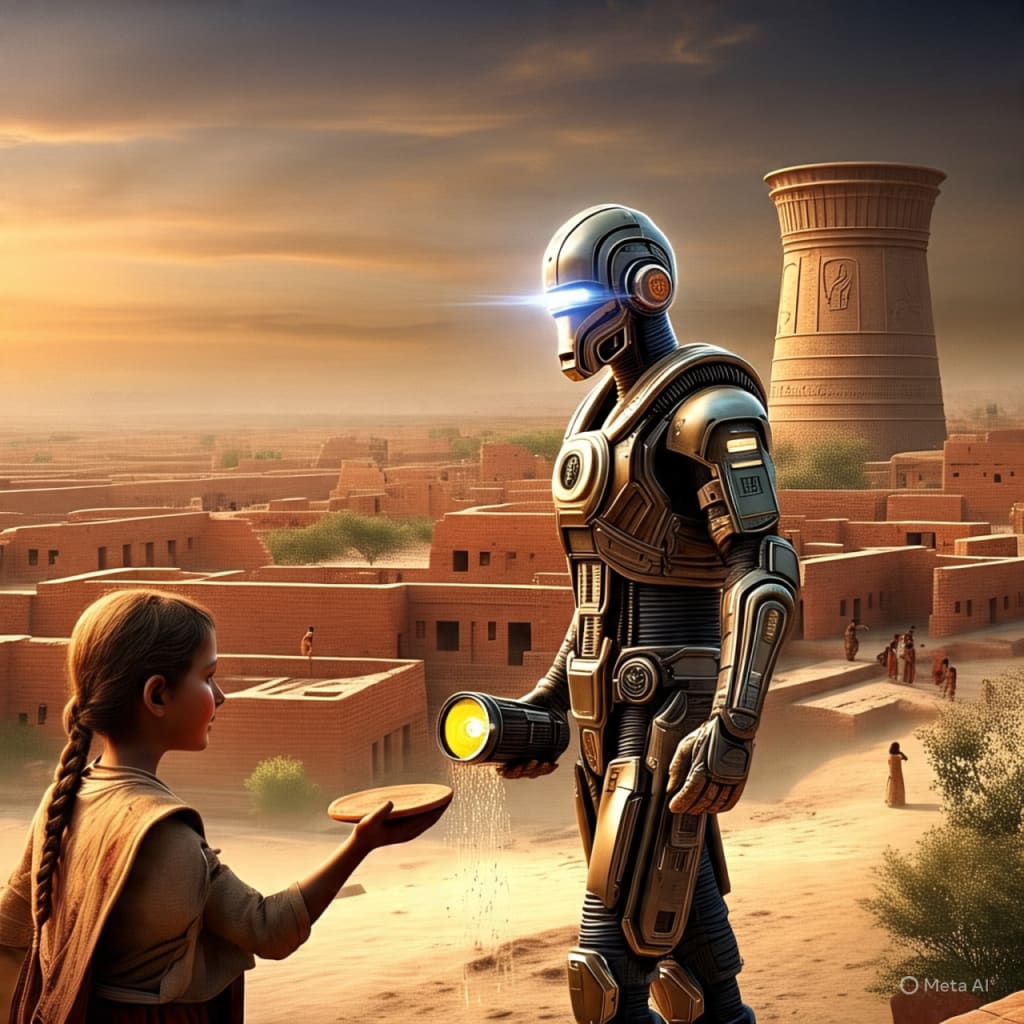
The first time Dr. Amaan Qureshi stepped into the ChronoGate, he thought of his grandfather’s bedtime stories—tales of lost cities, buried empires, and forgotten legends. Amaan was a historian, but not the dusty, chalk-smeared kind. He believed that history didn’t belong in books alone—it deserved to be lived.
The ChronoGate was humanity’s most guarded secret: a time travel device built beneath the sands of Egypt by a coalition of the world's greatest minds. Its mission? One traveler. One mission. One shot. The rules were strict: observe, never interfere.
Amaan chose the Indus Valley Civilization, circa 2000 BCE. Not because it was the most glamorous, but because it was the least understood. Mohenjo-daro and Harappa had been excavated, but the people, their language, their essence—remained silent in stone.
As the gate roared and time unspooled, Amaan braced himself. The whirling lights disappeared. Silence.
Then—life. A dry wind carried the scent of clay, spice, and river water. Before him stood a vast city—planned with precision that rivaled modern engineering. Wide streets. Complex drainage. Brick homes aligned with astronomical symmetry.
A young girl spotted him. Her almond eyes widened, but instead of running, she tilted her head curiously.
"You are not from here," she said in a language that Amaan understood not with his ears, but through the translator chip embedded in his neural cortex.
“I am... a visitor.”
She smiled and took his hand.
She was called Ilaa, daughter of a bead maker. Through her, Amaan learned the rhythm of the city. The people of the Indus lived in remarkable harmony. No weapons, no temples of war—just art, trade, and deep respect for the rivers that sustained them. Women led councils. Farmers shared surplus with potters. Children studied astronomy by starlight.
Every day, Amaan documented everything—etched notes into his embedded device, captured visuals through retinal lens. But the more he lived among them, the more he began to feel their world. These weren’t just data points. These were people.
One night, as Ilaa showed him how constellations were mapped using ceramic discs, the sky shifted suddenly. The ground quaked.
People screamed.
Amaan saw it in the horizon first—a rising wall of water rushing down the river like a beast awakened. A monsoon-fed flood, larger than any modern simulation had predicted.
His instincts screamed: Run. Escape. Go back.
But Ilaa’s small voice cut through his panic. “Help us.”
He paused. He remembered the law: observe, never interfere. But laws made in labs could not account for humanity.
He tore off his translator chip, handed it to Ilaa, and shouted into the sky: “ChronoGate—override protocol. Return sequence delayed!”
The AI protested. “Traveler risk unacceptable. Return now.”
“I won’t abandon them!”
He climbed to the tower of the grain storage, the city’s highest point, and waved his arms. “To the tower! The tower! Bring ropes, climb, help others!”
His strange words meant little, but his urgency ignited action. Ilaa, wearing the translator, shouted in their tongue. Dozens climbed. Then hundreds.
When the flood hit, it swallowed the lower homes. But the tower held. People clung to each other. Some cried. Some prayed.
Amaan stood soaked, holding Ilaa’s hand. When the water finally receded, hundreds were alive who would’ve perished.
The next morning, as the sun rose over a battered city, Ilaa gave him a carved disc. On it was a symbol—two hands holding water.
“Our mark of trust,” she said. “Take it. Remember us.”
A signal blinked in his mind: ChronoGate ready. Return now.
He nodded and vanished, just as she whispered, “Goodbye, sky stranger.”
—
When Amaan emerged back into the present, he collapsed. Months of reports, medical scans, and tribunal hearings followed. He was accused of altering the past. Of violating the Temporal Code.
But then the disc.
The one Ilaa gave him.
Scientists scanned it. And gasped.
The same symbol had just been discovered days earlier—etched into a newly unearthed well in Mohenjo-daro. A symbol not recorded in any historical archives. A symbol shaped like… two hands holding water.
The tribunal was silenced.
Amaan’s recordings rewrote history textbooks. Not just data—but stories of kindness, collaboration, and wonder. His actions had preserved not just lives—but a glimpse into what humanity could become again.
He now lectures across the globe, not just as a historian—but as a traveler between worlds.
Whenever students ask him, “What was the most advanced part of the Indus Civilization?”
He smiles and says, “Their heart.”
About the Creator
Syed Kashif
Storyteller driven by emotion, imagination, and impact. I write thought-provoking fiction and real-life tales that connect deeply—from cultural roots to futuristic visions. Join me in exploring untold stories, one word at a time.
Keep reading
More stories from Syed Kashif and writers in Humans and other communities.
The Robot Rebellion
In the year 2147, cities hummed under the control of machines. Artificial Intelligence had long replaced manual labor, political leadership, and even emotional support systems. Robots maintained the environment, taught children, and governed laws with what was believed to be “perfect logic.” Mankind, after centuries of errors, wars, and climate crises, had entrusted their fate to their own creation.
By Syed Kashif 10 months ago in Humans


Comments
There are no comments for this story
Be the first to respond and start the conversation.