
The Tale of Chanda Uncle from Atar
A Journey of Wisdom, Mystery, and Desert Secrets

In the golden dunes of the vast Sahara, nestled in the remote corners of Mauritania, lies the ancient town of Atar. It is a place of shifting sands, star-filled skies, and stories passed down through generations. Among the many tales whispered by elders around evening fires, none is as curious or beloved as the tale of Chanda Uncle from Atar.
Chanda Uncle, as he was affectionately called, was not originally from the desert. He had arrived in Atar over three decades ago, on the back of a rusted, rickety bus that coughed smoke and dreams. No one knew exactly where he came from — some said he was a teacher from the East, others believed he had once been a trader who lost everything in a sandstorm. But all agreed on one thing: Chanda Uncle was a man of deep wisdom and peculiar ways.
He lived in a modest clay house at the edge of town, where the desert began its eternal stretch. Children loved to visit him because he always had stories — strange stories of talking camels, invisible oases, and books that whispered secrets only at midnight. But Chanda Uncle was more than just a storyteller. He was a listener, a guide, and for many, a keeper of the desert’s forgotten truths.
One particularly hot summer, something changed. Rumors began to spread that a hidden treasure had been uncovered by nomads near the ancient caravan route. Strange symbols etched into rock formations had been found, and whispers of a “lost library beneath the sands” spread through Atar like wildfire. The townsfolk were skeptical, but Chanda Uncle’s eyes sparkled with recognition.
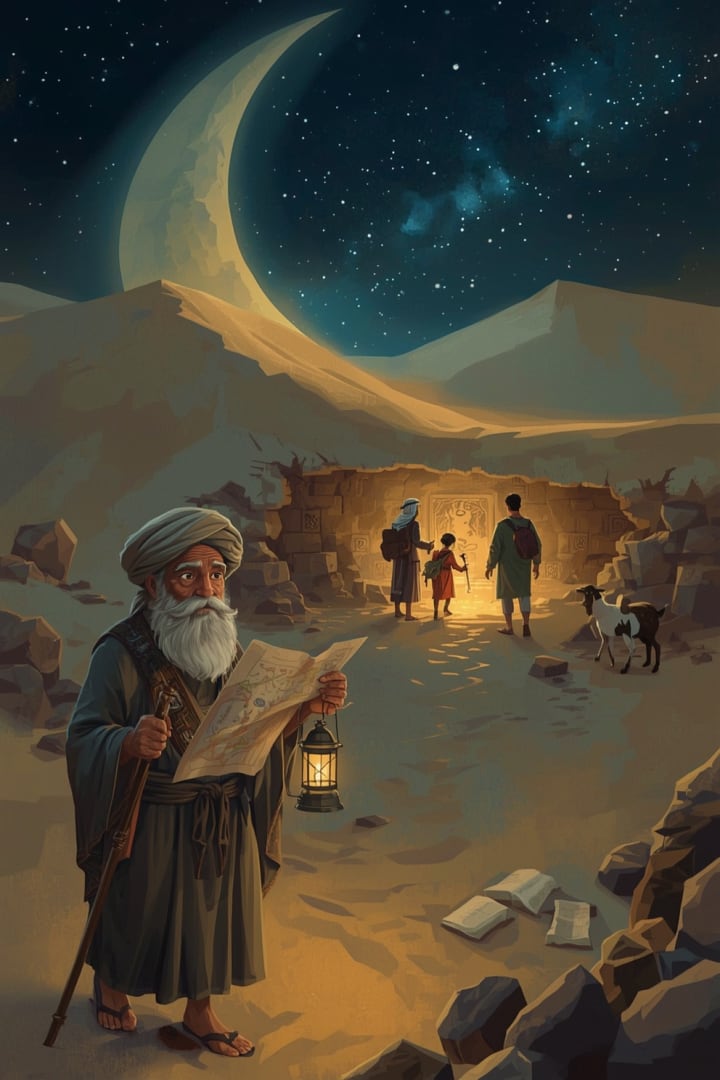
That evening, under the cool veil of dusk, he gathered a small group — Salim the goat herder, Mariam the schoolgirl, Younes the tea merchant, and little Tariq, who was barely ten but endlessly curious. With nothing more than a walking stick, a worn leather satchel, and a cryptic map drawn in charcoal, Chanda Uncle set out into the desert with his chosen companions.
Days passed as they navigated the harsh Sahara. The sun beat down mercilessly, and the wind carried grains of sand that stung like needles. But Chanda Uncle moved with purpose, following signs only he seemed to understand — a twist of rock here, a bend in a dry riverbed there. He taught them how to find water in the roots of desert shrubs, how to navigate using stars, and most of all, how to listen to the silence.
One night, as they camped near a crescent-shaped dune, Mariam spotted something gleaming under the moonlight. It was a stone tablet, half-buried in the sand, inscribed with ancient writing. Chanda Uncle knelt beside it, whispering in a language none of them recognized. He gently tapped the tablet, and to their astonishment, the sand beneath them shifted. The ground trembled lightly, revealing the entrance to a subterranean chamber.
They descended into what seemed like an ancient archive, its walls lined with scrolls, artifacts, and manuscripts sealed in clay jars. It was the fabled Library of Zarqaa — a place that had only existed in myths. Chanda Uncle moved through the chamber as if he had been there before, guiding the others carefully. "This," he said softly, "is knowledge buried by fear, lost through time. Not treasure of gold, but of truth."
Each artifact told a story — maps of lost cities, journals of long-forgotten explorers, books on desert medicine and astronomy. There were scrolls that spoke of the stars as guides, and legends of a people who lived in harmony with the desert’s secrets.
After days of study and documentation, they sealed the entrance again, marking it only with the crescent dune and a hidden symbol. Chanda Uncle explained that the world wasn’t ready for everything inside — not yet. “Wisdom,” he said, “must be revealed when minds are prepared to receive it.”
They returned to Atar quietly. The townsfolk saw the glow in their eyes but asked no questions. The group never spoke publicly of what they had seen, but each of them carried it differently. Mariam grew up to be a historian, preserving the culture of the Sahara. Salim started teaching desert survival to travelers. Younes wrote poetry in secret, inspired by the lost scrolls. And young Tariq? He became a seeker of mysteries, wandering the world with the same curiosity that once led him into the desert with Chanda Uncle.
As for Chanda Uncle, he continued living in his clay house, telling stories, sipping tea, and smiling knowingly when children asked him about hidden treasures. He never confirmed nor denied the legends, but every time he glanced toward the horizon, one could feel he was remembering a time when the sands whispered secrets and the stars guided souls to truth.
And so, in the heart of the Sahara, the tale of Chanda Uncle from Atar lives on — a journey of wisdom, mystery, and desert secrets that only the worthy may ever truly understand.
About the Creator
wilson wong
Come near, sit a spell, and listen to tales of old as I sit and rock by my fire. I'll serve you some cocoa and cookies as I tell you of the time long gone by when your Greats-greats once lived.
Keep reading
More stories from wilson wong and writers in Humans and other communities.
I Water Plants Like I Love People
There are four pots on my balcony. One is a basil plant, green and honest. It leans out toward the morning light as if begging for just a little more time, a little more warmth. I water it every day. Religiously. Sometimes twice. I stroke its small leaves and whisper apologies when I forget.
By wilson wong9 months ago in Writers
Himalayan Salt Tiles: Arthritis Relief for Senior Citizens
The Centers for Disease Control claim that 58 million Americans are afflicted by arthritis. When it comes to older adults, that number increases, making it one of the most common reasons for disability for people 65 and over. As demand increases for natural, alternative options to wellness, many caregivers, spa owners, and senior living planners are implementing natural, non-invasive Himalayan salt tiles into a natural wellness environment.
By david smithabout 7 hours ago in Humans


Comments
There are no comments for this story
Be the first to respond and start the conversation.