

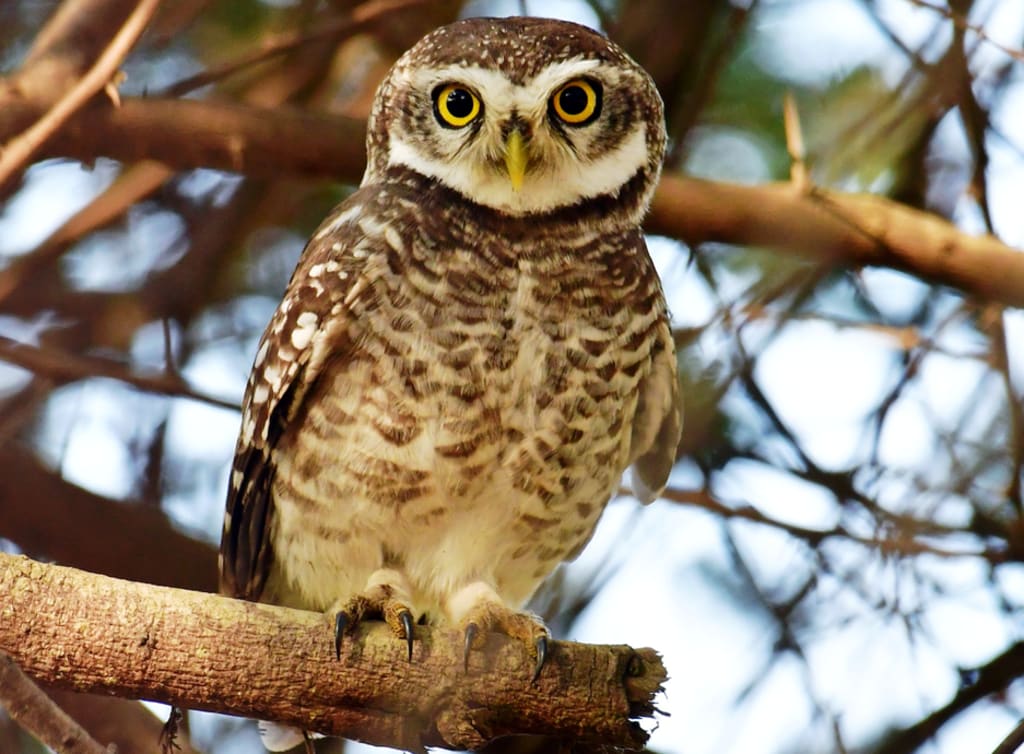
The spotted owlet is one of the smallest owl species found in Asia. Despite its small size, this little owl plays an important role as a nocturnal hunter. Measuring just 15 centimeters from head to tail with brown and white speckled plumage, the spotted owlet has adapted well to survive in both forest and urban habitats.
Territory and Nesting: Spotted owlet pairs defend a territory of around 5-10 acres. They will nest in tree cavities, holes in walls or cliffs, dense foliage, or even man-made structures. The female lays 2-4 white eggs.
Parental Care: Both parents take turns incubating the eggs for 21-24 days. The altricial chicks are fed regurgitated food by the parents. The chicks fledge (leave the nest) at 4-5 weeks old but continue to be fed by parents for several more weeks as they learn to hunt on their own.
Hunting and Diet: Spotted owlets are nocturnal hunters, using their acute vision and hearing to locate prey like insects, spiders, frogs, lizards, rodents and small birds. They have been known to catch prey up to the size of a mouse. Hunting typically occurs from dusk to dawn.
Threats: Predators of spotted owlets include snakes, larger birds of prey and mammals. They also face threats from habitat loss and competition for nest sites with other species.
Lifespan: In the wild, spotted owlets have an average lifespan of 2-3 years. However, they can live up to 10 years in captivity with adequate food, shelter and protection from predators.
Nesting begins in late winter or early spring when pairs come together to find a suitable location. Spotted owlets prefer natural cavities in trees or holes in buildings, cliffs, and walls providing an enclosed, sheltered space. The pair works diligently, carrying nesting materials like grass, leaves, and feathers in their beaks to construct a soft, lined nest.
Adaptability: Despite the harsh desert conditions, they have adapted well to living close to villages where they find shelter, water and a reliable food source in rodent populations.
Once complete, the female will lay a clutch of 2-4 pure white eggs. She remainsin the nest incubating them for around 3 weeks while the male hunts to bring her food. The hatchlings are completely dependent, lacking feathers or the ability to regulate their own body temperatures. Both parents take turns brooding the young and feeding them regurgitated food until they are old enough to thermoregulate.
By hunting mainly at night, the spotted owlet avoids competition with other diurnal raptors and predators. Its acute hearing and night vision allow it to pinpoint the sounds and movements of prey with excellent accuracy. A successful hunt often involves stealthy stalking as it flies silently on soft wings before swooping in for the capture.
While primarily nocturnal, spotted owlets may also hunt at dawn and dusk. During the day, they roost well-camouflaged to avoid detection. This small owl faces few natural predators thanks to its cryptic coloration and ability to squeeze into tight spots for cover. Occasionally, larger birds of prey, snakes.
Across its range from India to Southeast Asia, the spotted owlet readily adapts to both forest and human-modified landscapes. Wooded areas, parks, and gardens with trees provide natural nesting sites and foraging grounds. However, it also easily nests in buildings, temples, and walls of villages and cities. This allows the species to benefit from urbanization and thrive in proximity to people.
Playing a role in controlling pest insects and rodent populations, the spotted owlet provides ecological services where it lives.
About the Creator
Keep reading
More stories from Ramoon Mal and writers in Humans and other communities.
Crocs launching a new cowboy boot-style
Famous for their lightweight and colorful clog shoes, Crocs is venturing into new territory with the launch of their first-ever cowboy boot. The foam clog maker unveiled the 'Classic Western Boot' this week, putting their unique spin on the classic American style.
By Ramoon Mal2 years ago in Humans
A Historic Declaration
We the People of the Husbands of the United States of America, in Order to form a more perfect Union, and I mean you...with me...establish Justice, insure domestic Tranquility, provide for the common defence, promote the general Welfare, and secure the Blessings of Liberty to ourselves, after Puberty, do ordain and establish this Declaration of Co-Dependence.
By Gerard DiLeo7 days ago in Humans
Flower Bloom 369
FLOWER Bloom 2/25/26 Wednesday By Mariann Carroll Karen had been with Tony for 7 years. Tony started acting strangely after her surgery. He would mow the lawn in the rain and be on his cellphone. He started pushing Karen away. Tony came clean about seeing someone. Karen moved out two months later. Karen moved in with a friend. She felt betrayed.
By Mariann Carroll7 days ago in Fiction




Comments
There are no comments for this story
Be the first to respond and start the conversation.