
“The Sky Over Gaza Never Sleeps”
Stories of Survival, Silence, and the Sound of Hope in a Wounded Land
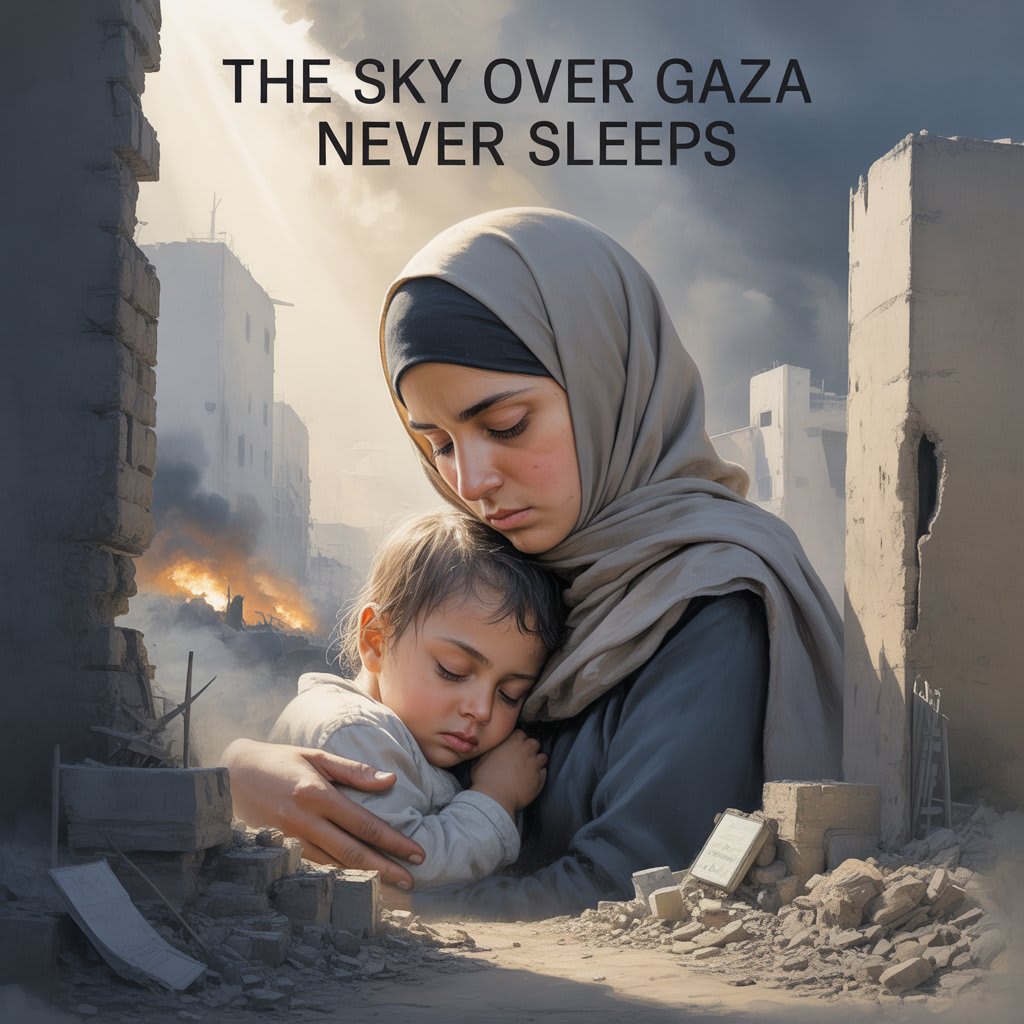
The sky over Gaza never sleeps. It hums. It watches. It remembers.
Twelve-year-old Sami knows this well. Every night, he lies awake on the thin mattress next to his little sister Noor, listening. Not for lullabies or stories, but for the distant, rising thunder of engines overhead. Sometimes drones, sometimes worse. Their hum is quieter than a whisper, but Sami always hears it—because it means he must be ready.
He wraps one arm around Noor and whispers stories to her. Not fairy tales. Real ones. Like the time their father carried both of them through the smoke to find water after the bombing in spring. Or how their mother, even with the ceiling half-gone, still made bread on a fire of broken furniture. Noor listens with wide eyes, and only when he starts to describe stars above the ruins does she finally fall asleep.
Sami doesn’t sleep. He watches the sky.
The family used to have a roof, once. A real roof with metal sheets and solar panels, and a garden where their mother grew mint and basil in colorful pots. Now, it’s mostly sky. The air smells of ash and salt. The sea is nearby, but they haven’t seen it in months. Too dangerous.
At school, which now operates only twice a week in a basement, Sami writes a poem for his assignment. The teacher—a tired man with kind eyes and a missing finger—reads it slowly, then places a trembling hand on Sami’s shoulder.
“The sky is heavy,
But we are heavier with memory.
Even the stars blink with fear.
But still, we stay.”
The poem is pinned to the wall, above a cracked chalkboard, beneath a ceiling water-stained and broken.
One evening, there’s a rare silence. No buzzing above. No sirens. Just the wind playing with plastic bags tangled in barbed wire. Sami sits on a broken wall outside their shelter, holding a small notebook where he collects stories and fragments of hope. He draws Noor’s face and adds wings. “So you can fly to school, even if the roads are closed,” he tells her. She giggles and hugs him, sticky fingers smudging the page.
Their mother calls them in as the sun dips behind smoke-stained buildings. Tonight, there's food: rice, tomato paste, and a slice of canned meat. A feast, by recent standards. They eat slowly, saving bits for later, knowing tomorrow may not offer more.
When the night deepens, the sky begins again—buzzing low, constant, like an angry breath. Noor clutches Sami tighter.
“Will they come tonight?” she asks.
“I don’t know,” he answers, truthfully.
“What if they do?”
“Then we wait for morning, like always.”
Their father left two months ago to find medicine in the south. No word since. Their mother says he’s safe, but Sami sees the way her eyes never stop searching the door.
Sometimes, when he can’t sleep, Sami writes letters to no one. Letters to the sky, maybe. He folds them and tucks them into cracks in the wall, hoping the wind carries them somewhere beyond the blockade, beyond the headlines. Beyond the forgetting.
Dear World,
We are still here.
We have names, dreams, and birthdays.
We still draw, still laugh, still cry when someone is gone.
We are not rubble.
We are not just numbers.
Love, Sami.
In the morning, he walks through the neighborhood—if it can still be called that. Piles of broken concrete, steel rods twisted like vines, laundry lines stretched between ghosts of homes. Still, someone has painted a mural on a wall: a dove, wings open, eyes closed, as if dreaming.
Sami touches the paint. It's still fresh.
Later, back at the shelter, the sky grows strange again. Too quiet. A kind of quiet that makes even the air feel afraid. His mother ushers them inside. The candle is lit. Noor starts to cry. And for a moment, even Sami forgets how to be brave.
Then a sound, like the sky breaking.
Then silence.
Then dust.
When he wakes, there’s blood on his arm. His mother is digging through debris with her bare hands. Noor is missing. Screams echo from somewhere close. The building is gone. The mural is gone. The dove is gone.
But the sky is still there. Watching. Humming.
Three days later, they find Noor. Alive. Bruised, quiet, changed.
Sami no longer writes poems.
He writes names.
Of friends. Of places. Of people who were.
Yet somehow, the next night, he finds his notebook under a pile of ash. He flips to the last clean page.
And writes:
“Even under this sky,
We still wake.
We still speak.
We still hope.
And we still live.”
The sky over Gaza never sleeps.
But neither do its stories.
About the Creator
Keep reading
More stories from Muhammad Aizaz and writers in Humans and other communities.
“Rising Through the Ashes”
Leena sat on the cracked bench outside the small café, the weight of the past few months pressing down on her like an invisible storm. Her job at the marketing firm had been her world — her identity, even. But when the company downsized, she was the first to go. No warning, no second chance. Just a sudden, harsh goodbye.
By Muhammad Aizaz8 months ago in Motivation
Deep Love Quotes That Will Melt Your Heart
Love is the most profound emotion, capable of transforming hearts and souls. It is the language of the soul, whispered in glances, spoken through touch, and felt deeply in every beat of the heart. Here are some deep love quotes that capture the essence of this timeless emotion, each one crafted to resonate with your heart and stir your soul.
By Ahmed aldeabellaabout 8 hours ago in Humans


Comments
There are no comments for this story
Be the first to respond and start the conversation.