
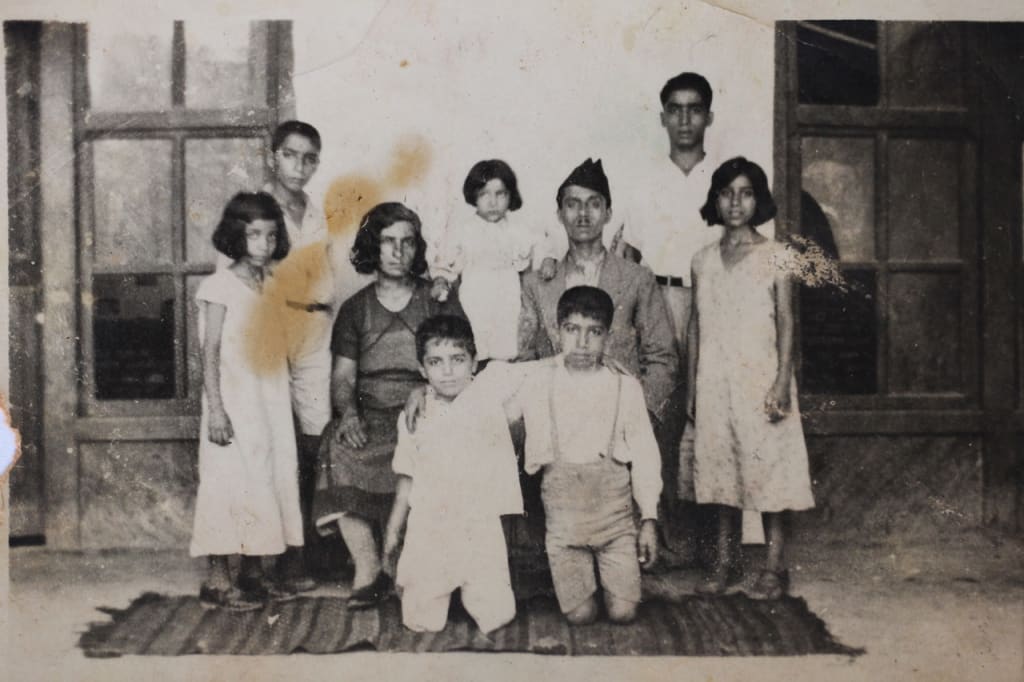
The blazing sun of Baghdad set once again and when it rose the next morning, the cries of a new baby boy echoed throughout the city. Aharon Matityahu, son of Meir and Tefaha, was born blessed by the very nature of his name. Aharon, brother and confidant of Moses who led the Jewish people to freedom. Matityahu, a Maccabi warrior who saved the faith all those years ago. He came into this world strong before he even knew what he had to be strong for.
Aharon spent the first ten years of his life within a small Jewish community and attended a Jewish school. His father, Meir, owned a small fabric store while his mother, Tefaha, was in charge of taking care of the eight children. As the third to last-child, Aharon wanted to stand out and make something of himself. He always thought his siblings were too cautious, always doing what they are told and never wanting to think outside of the box.
“Aharon, what are you doing?” Yaacov, his oldest brother asked.
“I’m just gathering supplies…” Aharon trailed off, his eyes focused on the ground in the backyard.
“Supplies for what?”
“I’m building a boat,” Aharon stated matter-of-factly.
“A boat!” Yaacov chuckled, “what, are you planning on sailing down the Hidekel river with some wood and scrap metal? You wouldn’t even travel more than a few meters before drowning.”
“Of course not, they say it’s supposed to rain soon and I’m going to build my own river!”
“Little brother, you sure know how to make me laugh,” Yaacov chortled. “I’ll give you 25 dinars if it rains, and 100 if you build a river and a boat.”
“Fine. I agree to that bet, but you are going to lose.” Aharon was confident in his plan and knew exactly how to build his river. What Aharon did not tell Yaacov, was that the “river” was going to be a small trench he dug and the boat even smaller. He scooped out handfuls of sand into a three-meter strip sloped down toward the house. He carefully placed rocks to cover the exposed sand to keep the water from sinking once it rained. He took a step back and marveled at his creation. ‘I should be an architect,’ he thought to himself.
The next step was building the boat. He searched the yard for anything that somewhat resembled the bottom of a boat but came up empty. He ran into the house,
“Aharon! No running in the house!” Tefaha yelled from the kitchen, “go wash your hands, dinner is almost ready, and it is your turn to set the table.”
“But mom! I am building a boat!” Aharon exclaimed.
“A boat!? Wow! I’m sure it will be wonderful,” she smiled, “but it will need to wait until tomorrow, now go wash up! Yala!” Aharon hurried to the bathroom to wash his hands, but on the way, something caught his eye. Yaacov had a plastic container where he kept his secret sweets. ‘Perfect!” Aharon thought, ‘this is exactly what I needed.’ He took the container and shoved it under his bed.
“Aharon! Yala!” Tefaha was getting impatient, “stop daydreaming, you have chores!”
“Coming!” Aharon quickly ran his hands under the water and sprinted to the kitchen, “I’m here! What would you like me to do?” Tefaha looked down at five-year-old Aharon with a warm grin, she knew he was going to do great things from the first moment she held him.
“Go set the table and call your siblings down, your father will be home any minute and the food will get cold.”
Once his belly was full, Aharon went to his mother and father’s room and asked a question that most five-year-old children would never even think of.
“Why do they hate us?” Aharon looked down at his feet.
“Who?” Meir said with a puzzled look.
“This country. I overheard Itzchak and Adda talking about a paper they found in town. It said Jews were bad and not to be trusted. What did we do?” Aharon looked at his parents, “Am I bad?”
“Oh Aharon, don’t listen to them, your siblings don’t know anything,” Meir replied, “you are not bad, our religion is different than most people in Iraq and they don’t like that.”
“You don’t need to worry bubba,” Tefaha said softly, “you are my perfect boy. Now go to sleep, it is late, and you have school in the morning.” Aharon sighed. His parents didn’t answer his question. He walked to the room where he and his brothers slept and got into bed but could not sleep. He turned to his brother, Itzchak who was in his bed reading a book while his other brothers slept.
“Itzchak, why did you say that people don’t like us?” Aharon couldn’t shake the thought that he had done something wrong.
“Aharon, go to sleep. I will tell you in the morning on the way to school, mother and father can’t hear us talk about it or we will get in trouble. They don’t want us to know what is going on, but I found a paper outside that explains everything. I kept it in a safe place so nobody will find it and I will show you tomorrow, but you need to swear that you won’t tell.”
“I swear! I swear!” Aharon tried to close his eyes but sleep would not come. He was worried something would happen to his family if what his brother said was true. After many hours, Aharon finally drifted off to sleep.
The next morning, Aharon awoke to the smell of freshly baked ‘Khubz’, Arabic for pita bread, and ‘fool’, cooked fava beans and hummus. He quickly got dressed and raced to the kitchen.
“Aharon! No running!” Tefaha called out.
“Is breakfast ready?” Adda said, “I am finished setting the table.”
“In a moment. Aharon, go get your brothers and sisters, but NO running,” Tefaha said sternly. Aharon walked over to the girls’ bedroom but before he could tell them breakfast was ready, Yaacov stopped him.
“Where is my candy?” Yaacov whispered angrily.
“I don’t know what you are talking about,” Aharon replied.
“I know you took it!” Yaacov exclaimed, “tell me where it is before I tell Baba and Nana about you and Itzchak’s little conversation last night. I only pretended to be sleeping.”
“Fine! Tell them then. I did not take your candy.” Aharon wasn’t lying. When he took the box, he had put the box under the bed, but when he woke up the box was still there, but the candy was gone. He didn’t know who had taken it or when. He suspected his brother, Moshe, who he knew couldn’t resist anything sweet.
“Aharon! What are you doing, daydreaming again? You are making everyone late!” Tefaha bellowed from the kitchen. Aharon rushed into his sisters and brothers’ rooms and relayed the delayed message. Aharon and his siblings quickly ate their breakfast and started on their way to school. Aharon ran up to Itzchak and exclaimed,
“Now will you tell me!?”
“Fine,” Iztchak stopped and waited for the rest of the kids to pass in front of them, “I found a pamphlet telling the Iraqis to boycott Jewish businesses. I also heard that a month ago, a group of Jewish students was beaten with sticks by Arab children. You need to be careful Aharon, I don’t want you to get in any kind of trouble.”
“With sticks? Why are they doing this? I heard Baba tell Nana that someone threw a stone through his store window last week, but I just thought it was an accident! Do you think it was on purpose?” Aharon felt a sense of insecurity that he didn’t quite understand.
“Probably, I don’t think you’ll understand yet. You are only five, maybe when you turn ten, I will tell you, but now, we need to get to school.” Iztchak smiled and walked ahead. Aharon was frustrated, Itzchak had barely explained anything. Aharon realized he could no longer see his siblings in the distance and ran the rest of the way to school.
When he got there, his best friend, Haim was waiting for him at the door.
“Where were you? School started five minutes ago! Now we are both late!” Haim said.
“Why are you waiting for me then?” Aharon replied.
“Because this is what we do every day! Why would that change today? Are you okay?”
“I don’t know, my brother Iztchak says that the Iraqis don’t like us, but he won’t tell me why! He says I am too young, but I know I could understand,” Aharon looked down.
“I heard my parents talking about that too! Apparently, their friend was beaten, and his store was robbed. They stopped talking when they realized I was listening, but I don’t understand it either. What did we do?”
“That’s what I said,” Aharon exclaimed, “I tried to think of anything I have done but I don’t know. All the stories we learn tell us that we were here first!” Suddenly, a teacher opened the door and saw the boys standing around.
“What are you doing! Go to class now!”
All-day, Aharon couldn’t stop thinking about what he had learned. Finally, school was over and Aharon remembered his boat. He ran home so fast he didn’t even wait for his brothers and sisters.
“Nana! I am home!” Aharon yelled.
“Where are your siblings?” Tefaha asked, “I always tell you not to walk alone! You don’t know what could happen.”
“I need to finish my river! I have a feeling it is going to rain tomorrow and if it is not done, Yaacov will laugh at me,” Aharon walked off and his mother sighed. She knew that Aharon saw the anti-Semitism in Baghdad but did not want to scare him. She wondered if it would be better to tell the kids to be careful, or to let them be kids. There was no good answer. How do you explain to a child that they are in danger every time they step outside? Tefaha knew that she had to be strong for her children, and no matter what needed to be done, she would make sure that they survive.
Aharon ran outside and looked at his boat. He knew that he had to make the boat look real, so he grabbed a stick that he thought would be perfect for a mast, but Yaacov’s bowl had no hole in the middle to put in the stick. Aharon thought for a minute and then had an idea. He ran inside to his sister’s bedroom.
“Adda,” he asked softly, “can I ask you a favor?” Adda was working on her homework and ignored her little brother. “Adda, please!”
“What do you want? I am busy,” she said without looking up at him.
“I need a piece of gum, it’s for my boat,” Aharon pleaded.
“A boat? Why would you need gum for a boat?” she scoffed.
“I need to make a sail and I can’t keep the stick in place,” Aharon looked at his sister with the cutest face he could make that always worked on his mom, “please? Yaacov is going to pay me if I make a boat and a river, and I’ll split it with you!”
“How much?”
“100 dinars!” Aharon knew she was about to give in.
“Really? He is such an idiot, yes you can have a piece of gum and I want to help you, but I get to chew it!”
“But how about your homework? You said you were busy,” Aharon said.
“I always have time for you motek,”
Aharon motioned Adda to follow him and the pair went outside to build the boat. Adda chewed up the gum and stuck it in the middle of the bowl. Aharon placed the stick into the gum, and it held! Aharon had already taken a handkerchief from his mom for the sail and fastened it to the stick.
“It’s ready!” Aharon exclaimed.
“Not yet, all boats have names. We need to name it,” Adda replied.
“Let’s name it alhuriya, freedom.”
“That’s perfect!” Adda exclaimed, “now we wait.”
Aharon and Adda were too anxious to fall asleep hoping for a glimpse of rainfall to fill their river and sail them to freedom. While Aharon tossed and turned, he wondered why the people with who he shared the land, who shopped in his father’s store, who he passed by on the street every day could possibly hate him. What would happen if they had to leave? Where would he go? Thousands of questions filled his young brain, and all of them went unanswered. He thought that if he just knew why, then he could make it better and keep everyone happy, but the reasons why could not be understood by even the smartest five-year-old like Aharon. He turned over to check if it was morning. He did not see light through the curtains, so he pulled them open, and to his delight, it was raining.
“Yaacov! Yaacov!” Aharon said, “come see where your money has gone!” Yaacov rubbed his eyes,
“What? Okay, it’s raining, but that doesn’t mean you made a river!” Yaacov said slyly.
“Come see for yourself!” Aharon grabbed his boat and ran outside in his pajamas. Yaacov and Adda followed. To their surprise, there was a small stream of water running down the side of the house. Aharon kissed his creation for good luck and carefully placed it into the water. The little boat picked up speed and went rushing down the river. When Aharon went to retrieve it, he found that the boat had held, and no water was inside. Adda smirked and looked at Aharon
“Yaacov, isn’t there something you need to give Aharon?”
“Yeah Yaacov, you owe me 125 dinars!” Aharon gloated. Yaacov nodded and retrieved the money. As he handed it to his little brother, he whispered,
“Remember Aharon, walk a month and don’t pass a river.”
“What?” Aharon said puzzled.
“When the time comes. You’ll know.”
About the Creator
Keep reading
More stories from writers in Humans and other communities.
Whiskey At Dusk
Guess the whiskey was more important to you in the end, wasn’t it? It was more than the well-being of your friends; more vital than showing up to the places you promised you would and could come to; more critical of a matter than fulfilling your damn responsibilities and getting the press off your back.
By Snarky Lisaabout 14 hours ago in Humans


Comments
There are no comments for this story
Be the first to respond and start the conversation.