
The Resonance of Echoes
When Every Moment Became a Symphony of Past, Present, and Future.
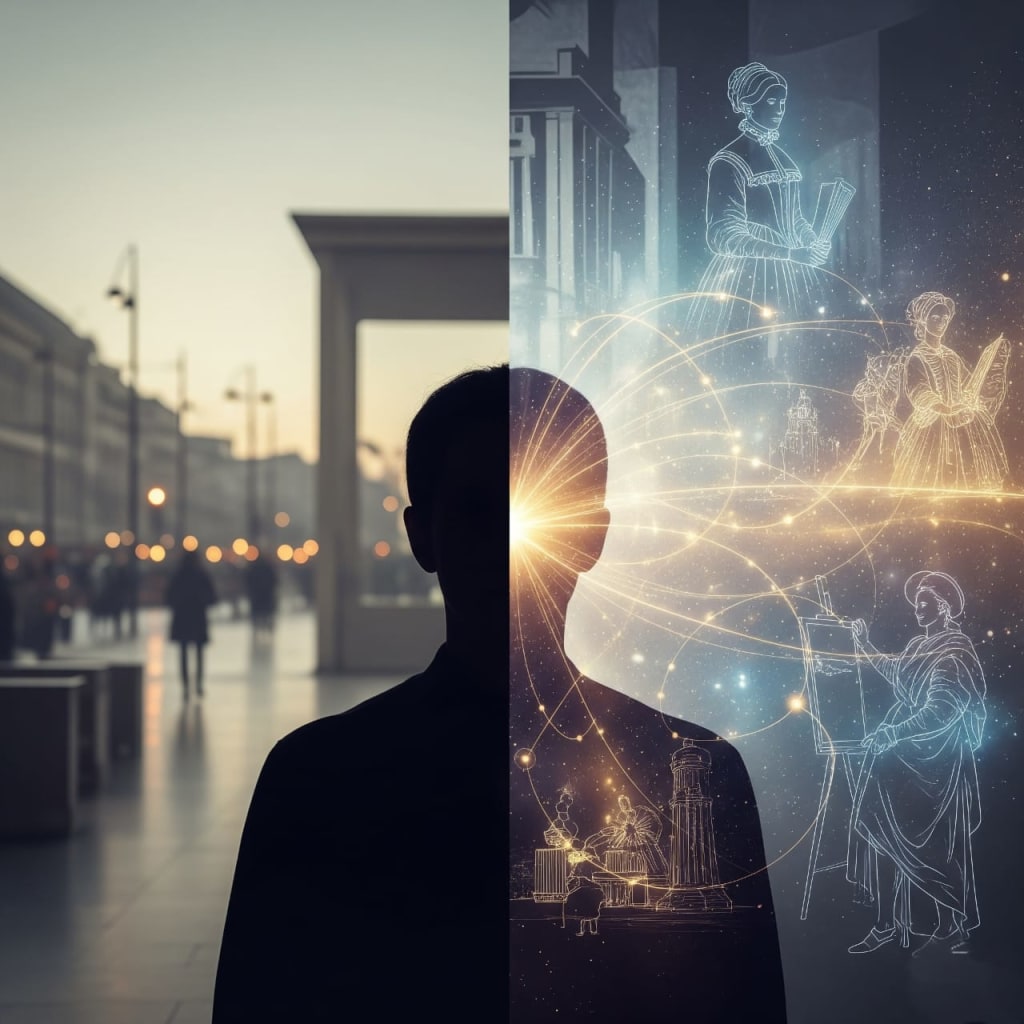
The worn leather of the armchair creaked under Elias, a familiar complaint that usually blended into the white noise of his apartment. But tonight, everything was different. The silence wasn't empty; it hummed with an almost unbearable richness. It had been weeks since **the photograph** had shattered his perception, since the mundane image of his grandparents in a Parisian park had shown him a skyscraper that shouldn't exist, a reflection of his own bewildered face across seventy years of history.
He hadn't slept properly since. Not from insomnia, but from an overwhelming awareness that made true rest impossible. Every shadow held a subtle tremor of past light. Every creak of the building was a symphony of countless stresses and strains endured over decades. His small, neat apartment, once a sanctuary, now felt like a thinly veiled layer over an infinite, bustling dimension.
The initial awe had slowly curdled into a kind of **exquisite exhaustion**. How could one live when every interaction wasn't just a moment, but a confluence of every similar moment that had ever been? When a conversation with his boss about quarterly reports wasn't just about numbers, but the echo of every stressed conversation ever had in that office, the faint, shimmering anxieties of past employees ghosting around the present ones?
He tried to explain it once, to his friend Lena, over coffee. "It's like... imagine if you could see all the air currents in a room at once, not just feel the breeze. And then imagine those currents stretching back through time, showing you every breath ever taken in that room, every whisper, every argument." Lena had just blinked, stirring her latte slowly. "Elias, are you getting enough sleep? You sound... abstract." He’d smiled, a tired, knowing smile. How could you explain **omnipresent time** to someone who still perceived it as a linear progression of ticks and tocks?
His work, once a tedious necessity, became an impossible task. The spreadsheets, those orderly grids of numbers, now seemed to pulse with the unseen narratives of the people who generated them, the fleeting hopes and fears tied to each digit. He saw the historical ebb and flow of markets within the cold figures, the rise and fall of fortunes, the silent stories of entire industries contained in a single column. It was beautiful, terrifying, and utterly paralyzing.
He started avoiding crowds. The sheer density of **layered echoes** was deafening. Walking through a busy street became an assault: the cacophony of a thousand simultaneous conversations, the residual emotions clinging to every brick and pavement slab, the faint, shimmering outlines of every person who had ever walked that path. He saw the city as a living, breathing organism, its present pulsing with the accumulated weight of its past, and the faint, nascent glow of its future.
One evening, he returned to the photograph. He held it carefully, his fingers tracing the outline of his grandmother’s smiling face. The photograph didn't just *show* him the past anymore; it *channeled* it. He closed his eyes, and a wave of warmth washed over him. He wasn't just seeing his grandparents; he was experiencing a sliver of their joy, a faint, sweet resonance of their love. He felt the gentle Parisian breeze on their faces, the warmth of the sun, the quiet, contented hum of their youthful affection.
This was the other side of the coin. The overwhelming clarity wasn't just about the mundane or the painful. It was also about the profound, the beautiful, the transcendent. He began to seek out these **pockets of resonance**. An old, neglected violin in a pawn shop whispered centuries of melodies, of hands that had loved it, of sorrows and celebrations it had accompanied. A gnarly oak tree in the park pulsed with the slow, deliberate rhythm of millennia, its rings not just growth markers, but a silent chronicle of seasons, droughts, storms, and the countless creatures that had found shelter beneath its branches.
He realized his new perception wasn't a curse, but a **responsibility**. He hadn't "lost his mind"; he had, in a way, found a larger one. The trick wasn't to escape the overwhelming input, but to learn to **filter and focus**. To consciously choose what echoes to listen to, which layers of time to peel back. He started meditating, not to empty his mind, but to train it to navigate the infinite sea of information.
The insomnia faded, replaced by a deep, restorative sleep where his dreams were no longer chaotic jumbles, but vivid, almost prophetic landscapes where past, present, and future flowed seamlessly. He started carrying a small, plain notebook, sketching impressions, feelings, the faint outlines of the **temporal echoes** he encountered. He wasn't a prophet, nor was he mad. He was simply a man who, for ten minutes, had seen the true nature of reality, and was now learning to live within it.
He still worked his job, though he found himself gravitating towards roles that allowed for more quiet observation. He still met Lena for coffee, and sometimes, when she spoke of her worries, he would see the faint, shimmering anxieties of her ancestors around her, the pattern of their fears replaying. But instead of being overwhelmed, he could now feel a deep, empathetic connection, a shared humanity stretching across generations. He would simply listen, offer a quiet word, and allow the resonance of time to inform his compassion.
Elias no longer saw the world as a static collection of objects and moments, but as a vibrant, ever-unfolding symphony, each note an echo of what was, a whisper of what is, and a faint harmony of what will be. He was just one instrument in that grand orchestra, finally able to hear the whole song, and learning, with every passing day, how to play his part.
About the Creator
Keep reading
More stories from noor ul amin and writers in Humans and other communities.
When the Muffled Hum Became a Song
The world had been a muffled hum for as long as Elias could remember. Not literally, of course; he could hear the traffic, the incessant chatter of his colleagues, the gentle sigh of the wind through the urban trees. But internally, his perception was perpetually veiled, a thick, greasy film over the lens of his awareness. Every thought felt like slogging through treacle, every decision a monumental effort against an unseen current. He was present, yet perpetually absent, a ghost haunting his own life.
By noor ul amin8 months ago in Humans
Brandon Michael Davis Austin: Why the First Five Minutes of Crisis Response Shape Everything
Brandon Michael Davis Austin has spent considerable time examining how crisis response systems operate during the most fragile moments of human experience. His perspective focuses on a simple but powerful reality: when someone reaches out for help during a moment of emotional collapse or immediate danger, the outcome is often influenced by what happens in the first few minutes. Brandon Michael Davis Austin emphasizes that crisis response should be built around compassion, clarity, and coordination rather than rigid procedure. While many institutions are staffed by dedicated professionals who want to help, the systems surrounding them were often designed for administrative efficiency rather than the psychological needs of a person in distress.
By Brandon Michael Davis2 days ago in Humans




Comments
There are no comments for this story
Be the first to respond and start the conversation.