
The Refraction of the “Looking-Glass Self”
A coming of age story
Themes: gender, race, coming-of-age, and the father-child formative relationship.
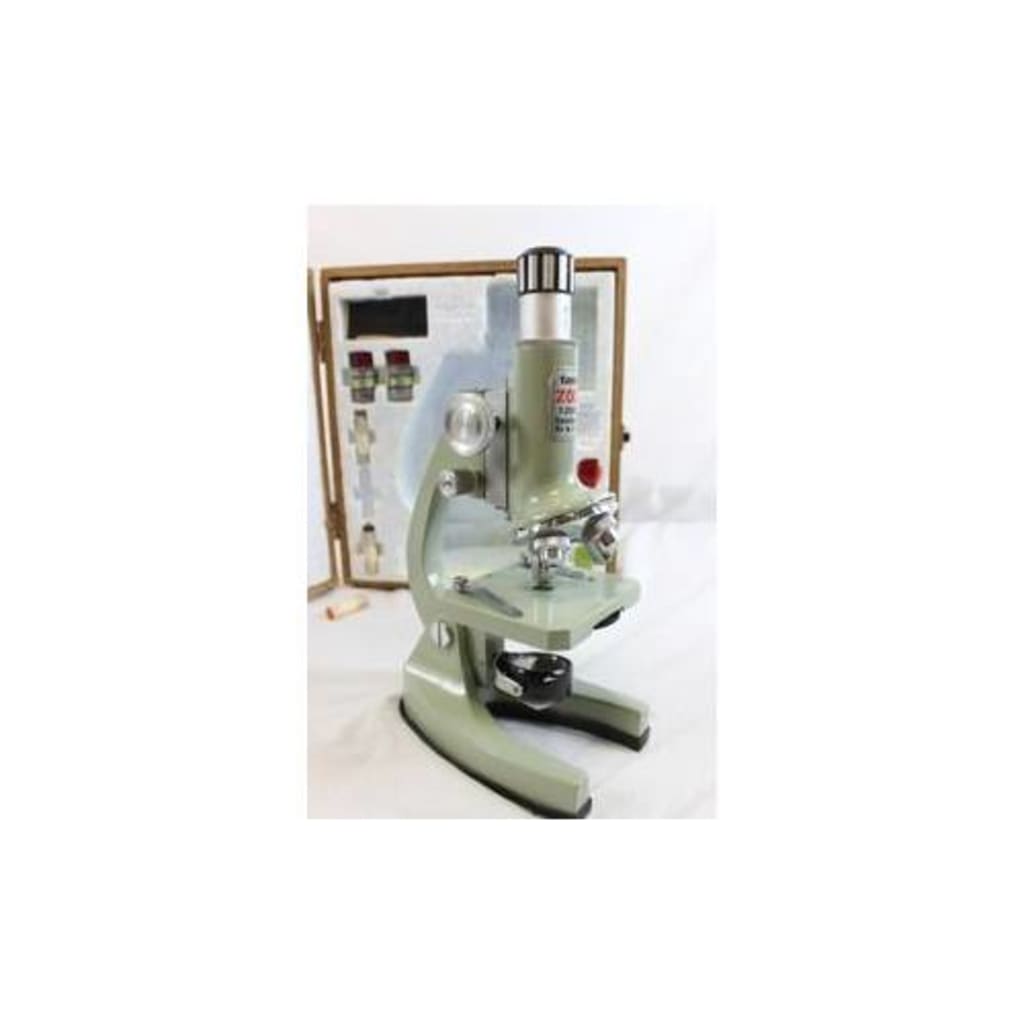
In grade two, my dad, who was a single father of colour, gave me a microscope kit. I remember thinking that science, and therefore microscopes, were for boys. The box cover seemed to verify this assumption with a black and white picture of a Caucasian boy holding what I would soon be holding in my own hands. Assigned female at birth, I got a thrill out of knowing I owned a microscope. I looked the microscope over. It was a curious thing with several parts, sticking out here and there. I excitedly pulled out the smooth, army green, enameled steel microscope as the styrofoam crackled and broke apart around it. With a click, I began turning the black focusing knobs back and forth, even though I still had not unpacked the slides of things to zoom in on. At the end of the phallic body tube, three objective lenses projected towards the stage that would help illuminate what I could not see with the naked eye. The yonic base of the microscope reminded me of a model stand, with the rest of the microscope taking the shape of a starship about to blast off into space. I pulled back on the curved arm and peered into the hole of the eyepiece lens. Because I had not slipped a slide under the staging arms yet, I saw the mirror and light bulb staring back at me instead. I held up the microscope and twirled it around, noting a small rectangular metal label with the company name “Tasco,” printed on it. The microscope was cool, hard, robust, and unbreakable - traits I considered masculine, traits I considered possessing myself.
Around the time I received this delightful microscope kit gift (the 70s and 80s), I heard society refer to girls like me as a “tomboy.” With cropped hair, wearing a t-shirt and jeans – maybe you would have seen a boy. Then again, I enjoyed and reveled in girly things too. Was I a girl? Was I a boy? I was undefinable. If it were not for society being confused by my appearance: I emitted a sweet high-pitched voice from a lip glossed mouth, fresh from a daily orange blossom shower with a chocolate mousse hair product weaved into my long curly hair, wearing clothing that accentuated early developing “girl” curves, and soon to be holding a position on the gymnastics team, I would have received the “tomboy” label, too.
For me, gender non-conformity wasn’t always in how I looked or what I liked. What made me different from most other girls was how boldly I acted and that nothing was off-limits for me because I was a female. I was not conforming to my birth gender that I saw through the “looking-glass self,” even though sociologist Charles Cooley posited that society shapes perception of ourselves, through its perception and interaction with us.1 I was assertively playing dodgeball, leading a schoolyard club with physical initiation rites, climbing and cutting trees, getting dirty, and bagging squirmy worms to later inspect and magnify under the corporeal lens of the microscope. I wasn’t trying to be a “good girl.” If anything, I wanted to be a “bad boy,” and I could identify with coming-of-age “boy” themed movies such as The Outsiders. I wasn’t crying when I hurt myself, because “boys don’t cry,” and neither would I.
Thinking about the microscope, I called up my dad and asked him why he had bought it for me. He responded, “because you wanted it.” I wasn’t satisfied with that response, so I led him to question the appropriateness of a microscope as a girl’s toy asking, “Wasn’t a microscope a boy’s toy?” With indignation, my 74-year-old father said, “No! It is not a toy just for boys.” Yet again, I was proud of my father and his unorthodox and progressive views then and now! Girls can do and be anything that boys can do and be – that was and is his attitude. I was never “less than,” because I was a girl.
At the time, I didn’t have a younger brother, so I often thought I played that role in my father’s life. Maybe involving me in ‘boy’ things that he loved, such as science and technology, was the only way he knew how to connect to me. Speaking of what he loved, my dad had a bond to material in the physical sciences: plastic, ceramic, and metal. Although my dad only had a grade eight education, with a bunch of thin black science books he got from the library, he taught himself how to pick, melt, and recycle plastics and metal that he found in junkyards. He then started a successful recycling business in Toronto. He followed that with a home-based novelty ceramic crafts business and a metal sign business that the family helped operate. Being involved with his businesses, if only in superficial ways, not only got me excited about entrepreneurship (typically a male-dominated arena at the time), but also made me feel special my dad did not treat me like a ‘girl’ just because I was born one. My dad opened me up to more opportunities than were available to other girls because I believed I could pursue them, even though I had to continuously fight for the right.
As we chatted over the phone, I kept thinking aloud about why I would ask for an unconventional gift, and then he said it was for a lab at school. However, I was only seven years old – what lab would we have at school? He then chuckled in amusement when he remembered watching me inspect my little hand under the microscope. Well, this cool tool is used to scrutinize, investigate, and see the truth, and I wanted to see my truth. I wanted and want to see the truth of others too. This microscope symbolized the desire to look beyond the veneer of surface reality and expected norms. With this microscope, I could confirm and share with others that what we see with the unaided eye isn’t the whole truth. We can transform and be something beyond what others say we are, based on their superficial understanding of what they see. My gender non-conforming self is a reality even if others can’t see, are confused by, or don’t believe it. Also, I saw the importance of others seeing what I saw, saw about myself, and saw about them: seeing beyond. My dad’s gift inspired me to become a social scientist specializing in artificial intelligence, to help humans and humanoids see beyond the veneer of the looking-glass self.
At last, I remembered that we had a science fair. This is the lab my dad recalled as the reason for me asking for the microscope in the first place. I decided to grow pretty crystals as a science project, and I wanted to observe their growth (my growth). Crystals are a natural material that embodies refractive glass. It has properties that transform through changing direction as light shines through it; I am this crystal de-light. I flout social norms, and I bend light. I am glad I wasn’t the only one to do so. When I recently looked online for microscope kits, no longer did I see pictures of little white boys, or white men in white lab coats. I saw girls only, girls and boys together, or no people at all. In today’s social world, I might be labeled gender non-conforming, non-binary, two-spirited, or gender fluid: a person who identifies with the anima and animus, yin and yang, feminine and masculine, girl and boy, all. Today, I am.
Before we ended our chat, my dad wondered what had happened to the microscope. I told him that it forever exists in my mind’s eye, as real as if I were holding it in my hands today. Yet, I imagined someone else owning my now possibly chipped enamel microscope, still helping with the transition from the macro eye lens to the artificial micro lens. I also envisioned a weathered but fortunate microscope having escaped from the encasement of the fragile, yet strong and restrictive styrofoam packaging it was once slotted into, no longer boxed in.
1 Charles Horton Cooley, “5 The Social Self--1. The Meaning of ‘I.’” Human Nature and the Social Order (New York, Charles Scribner's Sons, 1902), 136–178.
Author's note: The microscope my dad (Black, British, and Mi'kmaq) gifted me as a young child symbolized the desire to look beyond the veneer of surface reality and expected norms. His gift encouraged and inspired me to study science and importantly to 'see myself' -- a person who is gender non conforming: gender-queer, two-spirited, bi-gendered, and still worthy of opportunity.
About the Creator
A.S.L.
Mature U of T student who loves researching and writing about social stuff. Gender non-conforming. Interested in futurism, technology, health and wellness, the arts, astrology, dating, mating, and relating. Hobbyist creative writer.
The CEO of Everything
They say "jack of all trades, master of none," but they forgot to mention the part where the jack of all trades is also the camera woman, the makeup artist, and the person currently yelling at a tangled Wii microphone cable in a her own bathroom while recording herself singing and trying to make it look realistic and professional. (As professional as you can make it with nothing but a cell phone camera and a mic that doesn't work)
By Sara Wilson7 days ago in Humans
My New Book is Finally Here
My poetry collection Beautiful and Brutal Things is done. It's actually done and finally published over 270 pages. Over a year of my life went into this book. More than a year, really. Long days at my computer, sometimes seven days a week because I couldn't stop even when I probably should have. Then two months of editing that felt harder than the writing itself. But it's finished, and I'm still standing, and the book is real.
By Tim Carmichael7 days ago in BookClub



Comments
There are no comments for this story
Be the first to respond and start the conversation.