
I’ve never been to a real Pride parade.
Not because I didn’t want to — I watched them online every June, eyes wide as flags rippled in the sun, faces painted with glitter and joy, bodies dancing, kissing, marching. A living rainbow in motion. But growing up in the small town of Red Hollow, Texas, the only parades we had were for rodeos and the high school football team. Pride was something whispered, not waved.
My name is Eli. I’m 18. And until two months ago, I hadn’t told anyone I was trans.
My world was the kind where church was louder than law, and “boys will be boys” came with a threat. My parents ran a hardware store, good people in the way that meant rules mattered more than feelings. My mom ironed my Sunday shirts even when I started skipping church. My dad only looked at me sideways when I cut my hair short and stopped wearing dresses — he never said anything, but he started forgetting to say "good morning" too.
When I finally told them, it didn’t go well.
My mom cried like someone died. My dad left the room.
No one screamed. No one hit me. But the silence hurt worse.
I spent the night at my best friend Jamie’s house. Jamie’s nonbinary and out. Their parents — a lesbian couple who moved here from Austin — were like a postcard from a better life. They gave me tea and told me, “Sometimes, the bravest thing you can do is keep being who you are when people want you to stop.”
I didn’t feel brave. I felt broken. But I nodded anyway.
At school, things got weird. I’d gone by “Eli” with Jamie and a few others for a while, but now it was official. The name on the attendance sheet still said "Eliza," but I’d stopped answering. Some teachers made an effort; others didn’t bother. A few students suddenly forgot I existed. Others remembered me too much — spitball notes, giggles when I passed, a locker that kept getting jammed.
And then the bill passed.
State Bill 72-B. “A measure to protect traditional values in educational spaces.”
Translated: no more discussion of “gender ideology.” No books, no clubs, no visible support for queer students. Jamie’s pronoun pin was confiscated. The GSA was shut down. Our school counselor, who used to keep a rainbow flag on their desk, replaced it with a fake plant.
I remember walking home that day feeling like a ghost in my own life.
And yet, something strange happened. The quieter they tried to make us, the louder we got — not in words, but in presence.
Jamie wore all black to school the next day, with a rainbow patch sewn under their collar. Our friend Marcus — who hadn’t come out yet but always showed up — brought in donuts with “LOVE IS LOVE” written in frosting, and handed them out silently.
I painted my nails trans blue and pink and dared someone to say something.
They didn’t.
In Red Hollow, June used to mean barbecue, fireworks, and the town fair. But this year, a group of us — students, a few teachers, some parents from the next town over — decided we were going to have our own Pride.
It wasn’t going to be a parade. That would have needed permits. Attention. Noise.
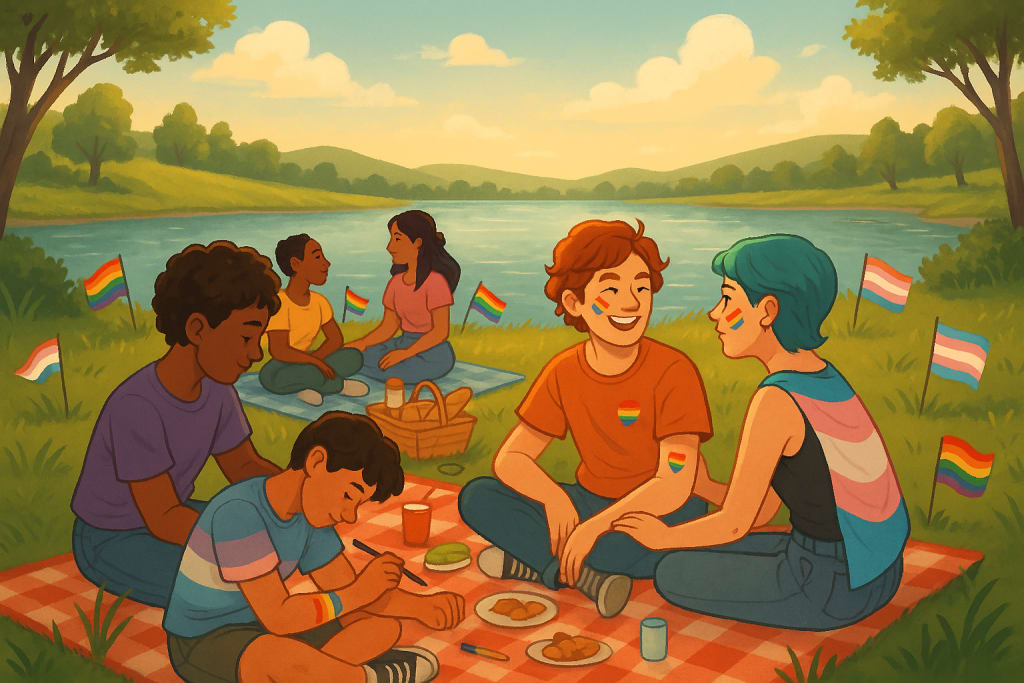
So we held a picnic. Quiet, careful, out by the lake on the edge of town.
We brought blankets and snacks. Wore shirts with faded slogans. We played music low, just enough to feel like summer. We didn’t call it a protest. We didn’t call it a party. We just were.
There were thirty of us, maybe more. We ate. We talked. We laughed. A few people cried.
One girl — whose name I still don’t know — stood up and read a poem. “Being seen,” she said, “shouldn’t be a risk. But it is. And we do it anyway.”
Jamie brought face paint. We drew flags on each other’s arms, hearts on cheeks, words on skin.
I wrote "I’m still here" on my forearm in sharpie.
It washed off the next day, but the feeling stayed.
My parents didn’t ask where I’d been. But later that night, my mom left a box outside my room. Inside was a sweater — blue and white, the kind I always used to borrow from Jamie. No note. But I understood.
It’s not a parade. It’s not perfect. But it’s mine.
Sometimes, Pride looks like confetti and music and a city lit in rainbows.
Sometimes, it looks like a picnic by a lake in a town that won’t say your name.
But it’s still Pride. It’s still resistance. It’s still love.
We’re still here.
About the Creator
Keep reading
More stories from Roland Nemeth and writers in Humans and other communities.
How AI Is Quietly Changing Everyday Life in 2026
Artificial Intelligence (AI) is no longer a futuristic concept reserved for science fiction movies. In 2026, AI has quietly woven itself into the fabric of our daily lives, often in ways we barely notice. From the moment we wake up to the time we go to bed, AI-powered systems help us make decisions, save time, and simplify complex tasks.
By Manikesh Tripathi5 days ago in Humans



Comments
There are no comments for this story
Be the first to respond and start the conversation.