
The Quiet Cost of Living Online
How the Attention Economy Rewired Our Minds—and What It’s Doing to Our Sense of Self

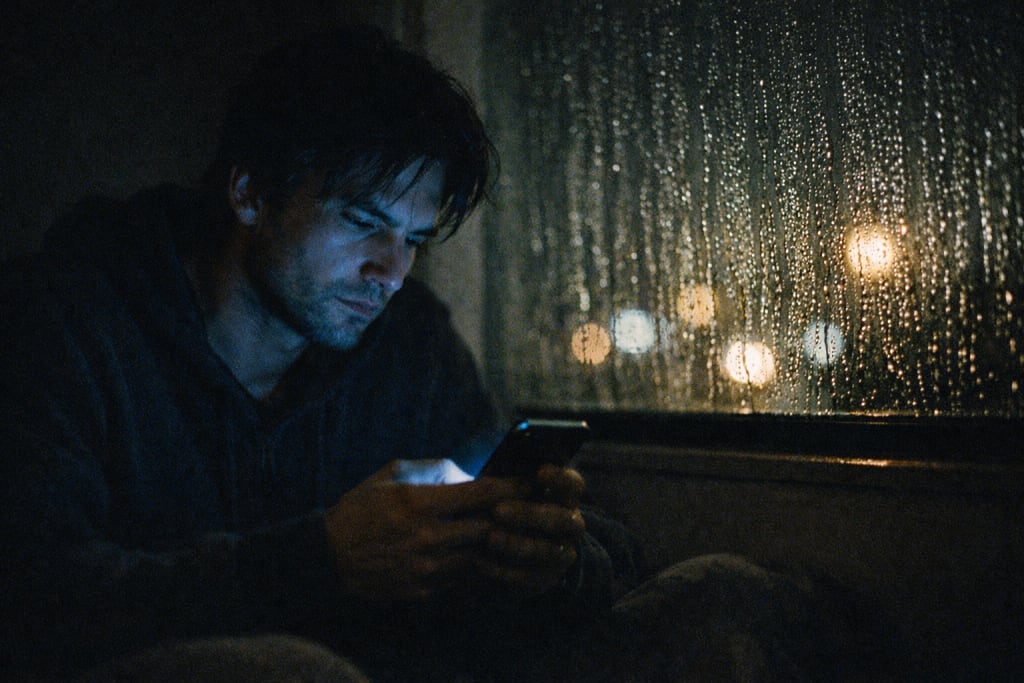
1. The Glow in the Dark
The room is dark except for the blue-white glow of a screen. It hums softly, like an appliance that never sleeps. Somewhere outside, a car passes, tires hissing against wet asphalt, but the sound barely registers. Your thumb moves before you notice it moving. Up. Pause. Down. A face flashes by. A headline. A joke that exhales air from your nose but doesn’t quite become a laugh.
Time loosens. Minutes soften at the edges.
The screen warms your palm, a small artificial sun, and with every swipe it offers a promise: something better is coming next. Something sharper. Something more you-shaped. You are not bored, exactly—but you are not satisfied either. You are suspended in a narrow emotional hallway where nothing hurts enough to leave and nothing delights enough to stay.
When you finally lock the phone, the silence feels heavier than before. The room hasn’t changed, but you have. Your thoughts scatter like birds startled from a wire. You search for one to land on and can’t quite catch it.
This is not addiction in the dramatic sense. There are no needles, no rock-bottom stories. Just a quiet sense of being thinned out. Spread across too many places at once.
2. How the Internet Learned to Read You Better Than You Read Yourself
At some point, without ceremony, the internet stopped being a tool and became a mirror. Not a faithful one—a funhouse mirror that stretches certain features and hides others—but convincing enough that you start adjusting your posture to match the reflection.
Every pause, every linger, every half-second hesitation becomes data. The system notices what makes your pupils widen, what keeps your finger hovering instead of swiping away. It doesn’t need to know your name. It knows your rhythms. Your weaknesses. The exact flavor of curiosity that makes you stay up later than you planned.
This isn’t malicious intelligence. It’s patient intelligence.
You can feel it working when a video ends and another begins without asking. When a notification arrives just as your attention drifts. When content feels less like it was published and more like it was summoned. The line between desire and suggestion blurs until it’s hard to tell which came first.
Inside your chest, something subtle shifts. Your thoughts start to arrive pre-fragmented, shaped for quick consumption. Long ideas feel heavy. Silence feels suspicious. You reach for stimulation the way a tongue reaches for a sore tooth—instinctively, without asking whether it helps.
The mind adapts. It always does. But adaptation is not the same as improvement.
3. The Shrinking Room Inside Your Head
There was a time when boredom had texture. It came with sounds—the ticking of a clock, the distant bark of a dog. It came with smells—dust warming on a radiator, paper aging on a shelf. In boredom, the mind wandered. It built strange bridges between unrelated thoughts. It practiced being alone without panicking.
Now boredom is interrupted the moment it appears.
The internal room where thoughts used to stretch out has grown smaller. Furniture is pushed close together. There’s no space to pace. Ideas bump into each other and fall apart before they can become anything solid.
You notice it when you try to read something demanding. The words are clear, but your attention keeps slipping, like a bar of soap in water. You reread the same paragraph, aware of the effort, vaguely ashamed of it. Your brain wants the quick reward, the easy hit of novelty, the soft applause of engagement.
This isn’t a failure of discipline. It’s conditioning.
Neurons that fire together wire together, and lately they’ve been firing fast, shallow, and often. The deep-focus circuits—the ones built for contemplation, for slow synthesis—are still there, but they’re out of practice. Like a muscle neglected not out of laziness, but out of constant interruption.
The cost isn’t obvious at first. It shows up quietly, as a thinning patience, a shorter fuse, a creeping sense that everything important should be immediately rewarding or else not worth the effort.
4. Loneliness in a Crowded Feed
There is a particular kind of loneliness that only exists when you are surrounded by voices. It doesn’t feel like isolation. It feels like invisibility.
You can spend hours immersed in updates, opinions, confessions from people you’ve never met, and still feel untouched. The connections are frictionless, which means they rarely leave a mark. You react, you comment, you move on. No one’s breathing changes because you’re there. No silence deepens. No moment stretches long enough to become shared.
Your brain registers social cues—faces, laughter, conflict—but your body doesn’t get the full signal. There’s no eye contact that lingers half a second too long. No awkward pause. No shared air. The ancient parts of you, the ones shaped around campfires and kitchens, keep waiting for something that never quite arrives.
So you scroll more, trying to close the gap.
The irony is sharp if you look at it long enough: we have never been more connected by infrastructure and more fragmented by experience. We know more about each other and feel less with each other. Empathy becomes a performance. Identity becomes a brand. Even vulnerability starts to feel optimized.
And somewhere under all that noise, a quiet question hums: Is this all there is?
5. The Science of Attention—and Why It Matters
Attention is not just a spotlight. It’s a sculptor.
What you attend to repeatedly doesn’t just occupy your time; it reshapes the architecture of your mind. Short bursts of stimulus train the brain to expect reward without delay. Variable rewards—sometimes interesting, sometimes not—are especially powerful. They keep you checking, the way a slot machine keeps pulling you back with the promise that the next one might hit.
Over time, baseline dopamine levels adjust. Ordinary experiences—walking, thinking, sitting with a thought—feel muted. The world seems dimmer not because it changed, but because your nervous system recalibrated its expectations upward.
This has consequences beyond productivity. Decision-making becomes noisier. Emotional regulation thins. Anxiety rises, not as panic, but as a low-level buzz, a sense of always being slightly behind, slightly insufficient.
The future tech conversation often focuses on speed and convenience. But the more important question is qualitative: What kind of minds are we building? Minds trained for reflection, or minds trained for reaction?
Technology is not destiny. But it is a teacher. And it teaches whatever lesson it repeats most often.
6. Remembering How to Be Alone Without Being Empty
There is an experiment you can try. It doesn’t require deleting anything or moving to the woods.
Sit somewhere quiet. Leave your phone in another room. At first, your mind will protest. Thoughts will feel jittery, unsatisfied. You’ll think of messages you might have missed, information you should check. This is withdrawal—not from pleasure, but from constant interruption.
If you stay a little longer, something shifts.
The noise doesn’t disappear, but it rearranges itself. A memory surfaces. A question you’ve been avoiding wanders into view. The mind, given room, starts doing what it evolved to do: make meaning. Connect past and future. Simulate possibilities. Rest.
This is not productivity. It’s restoration.
The goal is not to reject technology, but to renegotiate your relationship with it. To decide, deliberately, what deserves the most precious resource you have: sustained attention. Not every moment needs to be optimized. Some moments need to be felt, even if what they offer is uncertainty or boredom.
Depth returns slowly. Like circulation to a numbed limb. At first it tingles. Then it hurts a little. Then it becomes normal again.
7. The Future Is Not Just Faster—It’s Quieter or Louder by Choice
We like to imagine the future as something that happens to us. A wave of innovation we either ride or drown beneath. But the future is also built in micro-decisions: where we look, how long we stay, what we ignore.
The next generation of technology will be more immersive, more personalized, more persuasive. It will know your patterns even better than this one does. The question is not whether it will change us—it will—but whether we will meet it with awareness or sleepwalk into its arms.
A mind trained only for consumption becomes easy to steer. A mind practiced in reflection retains friction. It pauses. It asks whether the next thing is actually better, or just louder.
When you choose depth over constant novelty, you’re not being nostalgic. You’re being strategic. You’re protecting the internal space where values form, where long-term thinking lives, where identity isn’t constantly renegotiated by feedback loops.
The screen will still glow in the dark. That’s not going away.
But you can decide whether it becomes a window—or a mirror you forget to look away from.
About the Creator
Alpha Cortex
As Alpha Cortex, I live for the rhythm of language and the magic of story. I chase tales that linger long after the last line, from raw emotion to boundless imagination. Let's get lost in stories worth remembering.
Keep reading
More stories from Alpha Cortex and writers in Humans and other communities.
Love: The Universal Language that Connects us All
Love is a universal emotion that is experienced by people of all ages, cultures, and backgrounds. It is a feeling that is difficult to define, yet it is something that we all crave and desire. Love is often portrayed as a feeling of affection, fondness, or admiration towards someone, but it is so much more than that. Love is a force that has the power to connect people, to heal wounds, and to inspire greatness.
By Alpha Cortex3 years ago in Humans
Cabin Fever Because of Snow, Sleet, and Freezing Rain That Turned to Icy Roads
What Is Cabin Fever? The short answer is that cabin fever is restlessness from being in a confined area. Cabin fever is the distressing irritability or restlessness experienced when a person or group is stuck at an isolated location or in confined quarters for an extended time. Research shows that prolonged cold, gray skies, and being stuck indoors can trigger mood shifts similar to “winter blues.”
By Margaret Minnicks5 days ago in Humans
Democracy Contested: The Two Party System is Tearing us Apart
The U.S. Constitution, a democratic promise from ourselves, for ourselves, and to our future selves. That we will always work to promote a culture and climate in the United States of America that is conducive to securing the blessings of Liberty; what ever that may subjectively be for the many people of this great nation. Because isn’t that what Thomas Jefferson meant by “self-evident” when talking about it in the Declaration of Independence. That liberty is unique to each individual as we each see it, and experience it; and to truly have liberty, we must accept equally what is subjectively self-evident to every person. Each human has the innate sense that they have the right to be themselves, who and how ever that means; as long as it doesn’t intentionally harm another physically or monetarily, right. We as Americans have lost the big picture, or maybe we never truly realized it, and we are now just slipping backwards, in a path that once had us headed in the right direction.
By Meko James about 10 hours ago in Humans




Comments
There are no comments for this story
Be the first to respond and start the conversation.