
The Peace Treaty Written in Children’s Handwriting
A playground fight turns into a life lesson in forgiveness, penned by innocent hands.

Author’s Note: This story was written by me with creative assistance from AI, then personally revised and edited for accuracy, tone, and authenticity.
The fight began with a shove.
At least, that’s what the teacher said when she rushed over.
> “That’s enough! Both of you, hands off!”
By then, Omar’s nose was bleeding, and Daniyal’s shirt was torn at the shoulder.
Both boys were red-faced and crying—not from pain, but from something heavier.
The kind of crying you only do when you’re nine and haven’t yet learned how to hide heartbreak.
A moment earlier, the playground had been full of squeaky swings and jump rope chants.
Now, even the birds seemed to have stopped.
They were best friends—Omar and Daniyal.
The sort of boys who brought two straws for one juice box, built Lego cities together just to knock them down, and knew each other’s favorite snacks by heart.
No one expected them to fight.
But grief has no timetable.
And nine-year-olds don’t always have the words for it.
It had been three weeks since Omar’s father died in a sudden car accident.
The funeral felt like a blur—his mother’s silent sobs, unfamiliar faces bringing food, the way everyone at school spoke softly around him.
It left Omar feeling like he was floating above his own life, watching it happen to someone else.
Daniyal tried to be there for him.
He sat beside Omar at lunch, didn’t talk too much, even gave him the last slice of pizza on Fridays.
But he couldn’t truly understand.
How could he?
That day at recess, Daniyal said something that hit the wrong nerve.
> “I wish your dad could have come to sports day. My dad cheered so loud, it was embarrassing.”
Omar didn’t remember much after that—just a hot rush in his chest, a shove, a punch.
A fight born from grief and misunderstanding.
They ended up in the principal’s office.
Parents were called.
They sat across from each other, arms crossed, cheeks blotchy from tears.
Silence stretched between them.
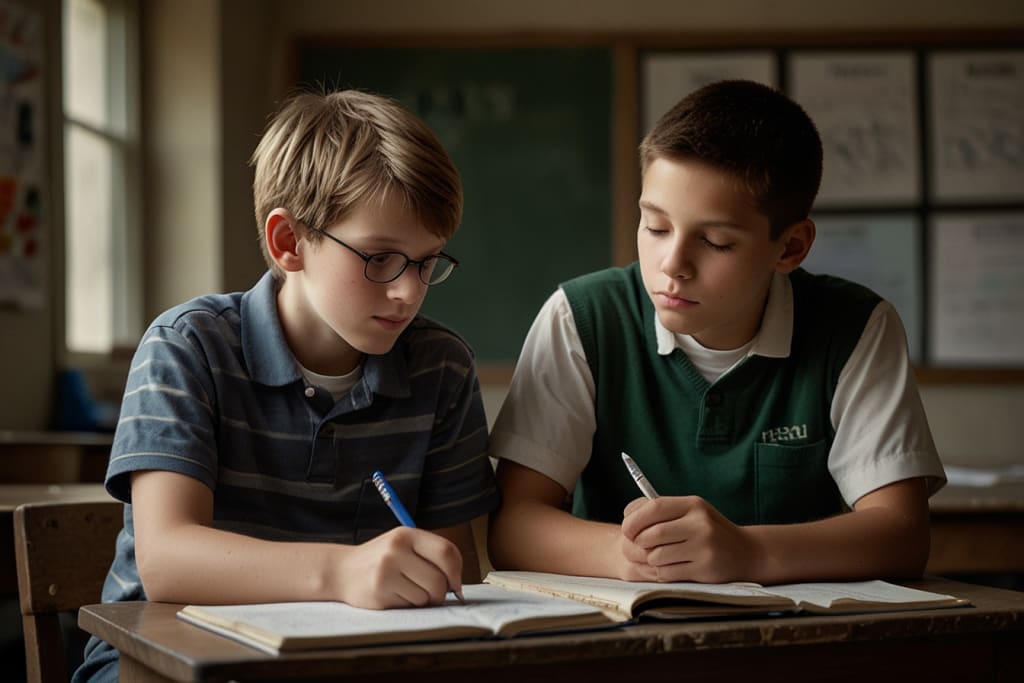
Then Ms. Parveen, their teacher, walked in holding a small, worn notebook—the kind used for spelling tests and superhero doodles.
She placed it gently on the desk between them.
> “I want you to write a peace treaty,” she said.
“In your own handwriting. Your own words. No grown-ups.”
The boys exchanged a look.
Something in their eyes softened—maybe from exhaustion, maybe from realizing they were tired of being angry.
They took the notebook into an empty classroom and sat side by side.
A pencil passed between them.
After a few minutes, Daniyal wrote the first line:
> “I promise not to say things I don’t understand.”
Omar added:
> “I promise to tell you when I’m hurting instead of using my fists.”
They kept going:
> “I will not laugh when the other one cries.”
“I will ask what’s wrong before assuming.”
“We will take turns on the monkey bars, even when angry.”
“I forgive you.”
“I forgive you too.”
At the bottom, Daniyal drew two stick figures holding hands.
Omar added a crooked heart above their heads.
They signed it:
> “By Omar and Daniyal, Best Friends (Even When Mad).”
When they handed it to Ms. Parveen, she didn’t say much—just smiled, nodded, and patted both their heads.
That peace treaty still hangs in the school hallway, laminated and framed.
A reminder to everyone—kids and adults alike—that conflict isn’t always solved with big speeches.
Sometimes, peace is written in pencil, a little misspelled, and illustrated with stick figures.
Years later, in high school, Omar told Daniyal something he had never shared before.
> “That day… when we wrote the treaty… it saved me. You saved me.”
Daniyal laughed.
> “I was just a dumb kid with a pencil.”
Omar shook his head.
> “Exactly. A dumb kid who didn’t walk away.”
And that’s how a playground fight became a lesson in forgiveness—penned by two children, sealed with friendship, and framed for everyone to see.
About the Creator
The Narrative Hub
Your daily destination for the most compelling stories and insightful articles. At The Narrative Hub, we bring you trending topics, human experiences, and thought-provoking narratives—all in one place.
Keep reading
More stories from The Narrative Hub and writers in Humans and other communities.
Two Grumpy Old Men Solve the Problem
Marty and Steve were two grumpy old men who lived together. They had known each other for years. Marty had been a bachelor all his life. Steve said it was because no one could stand to ever live with. Marty’s standard reply was “Well, you are, so what sort of a moron does that make you!”
By Calvin London3 days ago in Humor


Comments
There are no comments for this story
Be the first to respond and start the conversation.