
The ostrich people - the Vadoma of Zimbabwe.
A National Geographic moment.

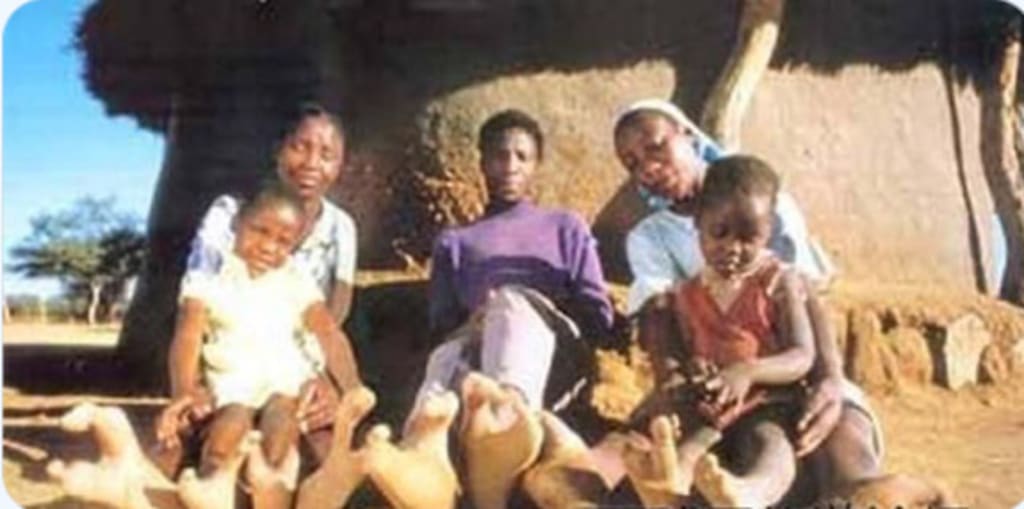
The Vadoma people of Zimbabwe 🇿🇼 have only two toes, also known as Bantwana tribe which means "descendants" are a tribe living in northern Zimbabwe, generally in Sipolilo and Urungwe districts of Zambezi river valley. Their main language is Dema language. This tribe is famous for a condition of their foot, in which the middle three toes are absent and the two outer ones are turned in, resulting in the tribe being known as the "two-toed" or "ostrich-footed" tribe
I knew these tribe when I lived in Rhodesia, in Binga, in the late 1970s during the civil war. Binga was a very isolated district, located along the banks of Lake Kariba and the Zambezi River.
Residing in northern Zimbabwe, this tribe is renowned for a rare genetic defect prevalent among its members: ectrodactyly, a condition also referred to as lobster claw syndrome.
The high occurrence of ectrodactyly within this tribe can be attributed to their strict adherence to marriage within the tribe, which effectively restricts their genetic diversity, contributing to the proliferation of this disorder among its members.
This mutation appears unlikely to fade away, as tribal laws expressly prohibit marriage outside their community. This strict rule exists to prevent the mutation from infiltrating other tribes.
These laws, coupled with the tribe's isolation, have enabled them to maintain this genetic mutation at a higher rate than any other population in the world. Interestingly, this deformity can also be found in other tribes, such as the Talunda and Taluta Kalgana tribes living in the Kalahari desert.
Many believe that these tribes share a common ancestry with the Doma.
Researchers and visitors who have spent time with the Doma tribe report that community members do not perceive this mutation as a disability. Despite the challenges it poses, such as difficulties with walking and running, and the inability to wear shoes, many tribe members do not typically wear any clothing.
Rather than lamenting their circumstances, the Doma tribe views their genetic mutation as a distinctive trait that enhances their ability to climb trees with exceptional speed. Tree climbing is a crucial skill for the tribe, as they adhere to a traditional hunter-gatherer lifestyle, sustaining themselves through hunting, fishing, honey-making, and collecting wild fruits and roots.
The Doma tribe is the only indigenous population of traditional hunter-gatherers in Zimbabwe, but they have limited access to fertile land.
In recent years, the Doma tribe has faced increased challenges from authorities seeking to curtail illegal hunting. Consequently, many have abandoned their traditional way of life as hunter-gatherers and moved to the lowlands. Today, although they have minimal contact with the broader population, numerous Doma families lead more organized lives as semi-food gatherers, constructing houses on wooden platforms to safeguard against predators.
In Zimbabwe’s remote and majestic Zambezi Valley, where nature and history intertwine in a tapestry of astonishing beauty, resides a tribe as fascinating and enigmatic as the very river that sustains them: the Vadoma. Known for their unusual physical features and ancient traditions, the Vadoma are a hidden gem that invites adventurers and explorers to discover their secrets and legends.
The Legend of the “Ostrich Feet”.
One of the most intriguing aspects of the Vadoma tribe is their genetic quirk known as ectrodactyly, which causes some members to be born with feet that look more like bird claws than human limbs, earning them the nickname “ostrich feet.” This distinctive trait has fueled numerous local legends, many of which tell of mythical ancestors who possessed supernatural abilities. In stories passed down from generation to generation, the Vadoma see themselves not only as inhabitants of the valley, but as guardians of a mystical legacy.
The Zambezi Valley is a natural paradise, home to incredible biodiversity and breathtaking scenery. Here, the Vadoma live in close harmony with their environment. Hunting and gathering are essential to their survival, and their ability to move nimbly through the rocky, jungle-like terrain is legendary. To the Vadoma, every plant and animal has meaning, and their knowledge of the local ecosystem is deep and reverent.
Vadoma life is marked by a rich tapestry of rituals and celebrations that honor both their ancestors and the land that sustains them. Among the most prominent are the initiation rituals, where young people are prepared to assume their role in the tribe through ceremonies that combine song, dance and storytelling. These events are not only a demonstration of physical skills and endurance, but also an affirmation of community spirit and connection to the ancestors.
The wisdom of the Vadoma is passed down orally, in a continuous flow of stories, myths and teachings that connect each generation to the next. The elders are the keepers of this knowledge, and their role is vital to the cohesion and identity of the tribe. Origin stories, legends about the Zambezi River, and practical teachings about hunting and gathering form a rich cultural mosaic that is both practical and spiritual.
When the country was Rhodesia, they were isolated and left alone. Now that the country is Zimbabwe, they have been documented and presented to the world as the treasure that they are. There are even guided tours available for tourists to see their villages and experience their way of life.
About the Creator
Guy lynn
born and raised in Southern Rhodesia, a British colony in Southern CentralAfrica.I lived in South Africa during the 1970’s, on the south coast,Natal .Emigrated to the U.S.A. In 1980, specifically The San Francisco Bay Area, California.
Reader insights
Outstanding
Excellent work. Looking forward to reading more!
Top insights
Compelling and original writing
Creative use of language & vocab
Easy to read and follow
Well-structured & engaging content
Excellent storytelling
Original narrative & well developed characters
Expert insights and opinions
Arguments were carefully researched and presented
Eye opening
Niche topic & fresh perspectives
Heartfelt and relatable
The story invoked strong personal emotions
Masterful proofreading
Zero grammar & spelling mistakes
On-point and relevant
Writing reflected the title & theme
My New Book is Finally Here
My poetry collection Beautiful and Brutal Things is done. It's actually done and finally published over 270 pages. Over a year of my life went into this book. More than a year, really. Long days at my computer, sometimes seven days a week because I couldn't stop even when I probably should have. Then two months of editing that felt harder than the writing itself. But it's finished, and I'm still standing, and the book is real.
By Tim Carmichaela day ago in BookClub



Comments (2)
Never heard of this before…. Still finding it hard to believe that it is not an internet hoax
Wow! Very interesting! Thanks for sharing this story.