

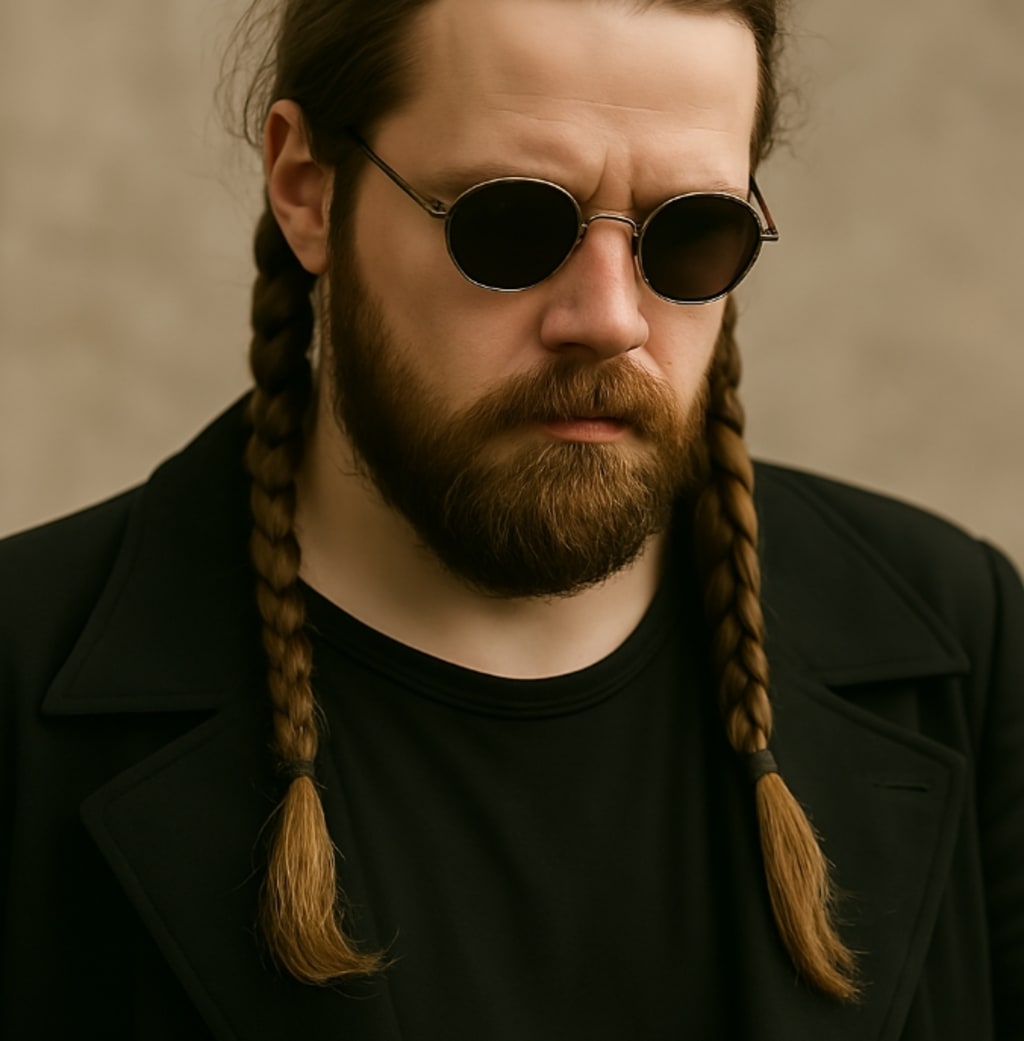
Jonathan A. Titchenal
September 5, 1982 – June 27, 2020
Note: the following memoir was written in anticipation of publishing a lost book of Jon's that I happened upon, published on a long defunct literary website. I have not yet done that for various reasons, and may never. Also, his introduction to my novel Joseph is posted after this article, in an audio version, as I think it is among the finest things he ever wrote.
The following book was originally posted by my late friend Jon Titchenal on a now-defunct literary website. I have known of it for years, but now is the first time it has ever been published and put into print. I once published, many years ago, a paperback version of a short science fiction novel Jon wrote called De Profundis. I am not certain, now that he is gone, who exactly owns this book—technically speaking. He seems to have been estranged from his family, and I doubt he left any literary executor. I am assuming, then, that it is in some sort of limbo. Be that as it may, I feel compelled to publish this work—to, at the very least, give one of his forgotten and certain-to-be-relegated-to-oblivion novels a chance for a wider readership. Jon Titchenal is one of the conundrums of my life, as I'll explain.
I first met him in early 2002, I think. It must have been that, because of the weird circumstances that led to our friendship—the formation of a "séance circle" at Ball State University in a historic dormitory in December of 2001—was the reason we even got together. At the time, there was a young woman I was dating, and she knew Jon, and Jon was a writer; and she knew I was a writer as well.
Jon came up to her room one night, toting a copy of his self-published book, Born Loser. Immediately, he and I had strong, disagreeable feelings toward one another. There is a reason behind this, perhaps, in what occurred later (and almost certainly what occurred before, in a past life), but we didn’t realize that at the time. Be that as it may, Jon agreed to take up the writing project of the small book that the spirit—which communicated almost exclusively through my trance-like states—had asked us to write.
That book was written—badly, I feel, from my end—and was self-published. The book, Awakenings: A Journey to the Center of Human Belief (iUniverse, 2003), is still regrettably being sold. It featured a cover painting by my friend, the artist Josh Lund, called Reaching From Falling. It depicted a man looking as if he were falling headlong from a precipice, in a nightmare. The book featured one long, poorly-executed section from myself, and ten thousand words in the back from Jon—a section redeeming the tiny 30,000 words or so of dreck, somewhat.
The section, as I remember (though it has been many years since I have read it), detailed our “trance” sessions, wherein I would phase out and let spirits speak—the spirit, in this case, calling itself “Zem.” Jon was very skeptical at first, and maybe he was always skeptical, but he went along with it. He and another friend and I would take long rides through the country, searching out places the ghost had specified—watching, waiting.
We also toured the Hotel Roberts, in downtown Muncie, Indiana. It’s no longer the Hotel Roberts (at the time, it was owned by the Radisson), but it was formerly a historic hotel, haunted by ghosts from the Roaring Twenties.
Joan Crawford reportedly stayed there; also, at a speakeasy downstairs—a place that during Prohibition was called “Barney’s”—one of the original Keystone Cops gave stand-up comedy routines. I can’t, now, remember the name of the man, but there it is.
More interestingly, Harriet Mitchell Bell Anthony, the infamous “Diamond Heels,” the glamorous socialite who made herself famous nationwide for her daring and outrageous fashion sense, reportedly died there—although I didn’t know it at the time. (“Diamond Heels” is one of those ghosts of my life, like suicided silent film actress Florence Lawrence, who seem to haunt me personally for some unaccountable reason.) I only found that out later.
“The Professor,” arch-criminal Gerald Chapman, was apprehended there, according to author Jay Robert Nash. Reportedly, he liked to sit outside Barney’s, in the little area overlooking High Street in Muncie, Indiana, reading his paper and watching for the “laws.”
Ghosts, ghosts, and more ghosts…
Some of the reported ghosts of the “Bob” were owner Lou Thornburgh, a mysterious man who poisoned himself munching crackers (and whose munching could still be heard by the staff and guests, at times, supposedly), and the enigmatic presence of a woman librarian, one Florence Bly, who fell to her death during a “blackout test” in Muncie after Pearl Harbor, the "blackout" to prevent the Japanese from bombing the city, presumably.
Florence, mysteriously enough, was dressed in her coat and carrying her purse. Strange for someone that just happened to be leaning out her sixth-story hotel window to get a view of the blackout. In her purse, apparently, was a little card reading, “In case of death, take me to Meeks Mortuary.” She wasn’t resident to Muncie, though, and there is a mystery concerning what a small-town Indiana librarian would be doing staying at the Hotel Roberts alone. Why was she there? Did the message on the card indicate suicide? Was she, perhaps, there to meet a lover? Was it murder? We shall, never, of course, know.
What I do know is that I personally saw the ghost of Florence Bly. Described as a “tall, matronly-like woman, dressed in black,” she appeared as if in a psychic mist in the foyer of my first visit to The Bob. I said nothing of it to my three friends in the Zem Group (two women and one other male), and only admitted it later.
That first night there has all the magic and mystery of the best and most haunting of my memories. Walking the claustrophobic hallways, pushing, as a group, against unseen forces. I remember the various suites had names dedicated to Old Hollywood—Clark Gable, Joan Crawford, Charlie Chaplin—evoking the haunted timelessness of the energy that still seemed to be walking, half-aware, through the ancient edifice, which served as a psychic battery, collecting and dispersing the vibrations of sacred years.
Jon eventually joined us on our ghost-haunting sojourns, but this was the year after, and the other two members of the group had already left. There we often sat, impressed with ourselves, smoking in front of the elevators, speaking about our book we were going to write, our sacred plans. But that was twenty years ago, and the shadows have grown long and cold.
One night, the spirit spoke through me at the Bob. I collapsed in a chair in front of the elevators, murmuring in various voices, and coming up with the enigmatic sobriquet of “Morgan Rexroth,” a putative gangster character that later became a regular fictional character for me to exploit. Jon paced back and forth in front of me, in front of the elevators at the Bob, positing questions. He didn’t believe me—at least, I don’t think he did. In later years, he would drive all the way from Milwaukee to come and sit up with me all night, to talk about the occult. It was a whirlpool of psychic energy that sucked both of us in, brought us together for a purpose. I don’t, even now, understand what that ultimate purpose was or is, but perhaps it destroyed Jon. Perhaps, someday, it will destroy me as well.
The summer of 2003, still living in an old house on the Ball State campus, was a “haunted summer,” if I may use the expression. All I thought about were ghosts, and all I wrote were haunted horrors and spirits of the departed. I heard them moan and cry by my ear while working as a janitor. Jon visited frequently, and we took long, lonely walks together at night. What did we talk about? We’d walk to the Sunshine Cafe, talking, talking, talking. Those conversations are lost in the mists of yesterday.
After I left campus and moved back “home,” Jon still occasionally came to visit. The subject was invariably the same. Jon was obsessed with the “spaces between,” the other-dimensional realm of the unknown; the hidden, “invisible world” beyond. I think he saw me as someone who had a possible deep connection to that world—or someone that could muster forces that he, quite possibly, could not control or fully grasp himself. I don’t know what his final estimation of me was, as a living human being.
Is death the end? I know it is not.
He could be arrogant and condescending. It is not good to speak ill of the dead, but it is true. But he could likewise be warm and compassionate, funny; and he was truly the most brilliant, maddest young man it has ever been my pleasure to have known. Every genius is an isolated, lone madman, screaming at the darkness, howling at the tempest, alone. And so was poor, doomed Jon.
He brings to life Jack Kerouac’s quote:
“The only people for me are the mad ones: the ones who are mad to live, mad to talk, mad to be saved, desirous of everything at the same time, the ones who... burn, burn, burn like fabulous yellow Roman candles.”
Jon was one of the madly brilliant ones; he burned out too soon.
Through 2007, he came multiple times, all the way from Milwaukee, to see me. I suppose he saw his family while here, too. Perhaps not. The conversations were all-night ramblings on arcane topics. I wish I could have taped those conversations.
I should stop, I suppose, for a quick description. This should have come far earlier in this memoir, but here it is:
Jon was tall. Now, to men such as me, who have lived their whole lives in a world of giants, I suppose everyone is tall. But Jon, while not especially tall compared to the average, seemed tall to me. Broad-shouldered, athletic. He was into martial arts, Renaissance fair-type stuff. Science fiction conventions. He was an enthusiastic attendee at the annual “Burning Man” festival in the desert.
He was instrumental in introducing me to niche publisher Schiffer Books. They accepted our book proposal, and we authored the book Haunted Indianapolis and Other Indiana Ghost Stories together in 2007. Afterward, he authored the intro to my book Midwest UFOs and Beyond (Atglen: Schiffer, 2011), as well as an essay called “In the Gathering Dark” for my novel Joseph (2004).
In late 2007 and after, Jon disappeared. For at least three years. I don’t know what the impetus behind this was. I didn’t see him again until 2011, in which time I had had a bad time of it: suffered a nervous breakdown, had been put on medication, and had gained a massive amount of weight. We must have reconnected for a while somehow; perhaps it was so he could write the introduction to my UFO book. He returned at least twice, to regale me all night with stories of haunted, creeping, paranormal events. We spoke of the occult all night in those sessions, and he enthusiastically told me of his new use of ayahuasca, the powerful teacher-plant psychedelic that he decided he must dispense to acolytes—he told me, “Doing this feels important.” I wondered at the risks, both legal and to his mental state, but knew better than to press him.
The last time I saw him in the flesh, he acted increasingly strange. We were both hungry, and so I suggested we make some ramen noodles. Jon was standing in my kitchen with a package of sixty-five cent ramen noodles in his hand and a puzzled look on his face. I told him, “Go ahead and make yours.” (He had a bowl of water in his other hand.)
Suddenly, he got the most bizarre look on his face. “I... I don’t know how,” he said. I thought this man was joking. But I took the block of ramen from his fingers, regardless, and broke them up into the water. I microwaved them.
I realized, upon pulling them out and handing them over, that I had not done it enough. They were still mostly solid.
He acted as if he didn’t even notice. He ate them anyway.
He had brought a bottle of beer with him—some sort of German ale. We drank and spoke, and he ate his hard, crunchy ramen in lukewarm water.
He demonstrated his martial arts, standing up, and I could tell he had been studying. He seemed to have pretty good form. He told me of his ayahuasca trips, of the fabled “machine elves” that Terence McKenna spoke of, as some sort of other-dimensional reality that was accessible “beyond the veil,” once the plant had been ingested. He also, prophetically now, it seems, spoke of, “Waking up on the floor. I think I nearly choked to death on my own vomit.”
I didn’t know that morning, as I saw Jon to the apartment complex entrance, watching as his back disappeared into the parking lot dark, that the one writer I admired the most—the one whose budding brilliance had poured forth an array of novels, novel after unpublished novel—was going to disappear into that darkness forever; that I had spent my final evening with Jon. (In, as they say, “the flesh.”)
It would be nine years before I would hear from Jon again. And then, for only a spare hour at most, over Facebook’s messenger function. And then, a month later, he would be dead.
Over the years, I increasingly began to miss Jon. I tried to track him down online. No dice. His trail seemed to run cold. He stopped sending Tweets after 2016. His Facebook was moribund. I could find nothing. I began to suspect that my friend had died.
I wrote a strange poem, “Where Have You Been, John Redhawk?”, about a weird, squalid circus midway in fantasy land, where a character—John Redhawk, a Native American—leaves the camp because he’s going to “punch a hole in the sky.” This line appears three times in my poem. I had awoken, the morning I wrote it, with the image of a red hawk sailing into the sky. Thinking, in some strange, connected, half-remembered way of dreams, of Jon, and his disappearance.
Where Have You Been, John Redhawk? - Tom Baker - Audio Poetry
The poem features the funeral of a character—one of John Redhawk’s lovers—and the third section includes “John Redhawk’s Return,” a fictional return of the man to the trailer of his clown friend (presumably me, who paints clowns).
The friend asks Jon, “We’ve done this before, haven’t we?” Which, to me at least, suggests past lives. The poem ends with Jon assuring his friend that he had finally managed to “punch that hole in the sky.”
As strange as that was, it is less strange—less prophetic—an occurrence than the poem I later wrote called “To Johnny (sic) Who Thought He Would Never Die.” (Yes, I found myself compulsively misspelling his name, although I must have known better. Why is that? It never looked right the way it was actually spelled. Not to me, at least. Again, I can’t explain that.)
The poem is based on an exchange we had while sitting in a coffee house in downtown Marion, seventeen years gone, when Jon told me, “I’m never going to die.” And I thought that was arrogant. And I’ll tell you: I had a spontaneous vision of me approaching a casket—with him in it.
I told him, “Well, that’s odd because I have a poem I’m thinking of writing called, ‘To Jonny Who Thought He Would Never Die.’”
A strange thing then happened as he sat across from me, looking at me blankly (we were seated with friends, by the way). He looked, for all the world, as if he almost were going to burst into tears. He even made a sound... but then he immediately gained composure again, his voice returning to that peculiar nasal drone, his almost feline eyes and gentle countenance returning. But for a flickering moment, it was as if he saw the truth of his arrogant remark and could stare down the barrel of not many more years.
I’ll reprint the poem below:
To Johnny Who Thought He Would Never Die
I remember sitting over coffee,
Seeing your beautiful face
Resplendent in the lowering gloom of afternoon sunset.
Lit by the damp electric—
And you snicker that breathless little laugh through your nose, and Johnny say to me, he tell me,
“I’m never going to die.”
And arrogant, I think, and I say,
But Johnny I have a poem in mind called:
“To Johnny Who Thought He Would Never Die.”
And you get a look on Johnny’s red-bearded face
Like tears bubble and boil up.
And fifteen years later you disappear from your seat—
Empty—blank—vamoose—gone—out of there, ya dig?
And so I sit here fifteen years on, looking for YOU, Johnny;
And now you’re raised up to the level of Holy Ghost;
Adventurer; Virgil; Psychopomp;
The Immortal Johnny, who walks resplendent with a halo of rumpled cap
And a heavenly gown of dark trench coat.
(Like it was Two Thousand and Three.)
And when the lights blink out and this thing in my chest kills me finally,
I’ll walk the Jesus-to-Hell Expressway in a tunnel of Hollywood lighting,
And reunion with relatives gone on before me;
And I’ll see YOU there, Johnny;
Shuffling, shambling, mumbling Johnny.
“There is Johnny.”
“There was Johnny.”
“There he goes.”
Psychopomp, writer, street magician...
Behind me move souls twisting in the gentle breeze—
And I’ll say,
“There’s Gramma and Granpa, and Gramma and Grampa, and Auntie, and Cousin J.”
And maybe I’ll say to a woman in a wheelchair:
“There’s Mama.”
But I should really stop all that.
Because, well, this poem is for JOHNNY.
Who Thought.
He Would Never.
Die.
Johnny Who Thought He Would Never Die I Tom Baker I Audiopoetry (2019 )
I was sitting at the computer in my mother’s living room one afternoon in May, when I got a message from a man I had just friended—someone going by the rather unusual sobriquet of “Jon Theriac.”* The profile pic was small, but as I chatted with him, he asked me, “Do you realize who this is, yet?” Sure enough, it was Jon Titchenal. In the pic, he looked a little mad, a little strange. He was wearing little round sunglasses.
I knew at that point he was still among the living. A girlfriend had sussed out that he was on probation for some minor public intoxication. Was this an indication of what type of person he was like now? I didn’t know. The guy I was chatting with seemed to exude, even across the internet, a sort of resigned sadness.
We greeted each other and chatted at length, I giving him links to all my various sites and creative work over the years, as well as the poem that I thought I had written prematurely about his death. He talked enthusiastically about putting together a cheap recording studio and recording a piece of Aleister Crowley’s Moonchild novel for Audible. I felt so unusual at that point, but I didn’t suspect that anything was up. I shared my poems about him with him, and a PDF of my monograph, The Men Who Loved the Dead, which counts him in the acknowledgments, and wherein I give my opinion that he had most likely passed on. He told me I seemed like the sort of fellow he remembered, who was always obsessed with things in the “liminal” stage. I’m not sure what he meant by that, but he used the word twice.
He told me he spent years working at a mill. I thought of his novels. Why did he not write many more, and try to get them legitimately published? He was brilliant—his books compulsively readable. He could have had a huge career, had his books sold on supermarket checkout racks and in retail bookstores. Yet, he seemingly had done very little. I wondered if it was the influence of drugs.
He was a sort of scarecrow at this point, one that had been transported back into my life from a time warp of nearly ten years earlier.
I was getting tired of sitting there typing, and I have back problems, so I finally signed off, fully expecting we would chat again at length, that “John Redhawk” had, indeed, finally returned, and that we would renew our friendship after so many lost years.
But it was not to be.
It was a short time later that I realized he had deleted his Facebook, only a short time after chatting with me. I emailed him about this. He mentioned it and sent me a small audio snippet of him reading Moonchild.
I didn’t hear from him again, though, by email or otherwise, for a few more weeks. Around me, the world raged over the death of George Floyd. The pandemic was the major news story of the last decade, and some events seemed to take on an eerie sense of impending collapse. Not wanting to lose track of my friend again, I sent him an email inquiring how he was.
Do you believe in death tokens? The “three stout” raps on the headboard, when someone has passed on. The “stopped clock” of legendry. The howling dog; or, hell, the actual, literal vision of a spectral black dog. The “weeping woman” (I have heard this personally).
Most famously, perhaps, a picture supposedly falls from the wall when someone has died—or when you are awaiting news of same. This happened to me, unexpectedly one day, while sitting at my computer in my living room.
The Victorian portrait of my great-grandfather fell from the wall, knocking another photo off with it. I was curious about this, as I already knew it to be a “death token.” It was not many days later that I sat down at my computer, and noting that I had an email from “John Theriac,” I opened it up, but with a sinking feeling. It took me a few moments to register what I was reading. It was actually his girlfriend using his email.
She informed me that Jon had died on June 27th of 2020. He had “passed away unexpectedly” in his sleep. Something to do “with his medication, maybe.” Yeah.
I had two browser windows open at the time. Just as I opened the email, to learn of his death, I heard a song playing in the background—the next video on an automatically mixed playlist on YouTube. I felt the horrific irony wash over me. The song was “The End,” by The Doors.
“This is the end, my only friend, the end…”
It was another synchronicity, like the picture falling. I later figured that Jon contacted me that day because he wanted to speak with me “one final time.” Then he felt he could leave this world. But why?
To look at the pictures of Jon posted to his memorial website at the mortuary, he looks much the same as he always did, even down to the manner of dress and how he wore his hair—which was incredibly long and worn in a ponytail down his back, when not in dual braids. His face looks older, though; of course, it was since last I saw him. But there is a tired, haggard, spent look in the eyes—an exhausted look. I don’t know if Jonny ever got done what he came here to do. I’m not sure what other part I can play in this but the one I’ve chosen.
Of his self-published novels, Born Loser (2002) and The Royal Theater (2002), both take place in a fantasy-horror world where paranormal investigators such as Harmon Blake exist side-by-side with werewolves such as the luckless Renton and the “lupines,” a race of werewolves Jon created a rather incredible mythological genesis for. Vampires and wizards exist there, in contemporary times. They are written in a hip, informal, off-the-cuff manner and are compulsively readable. What happened to Jon is a true tragedy—he could have been one of the great horror and science fiction fantasy novelists of modern times. He was utterly brilliant. But you already know that.
In our last chat, he made me promise NOT to expose those books to any who don’t know of them. I am caught, thus, in a kind of limbo. In a sense, I don’t feel I can do that—at least, not entirely. But, as Count von Cosel has stated: “Promises to the dead are sacred, and must be kept.”
The novels reflect the sorts of films and graphic novels Jon liked—but also his deepening interest in mysticism and the occult. He would journey miles to sit up with me all night, discussing ghosts, the nature of reality, the paranormal, UFOs, and other dimensions of time and space.
Certain presents he brought me—such as an old book he found in London, Temporal Power by Marie Corelli (which he brought me along with a bootleg cassette of an ancient interview with Philip K. Dick, a favorite author of his)—and a graphic novel called Black Summer by Warren Ellis, illustrated by Juan José Ryp (Rantoul: Avatar, 2007), still puzzle me. What was he trying to say? Black Summer begins with two characters named “Tom and John” in a discussion at a diner. It is about “John Horus” (Horus being the hawk-headed Egyptian Divine Child of Aleister Crowley’s Book of the Law, the “God of the New Aeon”) and how he assassinates the president. The rest of the novel concerns genetically-modified superhumans in a dark, dystopian world. The art is intricate and almost overly detailed—dark and often visually muddled. Again: Did he have some premonition of the “black summer” of 2020, the year in which he would leave the world? I don’t know.
All that’s left to say: Jon was a martial artist. There are pictures I’ve dug up on his Facebook of him fighting mock combat at a Renaissance fair with katana-type weapons. He was a member of a dojo.
He liked Stephen King’s Dark Tower series very much. His favorite movie was Blade Runner. He smoked a pipe, preferred dark beer, and loved gyro sandwiches.
I woke up, a few years ago, before he had even died, and thought he had died. I, after all, hadn’t heard from him in years. I saw his soul as a bird symbolically set free—punching that hole in the sky.
That’s what he wanted. The New Experience. The “turn of the screw.” The Final Frontier. He got his wish.
Were his gifts—his final chat with me—a part of a working or spell? I don’t know. More distressing: Did I, by writing my poems, by already assuming him dead, somehow either anticipate that outcome or, God forbid, hasten the day? I’m not certain but that I’ll be living with that long, lonely ghost for the rest of my life on this planet.
Because he is the saddest, loneliest, strangest character I’ve ever known. Now, he is the Psychopomp, adventurer, Street Magician of my poem. NOW, he is “Jon Redhawk.” Now he is “The Last Owl in the Barn,” the “Wild Bird” whose high, lonely call will ring out forevermore, across the remaining years of my life.
Sleep well, Jon. Dreaming dreams of other worlds waiting. You crossed into that Good Night first, and now you know. Astronaut of Inner Spaces—I'll meet you there someday, and then we’ll speak again.
And to quote Renzo Novatore, “And then we will love each other with a different love.”
In Pace Requiescat.
"In the Gathering Dark" I Jon Titchenal I 2003 I From the novel "Joseph: A Victorian Fairy Tale"
Connect with me on Facebook
About the Creator
Tom Baker
Author of Haunted Indianapolis, Indiana Ghost Folklore, Midwest Maniacs, Midwest UFOs and Beyond, Scary Urban Legends, 50 Famous Fables and Folk Tales, and Notorious Crimes of the Upper Midwest.: http://tombakerbooks.weebly.com
She Left Me For A Rich Guy, Look How She Turned Out
I sat back and watched you this weekend. I saw the photos. I saw the smiles. I saw the man you chose over the empire we were building. And for the first time in three years, I didn’t feel a sting of jealousy. I felt a cold, hard sense of irony.
By Nanu Nnabuife2 days ago in Humans




Comments (2)
Tom, Thank you for posting this about Jonathan. I met him in 2003. He was sitting Indian style on the stoop smoking a black and mild. From that moment on I adored him and my life was forever changed. I miss him so much and wish so badly I had not lost touch with him. I miss his criticism and our long late night walks and the music and the way he would shake his head at me. Thank you so so much for sharing and I’m so glad a found it. I love my sweet Night.
Marvelous tribute you've written here, Tom. The first two videos worked well & it was great to get to hear your reading again. The last one was barely audible. I went to YouTube where it was a little better but still quite soft, almost as though you were in another room.