
The Nomad’s Daughter
A city doctor’s encounter with a wandering tribe reveals harsh truths, hidden strength, and an unexpected path to love.

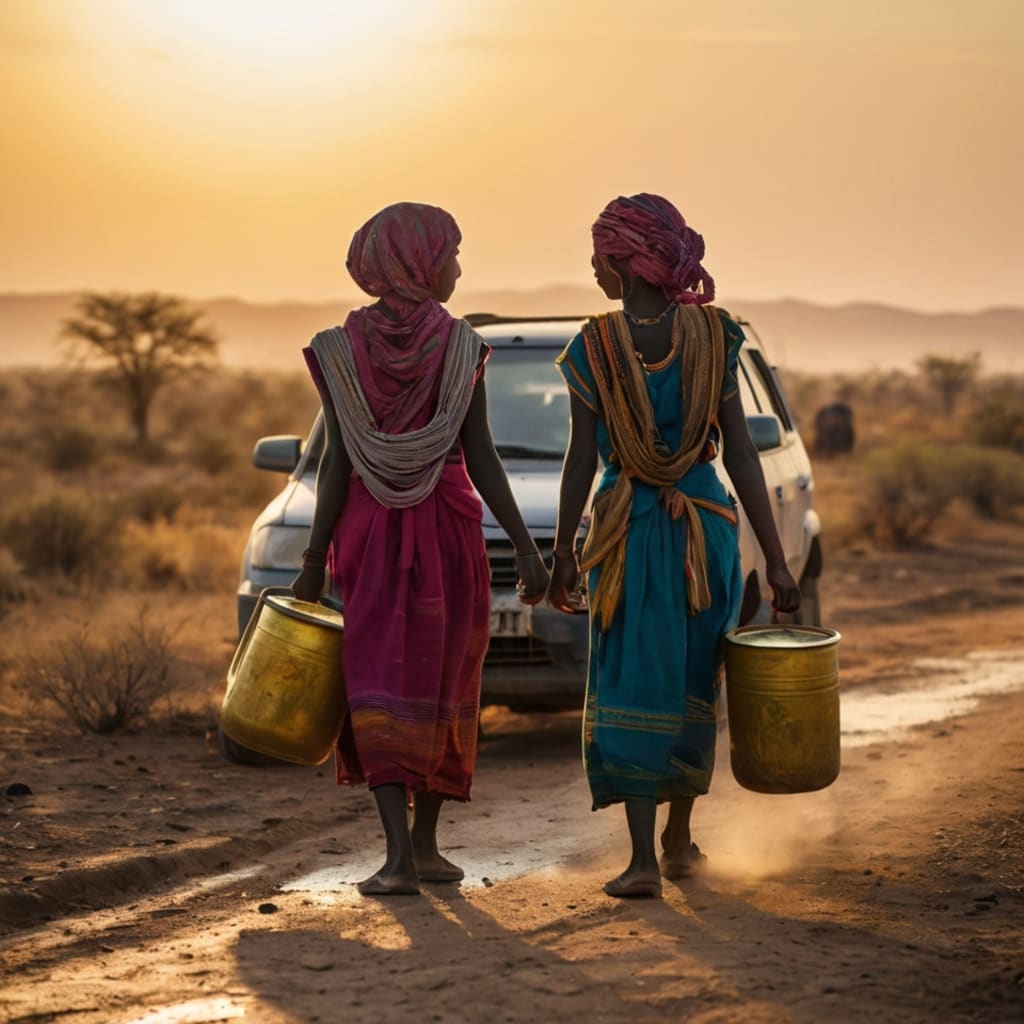
The Nomad’s Daughter
BY:Khan
Justice Asim steered his car off the paved road and onto a rough dirt track. Immediately, dust rose around the vehicle, coating it in a brown haze. The journey ahead was long, and for miles there was no sign of habitation. Beside him sat his attendant, Sarfaraz, a sharp and educated young man who helped manage both Asim and his father’s business affairs.
Though Asim was a well-off, educated, and handsome man, there wasn’t much age difference between the two companions. As they drove on, Sarfaraz noticed a small group of nomadic girls walking barefoot in the heat. Their faces were weary, their lips parched from thirst. Curious, Sarfaraz stepped out of the car and approached them.
“Sisters, could you spare us some water?” he asked politely. “I’ll pay you for it.”
One of the girls sneered, “Go away, city n. Water doesn’t come easy here. We walk a mile to fetch it.”
But another girl, standing quietly in the middle, spoke up with kindness. “I will bring you water. I don’t want any money.”
By then, Asim had driven up to them and overheard her words. He admired her sincerity but insisted, “No, you must take payment. Water in this heat is precious.” He pulled out three crisp hundred-rupee notes and handed them to the three girls. After they fetched the water, he thanked them warmly.
Meanwhile, Sarfaraz checked the car and discovered a troubling problem: both rear tires had gone flat. Traveling further seemed impossible.
The kind nomadic girl stepped closer. “What happened, sahib?”
“Our tires are gone,” Asim explained.
“Don’t worry,” she replied. “Our hut is nearby. My brother will help. He can fetch air from the town.”
Sarfaraz stayed back with the car, while Asim followed the girls. The kind one introduced herself as Bhooli. She led Asim to her family’s cluster of mud huts. She offered him a charpoy to rest on, handing him a clean towel and expensive soap. Asim was surprised—such items seemed out of place here.
Then he noticed a disturbing scene outside: an old man was beating a young woman viciously. Asim sprang up to intervene, but Bhooli stopped him. “Sahib, this happens every day,” she whispered.
She explained, “That man bought his wife for lakhs of rupees. She must bring him money daily. If she earns less than fifteen hundred rupees, he beats her.”
Asim’s stomach tightened at her words. He had always known poverty existed, but here it stared him in the face in its most brutal form.
Soon after, Bhooli’s brother, Hameeda, arrived in a donkey cart. Several weary women sat in the cart, and as soon as they climbed down, their husbands collected the day’s earnings from them. Bhooli introduced her brother to Asim and explained the situation with the car.
Hameeda agreed to help—but only on one condition. “You must drive me into the city to find my wife, Bijli. She disappears for a day or two whenever we fight. I love her dearly and need her back.”
Asim promised.
On the way to town, Hameeda confided more about their traditions. “Here, a man must pay lakhs to marry. Our women are our source of income. My wife Bijli, too, was bought for a heavy price. Each morning, our women leave at the first call of prayer, and by evening they return with money, which we men collect.”
Hearing this, Asim looked at Bhooli with new eyes. Despite being trapped in such a system, she had shown him generosity, dignity, and compassion.
As the three men drove toward the city, they saw a crowd gathered at a crossroads. Police had cordoned off the area. A young woman’s body lay there, her face crushed beyond recognition, scattered currency notes fluttering around her.
Hameeda screamed in horror, fearing it was Bijli. But the police quickly covered the body and carried it away without letting anyone confirm her identity.
Grief-stricken, the men returned to the huts at sunrise. But as Hameeda rushed inside, his despair turned to joy—Bijli was alive, nursing their child. She had given blood in the city to save an injured girl’s life and had just returned home.
Overcome, Hameeda embraced her, weeping with relief. Bijli, too, was shaken. Holding her daughter close, she declared, “City people educate their children. I will educate my daughter too. She will not live the life I lived—she will grow to serve this nation.”
Her words silenced everyone. Even Sarfaraz and Asim were astonished that a nomadic woman, bound by such harsh traditions, held such noble dreams.
At that moment, Asim made a decision that would change everything. He would marry Bhooli, no matter the cost. She deserved a life of dignity, and he saw in her a strength and purity no riches could buy. As for the marriage his father had arranged with the village landlord’s daughter in Dunyapur, Asim resolved that his loyal attendant, Sarfaraz, would wed her instead.
And so, in that dusty encampment where suffering seemed endless, a spark of hope ignited. Through Asim’s decision and Bijli’s dream, a vision of a brighter, more just future began to take shape—like the first rays of dawn after the darkest night.
About the Creator
When the Sky Burned Red
When the Sky Burned Red The first bomb did not sound like thunder. It sounded like the sky tearing apart. Aamir had never heard silence scream before. But that morning, when the explosion shattered the windows of his small family home, silence screamed louder than the blast itself. For a moment, everything froze — the birds mid-flight, the wind mid-breath, his mother’s voice mid-sentence.
By Tazamain khan 4 days ago in Humans


Comments
There are no comments for this story
Be the first to respond and start the conversation.