
The Long Walk to Freedom
He Was a Prisoner Who Became a President, a Revolutionary Who Became a Reconciler.
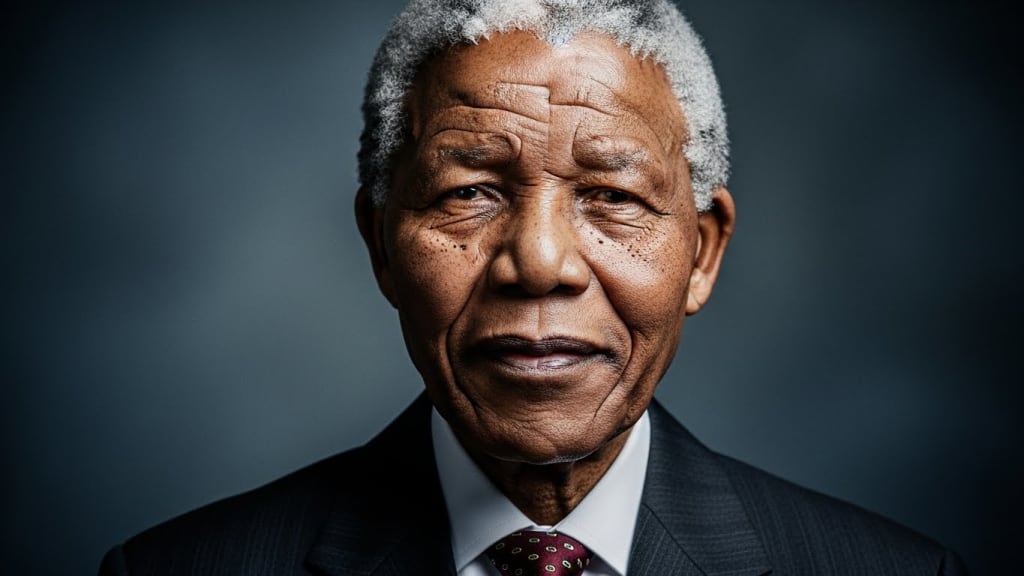
The story of Nelson Rolihlahla Mandela is not a simple one. It is the story of a man who was forged in fire, not broken by it; a man whose greatest strength was not in his defiance, but in his capacity to forgive.
He began as a young lawyer in Johannesburg, confronting the brutal, systemic racism of Apartheid—a legal framework designed to keep South Africa's Black majority in a state of permanent subjugation. It was a system that declared people like him inferior based on the color of their skin. Mandela’s initial resistance was through the law, but when peaceful protest was met with violent repression, he helped found the armed wing of the African National Congress (ANC), believing that sometimes, the only language a tyrant understands is force.
For this, he was branded a terrorist.
In 1964, from the dock of the Rivonia Trial, facing a possible death sentence, he spoke words that would echo through history: "I have cherished the ideal of a democratic and free society in which all persons live together in harmony and with equal opportunities. It is an ideal which I hope to live for and to achieve. But if needs be, it is an ideal for which I am prepared to die."
He was sentenced to life imprisonment.
For 27 years, the world knew him as Prisoner 46664 on Robben Island. He was subjected to hard labor in a limestone quarry, the glare permanently damaging his eyes. He was allowed one visitor and one letter every six months. The Apartheid regime sought to bury him, to erase him from memory, to break his spirit.
But they failed. Robben Island became his university. He disciplined his mind and body. He taught his fellow prisoners, and he learned from them. The prison that was meant to crush him instead refined him, stripping away anger and replacing it with a steely, strategic patience. He understood that to lead his nation one day, he first had to conquer himself.
Then, in 1990, the impossible happened. Amidst growing internal strife and international pressure, South African President F.W. de Klerk released him. Mandela walked out of prison, a free man, his fist raised in triumph, but his heart free of vengeance.
The world expected a fiery revolutionary, hungry for retribution. Instead, they found a statesman.
He knew that a South Africa liberated by bloodshed would be a South Africa doomed to perpetual civil war. His mission was no longer to defeat the white minority, but to unite with them. He championed reconciliation, a concept so profound it seemed almost superhuman. He had tea with the widow of the architect of Apartheid. He wore the Springbok jersey, a symbol of white Afrikaner pride, and presented the Rugby World Cup to the South African team, a moment that began to heal a nation's deep racial wounds.
In 1994, in the first democratic election where all races could vote, he was elected President. He did not seek to punish the old regime. Instead, he established the Truth and Reconciliation Commission, a revolutionary act of national therapy. It offered amnesty in exchange for the truth, believing that acknowledging the pain was the first step toward healing it.
After a single term, he stepped down, setting a powerful precedent for democratic transition in a continent plagued by leaders who clung to power for life.
Nelson Mandela’s legacy is not that he was a perfect man, but that he was a transformative one. He demonstrated that the path to true freedom is not through destroying your enemy, but by recognizing their humanity. He proved that leadership is not about power, but about service; not about pride, but about humility. His long walk was not just for himself, or for South Africa, but for everyone who believes that justice, forgiveness, and human dignity can light the way out of the darkest of times.
About the Creator
HAADI
Dark Side Of Our Society
"My Wife is Crazy": The Oldest Lie in the Book
It starts the same way every time. You are having a drink, or maybe chatting near the office coffee machine, and the tone shifts. He lowers his voice. He looks tired. He tells you that things at home are... difficult. He doesn't want to get into it, but then he gets into it.
By All Women's Talk2 days ago in Humans



Comments
There are no comments for this story
Be the first to respond and start the conversation.