
The Little Brown Lilac
In The Birchbark Napoleon's Notebook
For over a decade I worked as a tour guide, or rather on onboard train attendant on the Rocky Mountaineer in Western Canada from 1996-2007. I loved that job, well most of the time. The long hours or showing up to the train station on what would otherwise be a day off for a three-hour baggage duty was less than desirable, but overall it was great to be a professional bullshitter, as friends often chided me.
Taking tickets, chatting, answering questions, serving snacks, drinks, meals and relating the stories of how the railway would be completed across the difficult Canadian Rockies to the Pacific. It was a monumental task that was the realization of a promise to British Columbia to join the newly formed country of Canada lest the territory that had recently been overrun with American gold rush seekers, mostly up from California
The two main aspects of that job were to provide onboard commentary to the passengers, and this is a high ticket ride so an emphasis on professionalism is appreciated but, really, if you consider the long days and the sometimes reality that travel can be taxing half the time, or more, people just want to have a laugh. Standing up in front of 30, 40, 50 or more people can be either exhilarating or daunting but a universal truth is that if you can break the ice with a laugh then it sure eases the way to educating or informing.
One of my ice breaker stories was when a coworker was asked by a passenger in the Gold Leaf dining car to have her Eggs Benedict taken back and redone as it was soft and she had requested hard. No biggie you would think, just ask the chef to redo the order but, speed is of the essence, the other diners were dining already, the chef was busy and Brent had the immediate response to just quickly “zap” it in the microwave. He did not realize the effect that would have on the yoke…so in a matter of seconds really, he delivers the redone order to the guest and she promptly delves into the dish, knife in hand and with an unexpected burst of built-up pressure in the yoke due to having just been zapped the yolk burst like Mt Etna on and overall diners at the table. The gentleman sitting directly across had yoke dripping off his long, overgrown, white eyebrows, was completely taken aback. We were wiping off egg yolk every shift from the ceiling, in little nooks and crannies, in that car for weeks.
But the thing that really inspired me in that position though was history; to learn as much as I could about the part of the world that we were not only traveling but where I had been born & raised. The flora and fauna, the geography, the history, the native first nation’s history, and everything in between kept you busy in amongst the everyday minutiae to be discussed. You had two full days to “comment” on things so the more prepared you were the better for everybody.
To be able to personalize the history is far and away from a much more impactful way of relating a story. One of my forefathers in London, George Cruikshank, was a famous illustrator and caricaturist, whose one great claim to fame was being the illustrator for Charles Dickens in his lauded novel Oliver Twist met and befriended George Simpson, sometime around 1847 in London. Simpson was a slight Scottish bulldog of a man and controlled the mighty Hudson’s Bay Company in British North America. He was there briefly after his round the world trip and had just been married in London.
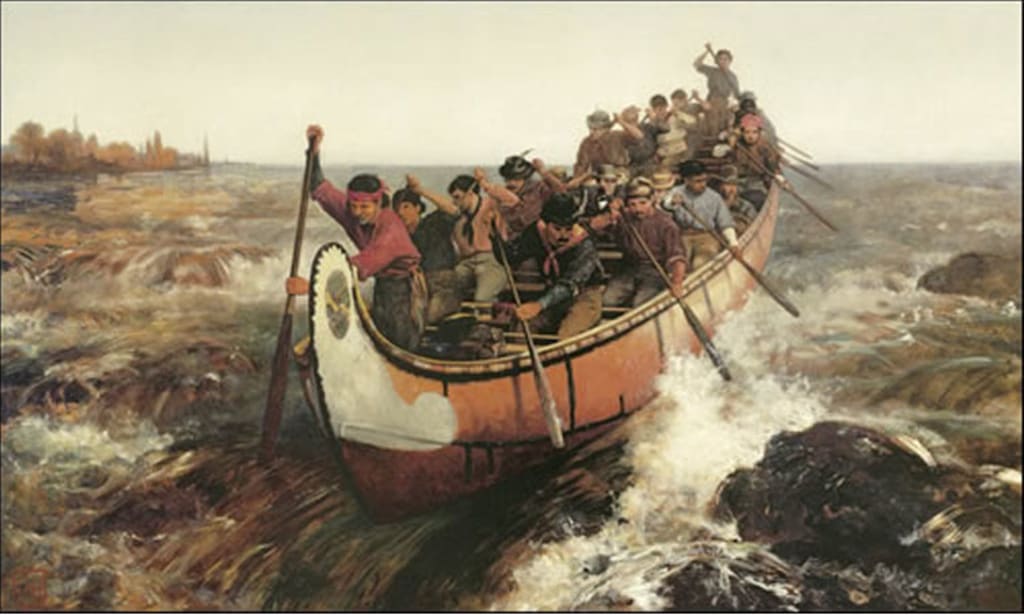
George Simpson had been the Governor of the Hudson’s Bay fur trading company; the company that had a royal charter from the King of England since 1672 with a monopoly to trade in all the watersheds that drained into Hudson’s Bay, called Rupert’s Land, after the king’s cousin, Prince Rupert. He had just published his account traveling around the world overland in 1847 (to later be considered as an inspiration for Jules Verne’s work “Around the World in 80 Days” published in 1872). Since 1820 or so when Simpson had taken the reins of the fur trading titan he was famous for his stamina and how he would be able to drive his voyageur paddlers in their large freight canoes to paddle from the Great lakes area to the mouth of the Columbia River in 60 days! Imagine.
Both Simpson and my Great great grandfather were horse fanatics and had struck up a friendship at the track while Simpson was in London. It didn’t take long to realize that Simpson was a treasure trove of inspiration for stories and what was offered up was one of his personal journals that detailed exploits across the vast territory of the Hudson’s Bay trading empire. There were no photocopiers in the 1840’s so it was agreed he could borrow the journal for just long enough for enough passages to be transcribed by hand. It took a couple of days.
It had sparked Cruikshank’s interest as he was on the outs with Dickens as Cruikshank had claimed partial credit for the famous novel Oliver Twist and none was given. He was looking for inspiration for new avenues for his work, and the British North American fur trading landscape might just have been the place. It was a New World rife with stories of conquest and adventure!
And Simpson had stories beyond imagination. He had control of one of the largest trading empires on the planet and had to oversee it, for the most part in a birch bark canoe. A trader could embark a journey just west of Winnipeg and, with a portage no longer than a day be at the Arctic, the Pacific, the Atlantic or the Gulf of Mexico. There was plenty to write about. And write he did. He filled notebook after notebook with amazing accounts.
Manifest Destiny was a battle cry from the American bully pulpits for the entirety of the North American Continent in the early 1800s. George Simpson, later to be knighted with the title “Sir”, foresaw the unveiling of macro level geopolitical events of his time, and through a series of shrewd actions and decisions staved off the encroachment of the Americans which eventually allowed for the breathing room to build the railway that would bind our country while the Americans were otherwise occupied with their Civil War and led to the ultimate formation of modern-day Canada.
Long before, decades before the advent of the telegraph and the birth of modern-day communications, the supply ships to London England and back took months for effective communication of vital information to be delivered. To effectively evaluate the fur trading forts & the men who ran them upon inspection, typically by canoe, he needed to be able to capture the moment, what’s working and why? Who is responsible for what’s working or not working? His deftness and ability to document all manner of activities in all corners of the British North American fur trading allowed him to gain control of the fur trading empire in 1821 and hold an iron grip on it until 1860.
In the early 1800s, George Simpson could have gone down in the history books as a slight unassuming Scottish man, but fate had its own course for his life. He was an illegitimate son, a big deal in the Victorian era, but had an accomplished Uncle that took him under his wing, and with all the favor of a powerful family influence took to his first job in London England in a Sugar Brokerage company who rose to become the head of the largest trading company of it time was no small feat.
But he became the “Birchbark Napolean” of the Canadian frontier. He traversed the northern territory by freight canoe with his Iroquois paddlers. It was assumed that he admired the French Emperor Napoleon because of his similar stature, both short men, and proudly hung a commanding portrait of Napoleon in his office to greet visitors upon their arrival. He dominated the Hudson’s Bay Company for four crucial decades and through his muscular corporate work ethic that overwhelmed friend and foe alike he was an integral part of forming modern day Canada. He inspired the scorched earth policy of trapping out the valleys north and west of the Montana northern mountain ranges, frustrating the Mountain men of American myth and preventing any further expansion northwards.
The journal ended up being passed down to my grandmother who recently passed and ended up in my hands as part of an inheritance. Cruikshank had never used its contents as desired. Turns out he was truly an illustrator and did not have near the touch of Dickens with the pen put to word over image. And thus consoled himself to sticking to what he was good at and in the end ended up with a portfolio of over 10,000 illustrations to his credit.
I love history and appreciate the men and women that strive to create it and be known for it. Exploration and settlement of the Canadian frontier by men and women of various backgrounds, indigenous First Nations, British, French, other Europeans, and the Chinese, that helped build the railway. Names that were not necessarily in it for the money, well, let’s be honest, most were likely working for commerce but there were the early explorers that were looking for their bit of fame, their name on the map, literally.
This little hide bound book journaling the feats of a Napoleonic titan of the pre Canadian frontier ended up shunted aside, lost in the shuffles of paper and cabinets for over a century until landing in my mailbox, Feb 2021, along with the probate papers of my grandmothers will. Being an enthusiast of Canadian frontier history I was always entertained by her accounts of early life on the Canadian Prairie. I think she knew I would appreciate this journal and included this note;
Dear Rodd,
I thought you may appreciate this; it’s been in the back of your grandfather’s closet in a shoebox of relics since the 50’s.
Love,
Nana
After some careful handling of the journal I found a couple of pages had been stuck together, worn yellow with age, weathered looking like they hadn’t been touched for six or seven decades. What slips out from between the pages and falls to the ground like a fluttering feather was almost discounted but boy am I glad I noticed the faint squiggly lines on the head because it drove me to really pay attention and see exactly what it was. And what it was was an 1884 rare British brown lilac stamp. Somebody along the way never got a package sent off. I know how that feels.
Turns out it’s worth a pretty penny! Two million pennies worth, or $20,000. Wow. Thanks Grandma! A bit of history is interesting yes, but a bit of history that people will pay you for Hell Yeah!!
About the Creator
Keep reading
More stories from writers in Humans and other communities.
Cabin Fever Because of Snow, Sleet, and Freezing Rain That Turned to Icy Roads
What Is Cabin Fever? The short answer is that cabin fever is restlessness from being in a confined area. Cabin fever is the distressing irritability or restlessness experienced when a person or group is stuck at an isolated location or in confined quarters for an extended time. Research shows that prolonged cold, gray skies, and being stuck indoors can trigger mood shifts similar to “winter blues.”
By Margaret Minnicks2 days ago in Humans
Why Supportive Relationships Are Essential For Long Term Mental Health
Positive relationships also satisfy one of the most basic human needs, which is a sense of connection and belonging. People are very social creatures and emotional attachment is a crucial factor in ensuring psychological balance. When people feel that they are connected to others they become more emotionally secure and less isolated. This attachment is important in controlling emotions and developing a stable emotional foundations which sustain mental health in the long term. Positive connections make people always reminded that they are important and comprehended, which increases resilience in terms of emotions and enhances a high level of psychological wellbeing in the long run.
By Willian James4 days ago in Humans
Killing him slowly
There’s an intruder in my house again. He stumbles through the door, wet carrier bags in hand. He’s bought me offerings. I show my appreciation, letting him caress my beautiful body. He wants to touch me. I rub myself against his legs. He sighs, dropping the bags. He can’t resist touching me. Running his hand slowly down my spine, I arch my back towards his caress, let out a low purr. It’s what we both need.
By N J Delmas6 days ago in Horror


Comments
There are no comments for this story
Be the first to respond and start the conversation.