
The Life and Legacy of Mahatma Gandhi: The Father of the Nation
A Man who waged War against a Imperial Nation with No Weapons
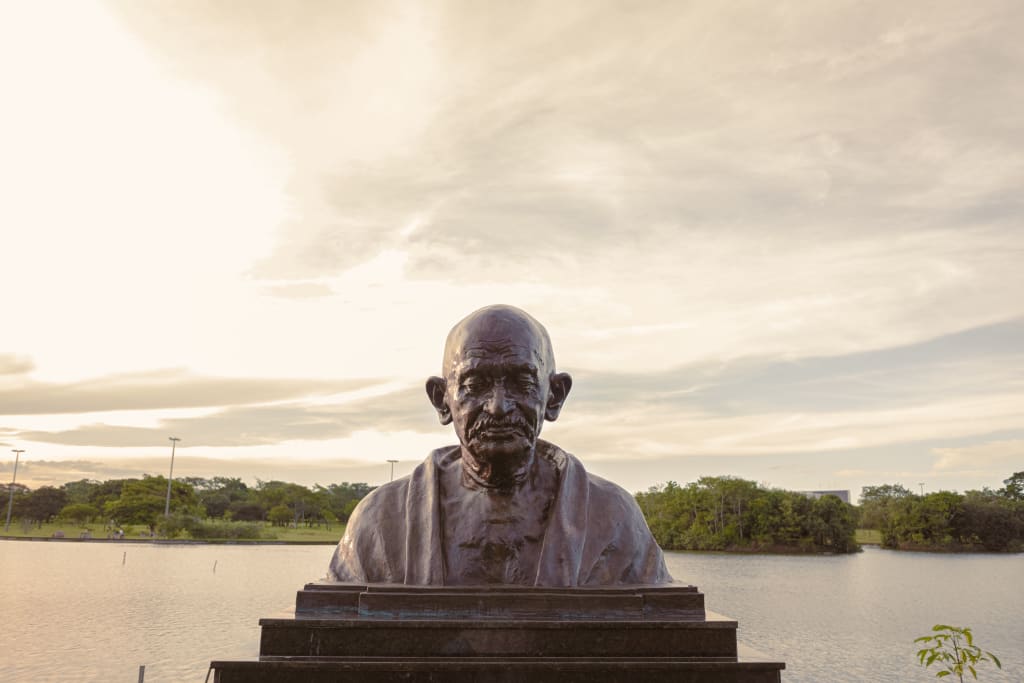
Mahatma Gandhi, also known as Mohandas Karamchand Gandhi, was a leader in India's independence movement against British rule.
He was born on October 2, 1869, in Porbandar, a coastal town in present-day Gujarat, India. He is widely considered as one of the greatest leaders of the 20th century, and is revered as the "Father of the Nation" in India.
Early Life and Education:
Gandhi was the youngest of his parents' three children. His father was the chief minister of the small state of Porbandar, and his mother was a devout Hindu who worshiped at the temple every day.
Gandhi was a shy and quiet child, but he was also very curious and inquisitive. He received a good education and was especially interested in history and religion.
In 1888, Gandhi left India to study law in London. He was not a strong student, but he worked hard and eventually qualified as a lawyer.
After he returned to India in 1891, he struggled to find work as a lawyer and was only able to secure a few minor cases.
The Turning Point:
Gandhi's life took a significant turn in 1915, when he was hired by the Indian National Congress to represent Indian interests in South Africa.
He was shocked by the discrimination and prejudice faced by Indian immigrants there and became involved in the struggle for their rights.
It was during this time that Gandhi developed his philosophy of nonviolent resistance, which he called satyagraha.
Return to India and Independence Movement:
In 1915, Gandhi returned to India and became a leader in the Indian National Congress. He used satyagraha to lead nonviolent resistance campaigns against British rule, including the Salt March of 1930 and the Quit India Movement of 1942.
These campaigns helped to galvanize the Indian independence movement and put pressure on the British government to grant India independence.
On August 15, 1947, India finally gained independence from British rule. However, the country was divided along religious lines, with Hindu-majority India and Muslim-majority Pakistan.
The partition resulted in widespread violence and suffering, and Gandhi was deeply saddened by the turn of events.
Gandhism:
Gandhism designates the ideas and principles Gandhi promoted; of central importance is nonviolent resistance. A Gandhian can mean either an individual who follows, or a specific philosophy which is attributed to, Gandhism.
M. M. Sankhdher argues that Gandhism is not a systematic position in metaphysics or in political philosophy. Rather, it is a political creed, an economic doctrine, a religious outlook, a moral precept, and especially, a humanitarian world view.
It is an effort not to systematise wisdom but to transform society and is based on an undying faith in the goodness of human nature. However Gandhi himself did not approve of the notion of "Gandhism", as he explained in 1936:
There is no such thing as "Gandhism", and I do not want to leave any sect after me. I do not claim to have originated any new principle or doctrine. I have simply tried in my own way to apply the eternal truths to our daily life and problems. The opinions I have formed and the conclusions I have arrived at are not final. I may change them tomorrow. I have nothing new to teach the world. Truth and nonviolence are as old as the hills.
Assassination:
Gandhi continued to work for peace and unity in India until his death on January 30, 1948. He was assassinated by a Nathuram Godse who opposed his views on religious tolerance and nonviolence.
Legacy:
Gandhi's legacy continues to influence political and social movements around the world. He is remembered for his advocacy of nonviolence and his ability to bring about political change through peaceful means.
He is an inspiration to people of all backgrounds and beliefs who are working to create a more just and equitable world.
Mahatma Gandhi was a visionary leader who dedicated his life to the pursuit of justice and equality. His philosophy of nonviolence and his tireless efforts to bring about change through peaceful means continue to inspire people around the world.
He will always be remembered as the "Father of the Nation" in India and as one of the greatest leaders of the 20th century.
About the Creator
Keep reading
More stories from vetti pasanga and writers in Humans and other communities.
"Artificial Intelligence is the Future: The Rise of Intelligent Machines"
Introduction: Artificial Intelligence (AI) has come a long way since its inception in the 1950s, and today it is one of the fastest-growing and most exciting fields in technology. With AI-powered machines and systems now able to perform a wide range of tasks, many experts believe that AI is the future, and that it has the potential to revolutionize the way we live and work. In this blog, we'll take a closer look at AI and explore why it is poised to play such a significant role in the years to come.
By vetti pasanga3 years ago in Futurism
Lost and Alone in the French Alps
Looking back, I can trace some of my life’s biggest adventures to a simple action from my sister. She’d introduced me to Tommy (a very long time ago), a colleague of hers, who had overshared his penchant for Italian-looking women, and I ticked that box.
By Chantal Christie Weiss20 days ago in Humans
Wild Card Weekend Recap: What Happens Now?
I think I figured out why I love Wild Card Weekend so much. It's because it's the first playoff anything of the calendar year. The NFL season starts in the fall, and once upon a time, the champion was crowned either on or slightly before New Year's. The evolution of the NFL schedule has resulted in the playoffs starting just into the New Year, and currently, the final week of the season falls on the first weekend of the New Year, with Wild Card Weekend coming a week after that. So yes, chronologically, the NFL's Wild Card Weekend serves as the first playoff anything of the calendar year.
By Clyde E. Dawkins7 days ago in Unbalanced



Comments (1)
👍