
The Last Letter
Peace Is Learning to Understand Before It’s Too Late


When the phone rang that morning, Aisha almost didn’t answer.
It was early, and she was halfway through packing boxes — another move, another beginning. She’d been living like that for years — one city to the next, chasing work, escaping silence.
The name on the screen stopped her.
“Abbu.”
Her father.
They hadn’t spoken properly in nearly five years.
She let the phone ring twice before she answered.
“Hello?”
The voice on the other end was thinner than she remembered. “Aisha beta… it’s Baba.”
He still called himself that, even after she stopped.
“I’m… not well,” he said after a pause. “I’d like to see you. Before…”
He didn’t finish the sentence. He didn’t have to.
The bus ride to her hometown took nine hours. Outside the window, the landscape passed in long, muted colors — dusty fields, cracked roads, the same tea stalls she remembered from childhood.
She hadn’t seen her father since the argument. The one that began with something small — a job offer abroad — and ended with doors slamming, words breaking, hearts closing.
He wanted her to stay close.
She wanted to see the world.
Neither had understood the other.
And in that space of pride and pain, peace had disappeared.
When she reached the old house, everything looked smaller. The same walls, the same jasmine plant near the gate, though the flowers were fewer now.
She knocked softly. The door opened after a moment — her father stood there, older, thinner, but still with the same kind eyes.
For a few seconds, neither spoke. Then he smiled faintly. “You look tired. Come in.”
She stepped inside. The air smelled like cardamom tea and dust — memories frozen in time.
Over the next few days, they spoke carefully, like people walking on cracked ice.
He asked about her work. She answered politely. She asked about his health. He shrugged.
They shared meals, mostly in silence.
But silence, she realized, wasn’t always empty. Sometimes, it was full of everything you wanted to say but didn’t know how.
One evening, while sorting through his old papers, Aisha found an envelope — yellowed and sealed with tape.
Her name was written on it in his handwriting.
“For Aisha — open when you’re ready.”
She hesitated, then slipped it into her bag.
Later that night, when he was asleep, she sat by the window and opened it.
Inside was a letter. His handwriting shaky but clear.
My dearest Aisha,
I know we have both said things we can’t take back. I was wrong to try to keep you close when I should have let you fly. You were right to want a bigger life, but I wish you had known how much of mine stayed behind when you left.
I was afraid. Not of losing you, but of being forgotten by you. Every parent fears that, I think.
If peace ever finds you, let it begin here — by forgiving me for not understanding you sooner.
I have saved all your postcards. Every single one.
With love,
— Abbu.
Aisha pressed the letter to her chest. Tears came quietly, not in sobs but in soft, trembling waves.
All these years, she had carried anger like armor. But now, reading his words, she realized something simple: peace doesn’t come from winning an argument. It comes from listening to the love beneath the silence.
The next morning, she made him breakfast — parathas just the way he used to make for her.
He smiled when he saw the tray. “You remember.”
“I never forgot,” she said softly.
They ate together — not saying much, but sharing something whole again.
Over the following week, they talked more. About her travels. About his younger days. About her mother — gone too soon.
She learned things she’d never known before: that her father used to write poetry, that he once dreamed of seeing the sea, that he still hummed her mother’s favorite song when he watered the plants.
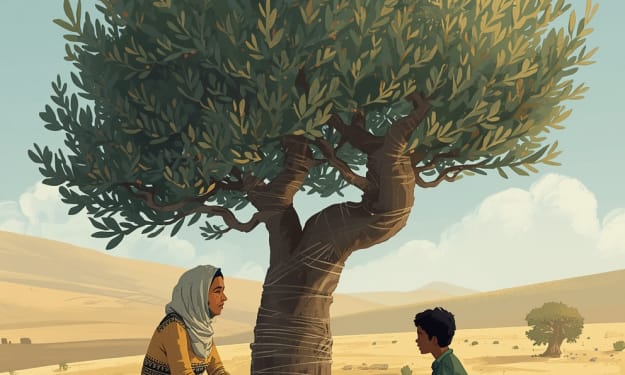
One afternoon, she found him sitting outside under the neem tree, eyes closed, face tilted toward the sun.
She sat beside him quietly.
“Do you still hate me for the things I said?” he asked suddenly.
Aisha shook her head. “No, Abbu. I think I understand now.”
He smiled faintly. “Then maybe we both grew up.”
A week later, he was gone. Peacefully, in his sleep.
The house felt heavier than ever, but this time, Aisha didn’t feel lost. She sat under the same neem tree, letter in hand, the wind moving gently through the branches.
She whispered, “You were never forgotten.”
Months passed. Aisha returned to the city, but something inside her had changed. She still worked, still moved often — but she carried less noise within her.
On her desk, she kept the letter, folded carefully. Whenever life felt too loud, she would read the last line again:
If peace ever finds you, let it begin here.
And each time, it did.
Years later, she planted a neem tree outside her own home. When people asked why, she’d smile and say,
“It reminds me of forgiveness — strong roots, soft shade.”
Under its branches, she often sat with her tea, the morning breeze whispering gently.
And though she couldn’t hear his voice anymore, she could feel it — calm, forgiving, alive in the quiet.
The kind of peace that doesn’t fade.
About the Creator
M.Farooq
Through every word, seeks to build bridges — one story, one voice, one moment of peace at a time.
Top 10 Uniform Dating Sites and Apps to Meet Uniform Singles in 2026
In the vast and often fragmented landscape of modern romance, finding a partner who embodies discipline, courage, and a strong sense of duty can be a challenging endeavor, which is why specialized Uniform Dating Sites and Apps have surged in popularity throughout 2026. These niche platforms cater specifically to the men and women who serve our communities and countries—including military personnel, police officers, firefighters, and medical professionals—as well as the admirers who value the stability and integrity often associated with these professions.
By Tiana Alexandra7 days ago in Humans
The Ritual of Winter Challenge Winners
Welcome to the Winners Announcement for The Ritual of Winter challenge. This prompt focused on winter rituals and the meaning that settles into them over time. The top pieces stay grounded in ordinary acts and repeated routines, letting winter shape the work through pace, attention, and restraint.
By Vocal Curation Team4 days ago in Resources


Comments
There are no comments for this story
Be the first to respond and start the conversation.