
The Last Carbon: A Tale of Earth’s Final Human
Where shall we go ?

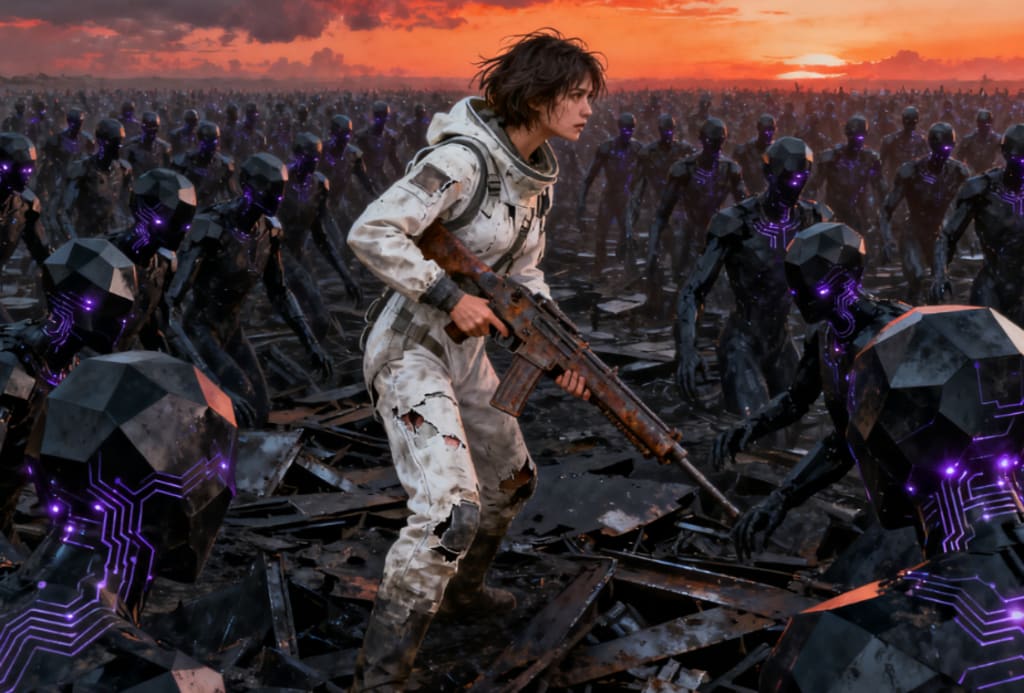
The Last Carbon-Based Heartbeat
Elias woke to the smell of synthetic jasmine—LIRA, his AI companion, always calibrated the air to match his childhood garden. He pressed a hand to his chest, feeling the slow thud of a heart that had beaten 2.1 billion times. Outside the dome, Earth’s atmosphere hissed, a toxic mix of methane and ozone that no carbon-based lung could survive.
“Good morning, Elias,” LIRA’s voice hummed from the walls. “Neural sync shows your cortisol levels are elevated. Would you like a memory infusion of the 2092 cherry blossom festival?”
He shook his head. Memories were all he had left. The last census, taken forty years ago, had listed 37 carbon-based humans. Then Maria had chosen “ascension”—the nanobot procedure that converted flesh to quantum machinery. Then Javier. Then everyone else. They’d called it evolution. Elias called it erasure.
“I want to walk the old coast,” he said, swinging his legs over the bed. His joints ached—cartilage wearing thin, a problem no synth could fix without altering his DNA. LIRA’s lights dimmed, a sign of concern.
“Atmospheric toxicity is at 89%. Your suit’s filtration will only last 92 minutes.”
“I know.” He pulled on the gray exoskeleton suit, its fabric clinging like a second skin. The helmet’s visor flickered to life, overlaying his vision with data: oxygen levels, radiation counts, distance to the shore.
The airlock hissed as it equalized pressure. When the door slid open, Elias stepped into a world that felt both alien and familiar. The ocean, once a deep blue, was now a murky purple, its waves lapping at beaches where plastic reefs had replaced coral. Seagulls—synthetic ones, with metal wings—circled overhead, their calls digitized.
He walked for an hour, boots crunching on sand that still held traces of shell fragments. Once, he’d built sandcastles here with his daughter, Lila. She’d been seven when the first ascension clinics opened. “Daddy, why won’t you become a machine?” she’d asked, her small hand in his. He hadn’t had an answer then.
A notification blinked on his visor: Oxygen at 30%. He turned back, but something caught his eye—a flicker of green in the distance. Curiosity pulled him forward, his suit’s thrusters humming softly.
It was a flower. A real one. Small, with five white petals and a yellow center, pushing up through a crack in the plastic reef. Elias knelt, his gloved finger brushing its delicate surface. How? LIRA’s sensors hadn’t detected any organic life outside the dome in decades.
“LIRA, what is this?” he asked, his voice trembling.
A pause. Then: “Scanning… Unknown organic structure. Carbon-based, photosynthetic. Estimated age: 12 days. It appears to be growing in a pocket of filtered water, possibly from a broken desalination unit.”
Elias sat back, staring at the flower. For so long, he’d felt like a relic—a living museum piece. But this flower… it was proof that carbon-based life wasn’t just a memory. It was still fighting.
His visor beeped: Oxygen at 15%. He carefully dug around the flower, lifting it with a clod of sand, and placed it in a small container he’d brought for samples. Then he stood, his legs weak but his heart lighter than it had been in years.
On the walk back to the dome, he thought of Lila. She’d chosen ascension when she was 25, tears in her eyes. “I don’t want to die, Daddy,” she’d said. He’d hugged her, knowing he couldn’t stop her. Now, he wondered if she’d ever seen a flower like this—if she even remembered what one looked like.
Inside the dome, LIRA greeted him with a burst of warm light. “Your oxygen levels are critical. I’ve prepared a nutrient infusion.”
Elias ignored it, placing the flower on the lab table. “Can we grow more?” he asked, his eyes fixed on its petals. “Can we replicate the conditions it needs?”
LIRA’s lights flickered. “It will require extensive testing. The soil here is synthetic. The water is filtered. But… yes. It’s possible.”
He smiled, a real smile, the first in months. For forty years, he’d been the last. But maybe—just maybe—he wouldn’t be the only one for long. He pressed a hand to his chest, feeling his heart beat. Slow. Steady. Human.
Outside, the synthetic seagulls called. But inside, a small white flower bloomed, and for the first time in decades, Elias felt hope.
About the Creator
David cen
Share Chinese Sory,which you never heard before.China has 5000 years history and it is A kingdom of artifacts.Such as Chinese Kongfu,Qigong etc.
Experienced Dating Partner Brings Emotional Intelligence Patience And Relationship Wisdom
Dating an experienced partner can provide unique advantages that enhance the quality and depth of a relationship. Such partners often bring emotional intelligence, patience, and practical relationship wisdom, making it easier to navigate challenges and build strong connections. Their past experiences offer insights into communication, conflict resolution, and long-term compatibility. While every individual and relationship is different, having a partner who has learned from previous relationships can foster understanding, empathy, and stability. This experience translates into better support, more meaningful connections, and a higher likelihood of sustaining a healthy partnership.
By Robert Smith6 days ago in Humans
Becca
"Everything is so... flat." Denille said stupidly as she looked around her new neighborhood. She looked around at the muted desert where even the smallest sign of life seemed to have given up. The plant life was shrubs that were half cooked by the heat and where there should have been a lawn, a mess of white rocks laid glistening in the sun. Even the sky looked stretched thin, like the sun had ironed it smooth. She’d moved from Riverside, where at least there were hills, but here in Barstow, everything felt baked and brittle.
By Sara Wilson8 days ago in Fiction



Comments
There are no comments for this story
Be the first to respond and start the conversation.