

It is accepted wisdom in China that when a bird shits on you, you should buy a lottery ticket.
When it happened to Fei, she was not in China – only Chinatown, outside the shop that, as long as she could remember, had red ducks hanging in the window. Now it was boarded up, and through the boards she could glimpse a sad ruin of commerce – empty boxes and a dusty counter, broken glass.
She was not given to superstition or risk, so the lottery ticket was left to someone else. She did, however, make an entry of it in her little black-bound journal, along with a brief calculation of the odds of the occurrence. She regretted not taking note of the bird species. Pigeons were plentiful throughout the city, but she had been clear of the eaves, and was fairly certain that pigeons do not relieve themselves in flight. A crow was a strong possibility.
In future, she would look back on the event with reluctant awe. Despite her best and most rational intentions, it would acquire the status of Omen.
The sequence of events began ordinarily enough. She went to the dry cleaners’, run by her aunt, to see what could be done about the stain on her jacket.
“It’s suede.” Said her aunt.
“I know that.” Said Fei. “Can you clean it?”
“It’s bird poop.” Said her aunt.
“I know that”said Fei.
“What am I supposed to do with bird poop on suede?”
“That” said Fei, “Is what I don’t know.”
“Hmmm” said her aunt. That was an indication that the matter would be a topic for lengthy family discussion.
“Bicarb..?” suggested Fei.
“Get out.” Said her aunt.
Glad to be relieved of responsibility for the garment, Fei went to the park to eat her noodles. It was a daily ritual. She bought the $8 lunch special at Wei’s, walked to the park, ate the noodles, scribbled briefly in her journal, and walked back to work. It all took exactly one hour. Today though the detour to the dry cleaners’ had cost her seventeen minutes. That was more than her total journal time. Even as she walked she was frantically reallocating what was left of the lunch hour. If she ate very quickly, she could eat half the food and still have time to record the bird poop incident. It was far from optimal, but the best to be achieved under the circumstances.
Fei abhorred waste, but she grimly emptied the remainder of the noodles into the bin. She would take the container home, as she always did, and wash it to reuse the next day. “You are single handedly saving the planet” Jason Wei never tired of remarking as she presented it for filling. She was under no such illusions.
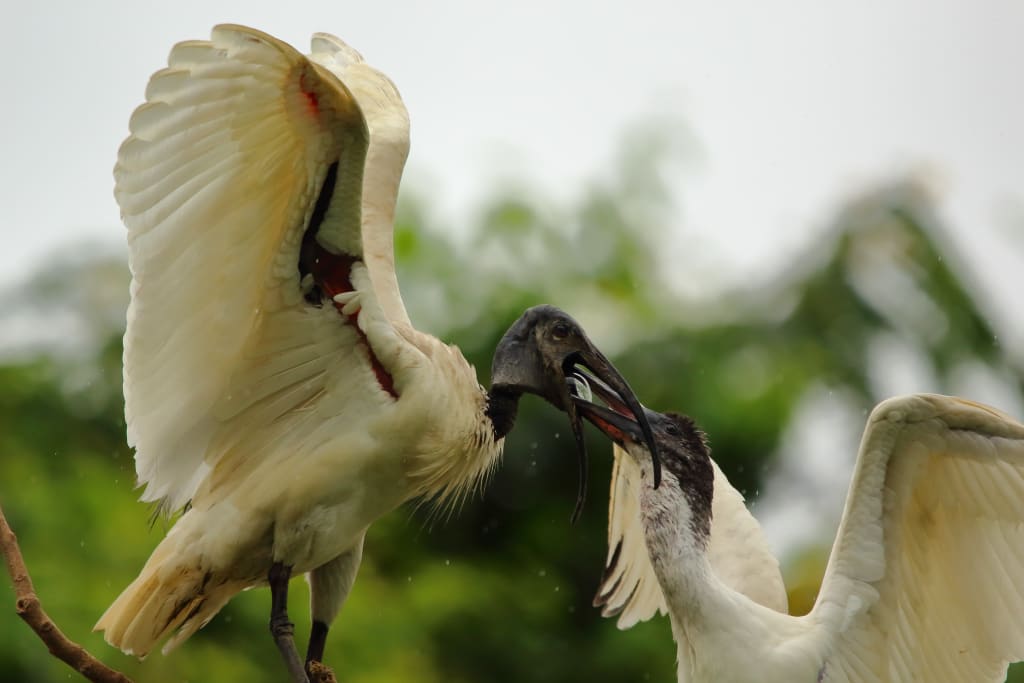
An ibis eyed her obliquely from a safe distance. “Help yourself” Fei told it. No sooner had she stepped away than the ibis swooped past her, perched on the bin’s edge, and tucked into the leftovers.
The afternoon at work was hectic, and Fei at last was looking forward to going home to a hot strong shower, when she realized that she had left her wallet in the pocket of her jacket. She had no money. She had no bus card. She phoned her aunt.
“Dear, I don’t know what you expect me to do. I’ve closed the shop. I’m cooking dinner. Call your brother.”
Fei was not about to call her brother. She guessed it was as hour’s walk home, and she started walking. Her shoes were not suitable, and she was cold because she had no jacket. She began to sob, at first just quietly, but soon loudly and rhythmically, supposing no-one could hear her who might actually care.
That is when she met the Elegant Man. She called him that, in her journal, despite the fact that his white suit might have been worn by a Cuban pimp, and had, in any case, seen better days. He had black skin and short, crinkly hair. His face was narrow and chiseled. He was tall and thin, with a languid baring, a way of moving as if half in a trance.
“Please don’t cry, Miss.” He said, sliding up beside her. “I become terribly affected by a woman’s tears.”
Fei apologized automatically. The Elegant Man stepped in front of her and tipped his head to one side. “No no no” he said. “You should not apololgise. After all, I am sure you are in some very straitened circumstance, and have every reason to bawl. You should not let strangers tell you how to be. Is there any way I can help?”
She shrugged. “Do you have a car?”
“No.” He told her. “I do not drive. Although I know plenty of people who do. I would not recommend you get in a car with any of them. Are you hungry? You look hungry.”
Fei thought he was about to ask her to dinner. Instead he produced a half eaten kebab. “I think you need this more than I.”
“thank you. I’m fine. Really…”
The Elegant Man looked baffled. “It is quite a good one. Please. I insist.”
“I’m vegetarian” Fei lied.
“Ah. Forgive me.” With that he unwrapped the roll, and painstakingly removed the pieces of meat, which he ate, hardly chewing them. When only salad remained, he reassembled the roll, wrapping it tightly in the foil, and presented it to Fei.
“You’ve been very kind” she said, “But I really must be going…”
“You are going home?”
It occurred to her that he might follow her. “no. I’m…I’m just running an errand.”
“you are cold” said the Elegant Man. He took off his coat. “it’s a long walk.” He said. “Pity you don’t fly.”
Before she could object he had draped the coat around her shoulders, and loped off into the night.
The next day Fei again lost seventeen minutes from her lunch hour. The detour to the dry cleaners’ was necessary to retrieve her wallet and her jacket. Even though she had no expectation of seeing him again, she presented the Elegant Man’s coat for a clean. She had discovered a small stain on the lapel.
“I think it’s kebab” she told her aunt.
“It’s a man’s coat” her aunt observed.
“He lent it to me because I had no jacket going home.”
“Hmmm”, said her aunt, so Fei knew she would shortly be on the phone to her mother.
In the park, she wolfed half her noodles. An ibis roosted next to her on the bench. “You can have the rest” she said to it.
The ibis released something from its beak. It was a tight roll of banknotes. It made no sense to question the bird, but she was prepared to do it anyway. “Where did you get this?” It flew off to investigate the bin.
Fei had always been good at counting. She counted, unerringly, fifty notes. Each of them was one hundred dollars. She quickly reassigned five of her remaining lunch minutes to working out what to do with them. Back at work she was undecided and distracted, and was still worrying the matter in her head as she waited, now jacketed and solvent, for the bus home.
The Elegant Man sat down next to her.
“Your coat…I…”
“Please” he waved his long hand dismissively. “Do not trouble yourself. I have coats.”
Indeed, he was wearing one indistinguishable from the other, right down to the stain on the lapel.
“I am delighted to find you in better spirits tonight….although it seems that something is still troubling you…”
“well, I…” It seemed, suddenly, natural to confide in him. “It’s only…at lunch today, an ibis dropped…a substantial sum of money next to me.”
“That does not surprise me at all.”
“Really?”
“What possible use would an ibis have for a substantial sum of money?”
“But how does it have it in the first place?”
He shrugged. “Ibises find all kinds of things.”
Some youths were teasing one of the birds. Cigarettes drooped from their lips as they kicked a bourbon mix can at it, laughing as it jumped. “Stupid bin chicken!” one snarled.
The elegant man sighed. “Long ago my people lived by the river. They were skillful and caught fish. At night they fell asleep to the song of the frogs. But when the white people came, they were displaced by the livestock and the fences, and they were seduced by the white people’s stuff – their food, their drink, their possessions. We followed them to the city, but all we got were scraps. I think we should not have left the river.”
“Would they have let you stay?” she asked.
“We could have fought.” He took a slow deep breath. “But then, perhaps we did not understand the battle.”
Her thought then traced the familiar streets of Chinatown.
She told him about the shop with the red ducks in the window, her father opening each morning with the line he had hoped to feature in a cheesy commercial, the round Buddhic man grinning and yelling “Yazi! Hao chi le!” – Duck! So yummy!
“We didn’t survive the pandemic.”
He nodded. “I know it. It is sad.”
He asked her name, and when he repeated it he did not call her Fay, as most non-Chinese did, but gave her the perfect high clear Mandarin tone, so the word seemed to float on the air. Fei means to fly, and the character, with which she signed each entry in her journal, has little wings.
The following day she visited the dry cleaners’ and collected his coat, and the ibis again fluttered over to her and presented her with a wad of notes. Again, exactly five thousand in tightly rolled bills. At the bus stop, she told the Elegant Man.
He fixed her with a look of immeasurable sadness. “Thousands of years ago, ibises were worshipped in Egypt, and your ancestors invented writing to record the way of Heaven. Now look at us all.”
She did not know what to say.
“Does it not seem to you, Fei, that everything is falling from grace?”
He insisted she keep the coat.
The next day the ibis – she supposed it was the same one – brought her an envelope. In the envelope was a further ten thousand dollars.
The Elegant man was waiting at the bus stop.
“It happened again.” She told him.
“he is courting you.” Said the Elegant Man.
“That’s ridiculous!”
“Not at all. You are very attractive.”
Her face warmed. “It’s insane” she said.
“No.” he insisted. “It’s twenty thousand dollars. That would buy a lot of ducks.”
It took her three months, all tolled. In that time she spoke to the realtor and the bank and transferred the money. The carpenters came to repair the shop. The duck supplier feigned frustration but she knew he was delighted, and the pots were warmed and the spices simmered and her parents once again traded in Chinatown like it was Samarkand.
Each evening, only at the bus stop, she spoke with the Elegant Man, and she showed him the day’s pages in her journal – the pictures of a river she was dreaming, of trees in the moonlight, lizards she had never seen except on the internet, fish she had imagined that looked like dragons, and each one marked with the flying sign of her name. Until the still night came when she stepped out into the darkness. She shivered, because she was naked.
He was waiting for her, in the shadows, under the trees. “Now I am glad I left you my coat.”
She smiled, because she had it with her. He draped it over her shoulders, and the white wings arched across her back.
“Old country, new country” said the Ibis, and the two of them flew far from the city and followed the silver thread of the river through the long dark and the pale dawn until the frogs sang them home.
About the Creator
Keep reading
More stories from Rachel Hogan and writers in Humans and other communities.
Whiskey At Dusk
Guess the whiskey was more important to you in the end, wasn’t it? It was more than the well-being of your friends; more vital than showing up to the places you promised you would and could come to; more critical of a matter than fulfilling your damn responsibilities and getting the press off your back.
By Snarky Lisa3 days ago in Humans


Comments
There are no comments for this story
Be the first to respond and start the conversation.