
The Hidden Science of Everyday Magic: How Ordinary Moments Fool Your Brain
Unveiling the Mind’s Sneaky Tricks

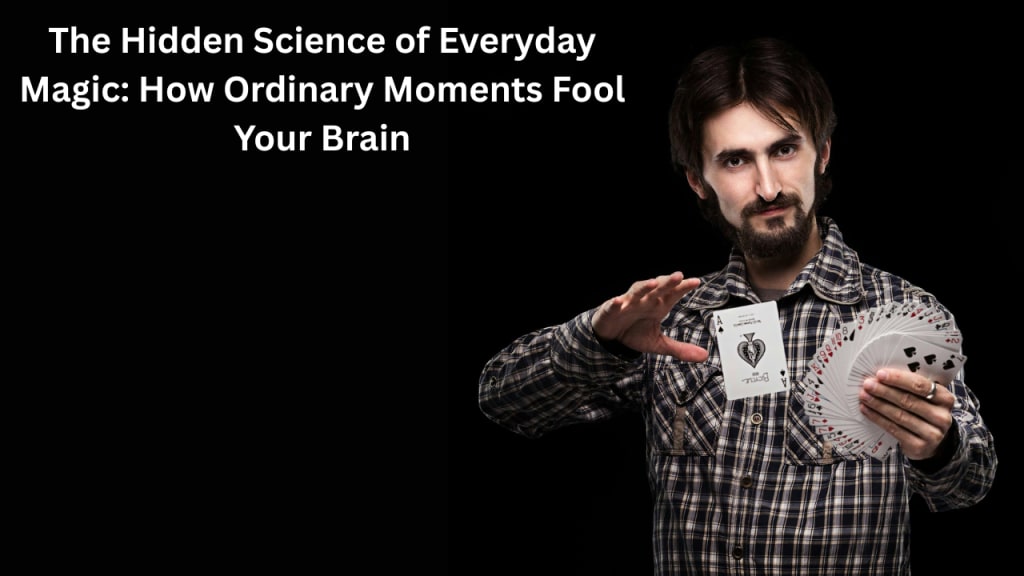
Have you ever wondered why a magician’s sleight of hand leaves you speechless or why you swear you saw something move in the corner of your eye—only to realize it was nothing? These aren’t just random quirks of life; they’re tiny glimpses into the secret workings of your brain. What if I told you that the most ordinary moments—like sipping your morning coffee or losing track of time—are packed with hidden science that feels like magic? Let’s dive into the fascinating ways your mind plays tricks on you every day, turning the mundane into something extraordinary.
The Illusion of Time: Why Five Minutes Feels Like Forever (or Flies By)
Picture this: You’re waiting for a bus on a chilly morning. Five minutes drag on like an eternity, each second ticking by in slow motion. Yet, when you’re scrolling through your phone or laughing with friends, an hour vanishes in a blink. What’s going on here? It’s not time bending—it’s your brain.

Scientists call this the "time perception paradox." Your brain doesn’t experience time as a steady stream; it processes it based on attention and emotion. When you’re bored or anxious, like at that bus stop, your mind hyper-focuses on the present, stretching every moment. But when you’re engaged—say, watching a gripping movie—your brain skips over the details, compressing time into a fleeting memory. It’s a built-in magic trick: your mind decides how long "now" really lasts. Next time you’re stuck waiting, try distracting yourself with a game or a song—watch how the clock suddenly speeds up.
The Coffee Conundrum: A Potion of Perception
Let’s talk about that cup of coffee you cradled this morning. It’s not just a jolt of caffeine—it’s a masterclass in sensory deception. The rich aroma hits your nose before the first sip, and suddenly, you’re more awake than you were five seconds ago. Is it magic? Not quite. It’s your brain’s anticipation at work.

The smell of coffee triggers your olfactory system, which sends signals to your brain’s reward center before the caffeine even kicks in. Studies show this "placebo effect" can make you feel energized just by the scent alone. Then there’s the taste: bitter, yet somehow comforting. Your brain rewires that bitterness into pleasure because it associates coffee with alertness and routine. It’s a daily spell cast by your senses—one you don’t even notice until it’s gone. Try this: next time, close your eyes and inhale deeply before drinking. You’ll feel the magic intensify.
The Ghost in the Room: Why You See What Isn’t There
Ever caught a shadow darting across your room, only to find it’s just your jacket hanging on the door? Don’t worry—you’re not losing it. This is your brain’s survival instinct pulling a fast one. Known as "pareidolia," it’s the tendency to spot patterns—like faces or movement—in random or vague shapes.

Back when humans roamed wild landscapes, this trick kept us alive. Seeing a tiger in the bushes when it was just wind-blown leaves was better than missing a real threat. Today, it’s why you might jump at a creak in the night or see a face in the clouds. Your brain fills in the blanks, turning ambiguity into something familiar—or spooky. It’s a leftover bit of evolutionary magic, hardwired to keep you on your toes. Next time you spot a "ghost," smile at your brain’s overactive imagination.
The Power of a Smile: Invisible Strings That Move You
Here’s a fun one: smile at a stranger tomorrow and watch what happens. Chances are, they’ll smile back without even thinking. This isn’t politeness—it’s mirror neurons at play, a hidden force in your brain that mimics what you see. When someone smiles, your brain fires up the same muscles in your face, almost like puppet strings you can’t control.

This mimicry builds connection, a silent language we’ve used for millennia to bond and survive. It’s why laughter is contagious and why a friend’s frown can drag you down. Your brain is a social magician, weaving invisible threads between you and the world. Test it out: flash a grin in a crowded room and see how many faces light up in return.
Why It Matters: The Magic Beneath the Surface
These everyday illusions—time warping, coffee’s charm, phantom shadows, and mirrored smiles—aren’t just quirks. They reveal how your brain shapes reality, blending science and wonder into a seamless experience. You don’t need a wand or a stage to witness magic; it’s happening right now, in the quiet corners of your mind.

So, the next time you lose yourself in a moment or jump at a shadow, don’t brush it off. Lean into it. Ask yourself: what’s my brain up to this time? You might just uncover a little more of the hidden magic that makes being human so extraordinary.
About the Creator
rakesh panse
Hello friends,
Hi, I’m Rakesh Panse, a passionate writer from India sharing stories on tech, lifestyle, and personal experiences. Follow me for unique insights! .
Keep reading
More stories from rakesh panse and writers in Humans and other communities.
Do You Know The Powerful Secret To A Loving Relationship?
It is said that love is the most powerful emotion. Love gives us the ability to see beauty and possibility where others may see only darkness and despair. Love fills us with hope and courage, and it is the foundation of lasting relationships.
By rakesh panse3 years ago in Humans
Who American People Meet While Traveling And Exploring New Places
As the American people go sightseeing and tour the countries, the journey that they take is defined not only by the nature and attractions, but by the people they meet on the way. Any destination becomes a melting pot where strangers are transformed into narrators, tutors, friends and even best friends. Travel makes the world not a group of places, but a kind of living network of human relations.
By Tiana Alexandra5 days ago in Humans
Violence Begets
"Any last words, cowboy?" "None you'd understand, sodbuster." "Funny. That's Marshall Sodbuster to you. But I meant some last nugget that would help us in the adjudication of the myriad offenses counted against you and your gang. I wasn't asking for penitence."
By Adam Diehl5 days ago in Fiction



Comments
There are no comments for this story
Be the first to respond and start the conversation.