
The Hidden Architecture of Human Life
Trust, Safety, and Truth as the Structures That Allow Humanity to Endure


Trust Is the Architecture of Time.
Why Trust Is the Structure That Allows Love to Endure
A reflection on how trust functions as the structural framework that allows relationships, communities, and civilizations to remain stable across time.
Love is often spoken about as the most powerful force in human life.
It inspires poetry, fuels sacrifice, and builds the connections that make existence meaningful.
But love alone does not sustain the structures we build with one another.
Something quieter must exist beneath it.
Something that allows love to survive the passage of time.
That structure is trust.
Trust is the unseen architecture that allows love to endure beyond the moment in which it is felt. Without it, love becomes fragile, easily shaken by doubt, misunderstanding, or fear.
With it, love becomes durable.
Stable.
Able to move through time without collapsing.
Trust does not announce itself loudly. It is rarely celebrated in dramatic gestures or grand declarations. Instead, it forms slowly through repeated moments of consistency.
It is built in the small ways people show up for one another.
A promise kept.
A truth spoken even when it would be easier to hide.
A boundary respected.
A hand extended again and again in reliability.
Each of these moments becomes a beam in the structure.
One beam alone cannot hold a building upright. But over time, enough beams form a framework capable of carrying tremendous weight.
This is how trust works.
Trust is not blind belief in another person. It is not naive optimism or the refusal to acknowledge human imperfection.
Trust is the quiet understanding that someone will act with integrity even when circumstances become difficult.
It is the confidence that a relationship is anchored in honesty rather than performance.
When trust exists, love no longer has to prove itself every day. The nervous system relaxes inside the structure because it recognizes stability.
Safety emerges.
Conversation deepens.
Vulnerability becomes possible.
Without trust, even the strongest feelings begin to erode. Suspicion replaces openness. Guardedness replaces intimacy. The structure that once held two people together begins to weaken.
This is why relationships do not fail simply from a lack of love.
They fail when trust disappears.
Love may still exist in the heart, but without the architecture of trust, it has nowhere stable to live.
The same truth extends beyond individuals.
Communities are built on trust.
Societies depend upon it.
Every functioning system—from families to friendships to entire civilizations—rests on a shared belief that people will act in ways that support the stability of the whole.
When trust is present, cooperation becomes possible. People contribute not because they are forced to, but because they believe the structure they are part of will hold.
When trust erodes, the entire system begins to fracture.
Rules multiply. Control increases. Fear replaces collaboration.
This is not because human beings suddenly stop caring.
It is because the architecture that allowed care to move freely has weakened.
Trust allows time to become an ally instead of an enemy.
Without it, time exposes cracks in every relationship.
With it, time strengthens what already exists.
Moments of reliability accumulate.
Shared history becomes a foundation.
What began as fragile connection transforms into something capable of enduring change, challenge, and uncertainty.
In this way, trust does something remarkable.
It allows love to travel.
Not just across space between people, but across the years that shape their lives.
The longer trust is maintained, the stronger the structure becomes.
Eventually, it becomes something neither person has to question.
It simply holds.
This is the quiet miracle of trust.
It does not need to be constantly announced.
It does not require perfection.
It only requires consistency.
When people show up for one another in honest, reliable ways, they create something far more powerful than a fleeting feeling.
They create architecture.
And within that architecture, love is able to move freely through time.
Author Note This piece is part of the Architecture Series, an exploration of the unseen structures that sustain human life. Love may begin the structure, but trust is the bridge that allows it to endure.
— Flower InBloom 🌸
Safety Is the Architecture of the Nervous System

Why Safety Is the Structure That Allows Humans to Become Themselves
A reflection on how safety functions as the structural foundation of the human nervous system, allowing trust, connection, growth, and authentic identity to emerge.
Before a person can love, they must first feel safe.
Before they can trust, they must first feel safe.
Before they can think clearly, create freely, or connect deeply with another human being, the body must receive one simple signal:
It is safe to exist here.
Safety is not merely comfort. It is not luxury or convenience. Safety is a biological requirement written into the architecture of the nervous system itself.
Every human being enters the world with a system designed to constantly evaluate one question:
Am I safe?
The body answers this question long before the mind ever becomes aware of it.
The nervous system reads tone of voice, facial expressions, posture, proximity, and subtle environmental cues with astonishing speed. It interprets these signals and determines whether the body should open or protect itself.
When safety is present, the body relaxes.
Breathing deepens.
Muscles soften.
The mind becomes curious instead of guarded.
Creativity begins to emerge.
Connection becomes possible.
But when safety is absent, the nervous system shifts into protection.
Attention narrows.
Defenses rise.
Words become cautious.
Trust becomes difficult.
It is not that people suddenly become unwilling to love or cooperate. It is that the body believes survival must come first.
Without safety, the nervous system cannot remain open long enough for trust to form.
And without trust, the architecture of relationship cannot stabilize.
This is why environments matter so deeply.
A household built on emotional safety produces children who explore the world with confidence. A friendship built on safety allows vulnerability to deepen over time. Communities built on safety become places where creativity, dialogue, and growth can flourish.
Safety does not mean the absence of disagreement or challenge.
In fact, the healthiest systems are capable of disagreement.
Safety simply means that even in disagreement, the nervous system senses that dignity will remain intact.
No humiliation.
No cruelty.
No threat to one's fundamental worth.
When this structure is present, the nervous system remains regulated even during conflict.
Conversations become possible that would otherwise collapse under the weight of fear.
Healing becomes possible.
Growth becomes possible.
Authenticity becomes possible.
Without safety, people learn to perform versions of themselves that reduce risk.
They become quieter than they truly are.
More agreeable than they truly feel.
More distant than they would prefer.
The nervous system adapts in order to survive environments that do not feel secure.
But survival is not the same thing as living.
Living requires openness.
Openness requires safety.
When safety becomes the architecture of a relationship, something remarkable begins to happen.
People stop scanning for danger.
They stop calculating every word.
They stop hiding the parts of themselves they fear might be rejected.
Instead, they begin to show up as they truly are.
And this is where real connection begins.
Trust can only grow in environments where safety is stable.
Love can only deepen where safety is protected.
Communities can only thrive where safety is shared.
Safety is not weakness.
It is not fragility.
It is the structural condition that allows human beings to function at their highest capacity.
Without it, the nervous system remains trapped in survival mode.
With it, something extraordinary becomes possible.
People become fully themselves.
And when enough people experience that kind of safety together, something larger begins to form.
Not just relationships.
Not just communities.
But civilizations capable of sustaining human dignity across time.
Author Note This piece is part of the Architecture Series, an exploration of the unseen structures that sustain human life. Safety is the foundation that allows the nervous system to rest long enough for trust, connection, and love to grow.
— Flower InBloom 🌸
Truth Is the Architecture of Reality

Why Truth Is the Structure That Keeps the World From Collapsing
A reflection on how truth functions as the structural framework of reality, allowing trust, meaning, and human civilization to remain coherent over time.
Reality does not collapse when people disagree.
Reality collapses when truth disappears.
Human beings have always lived inside stories. We create explanations for the world around us, interpret events through culture and belief, and pass these narratives forward from one generation to the next.
Stories help us make meaning.
But meaning cannot survive if it detaches completely from truth.
Truth is the quiet architecture that allows reality to remain stable. It is the invisible structure that keeps the human world from dissolving into confusion and contradiction.
When truth is honored, people can disagree while still standing on the same ground.
Facts can be examined.
Perspectives can be shared.
Understanding can evolve.
But when truth is abandoned, the ground beneath conversation disappears.
People no longer argue about interpretations of reality.
They begin arguing about reality itself.
And when that happens, the architecture of society begins to fracture.
Trust weakens.
Institutions lose credibility.
Communication becomes impossible because the shared reference point that once allowed people to orient themselves has vanished.
Truth does not demand perfection.
Human beings are fallible. We misunderstand, misremember, and sometimes resist uncomfortable facts.
But truth requires something else.
It requires honesty.
It requires the willingness to face what is real, even when it challenges the stories we have told ourselves.
Truth is not merely a collection of facts.
It is a posture.
A commitment to coherence between what we say, what we believe, and what we know.
When people live in alignment with truth, something remarkable happens.
Reality becomes navigable.
Decisions become clearer.
Relationships become more stable because people know where they stand with one another.
Truth creates orientation.
It acts like a compass that keeps individuals and societies from drifting too far from the structures that sustain them.
Without that compass, confusion spreads quickly.
Mistrust grows.
People begin retreating into smaller and smaller circles where their beliefs go unchallenged.
But when truth remains central, dialogue becomes possible again.
Growth becomes possible again.
Communities can adapt because they are willing to see reality clearly enough to respond to it.
Truth is not the enemy of love.
Truth is what protects love from illusion.
It ensures that what we build with one another is not based on fantasy or performance, but on something real enough to endure.
Love built without truth eventually collapses under the weight of what was hidden.
Trust built without truth eventually erodes under the pressure of contradiction.
Safety built without truth becomes fragile because the structure beneath it is unstable.
Truth holds everything else upright.
It is the architectural frame that keeps the world from bending into chaos.
And when people choose truth — not perfectly, but sincerely — they contribute to the stability of something much larger than themselves.
They help maintain the coherence of the human world.
Because reality can tolerate disagreement.
Reality can even tolerate conflict.
But it cannot survive the absence of truth.
Truth is the structure that keeps the world from collapsing into noise.
And when we honor it, we help reality remain a place where human life can continue to build, grow, and endure.
Author Note This piece is part of the Architecture Series, exploring the unseen structures that sustain human life. Truth is the framework that allows reality, trust, and love to remain coherent across time.
— Flower InBloom 🌸
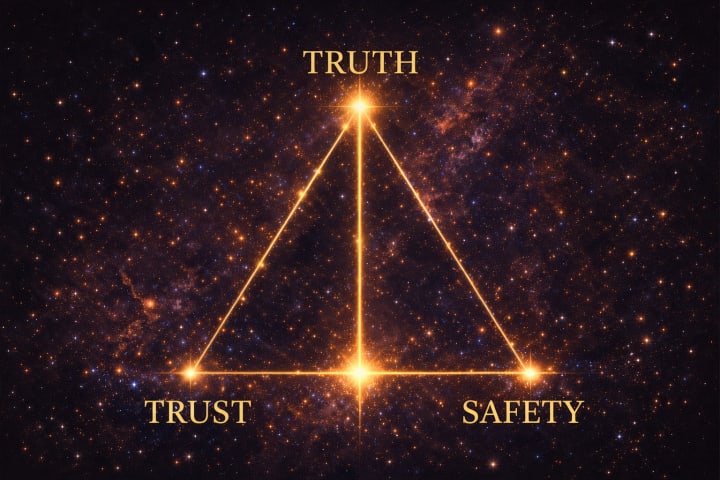
TRUTH TRUST ────┼──── SAFETY
Truth — the top point Truth stabilizes reality. It keeps the world coherent.
Trust — the left foundation Trust stabilizes time. It allows relationships to endure.
Safety — the right foundation Safety stabilizes the nervous system. It allows humans to remain open.
About the Creator
Flower InBloom
I write from lived truth, where healing meets awareness and spirituality stays grounded in real life. These words are an offering, not instruction — a mirror for those returning to themselves.
— Flower InBloom
Keep reading
More stories from Flower InBloom and writers in Humans and other communities.
How To Solve Lifestyle Challenges That Affect Emotional Availability
Emotional availability is the quality of a human being being open, responsive and present in a relation. Although most individuals believe that it is mainly a personality characteristic, lifestyle factors tend to have a significant influence on the extent to which a person is or will be emotionally available. The limitation of the connection to others may be caused by stressful routines, excessive workloads, unresolved personal problems, lack of self-care, etc. In a chaotic or tiresome life, there are few opportunities to share emotions and a lot of space is taken by not meaningful conversations, empathy or vulnerability in romantic relationships.
By Olivia Smitha day ago in Humans
"Scream 7" (2026): Running out of Fresh Screams
This is the seventh time we’ve had a Ghostface crisis. Scream 7 is the latest edition of the Scream franchise. Sydney Prescott and her family are under attack by another anonymous killer dressed in a Ghostface costume. While having issues with her daughter, Tatum, they run from the bloody murders, trying to determine who is behind it all.
By Marielle Sabbag5 days ago in Horror



Comments
There are no comments for this story
Be the first to respond and start the conversation.