
The GOOSE GIRL
🦢 The Silent Princess and Her Feathered Friends
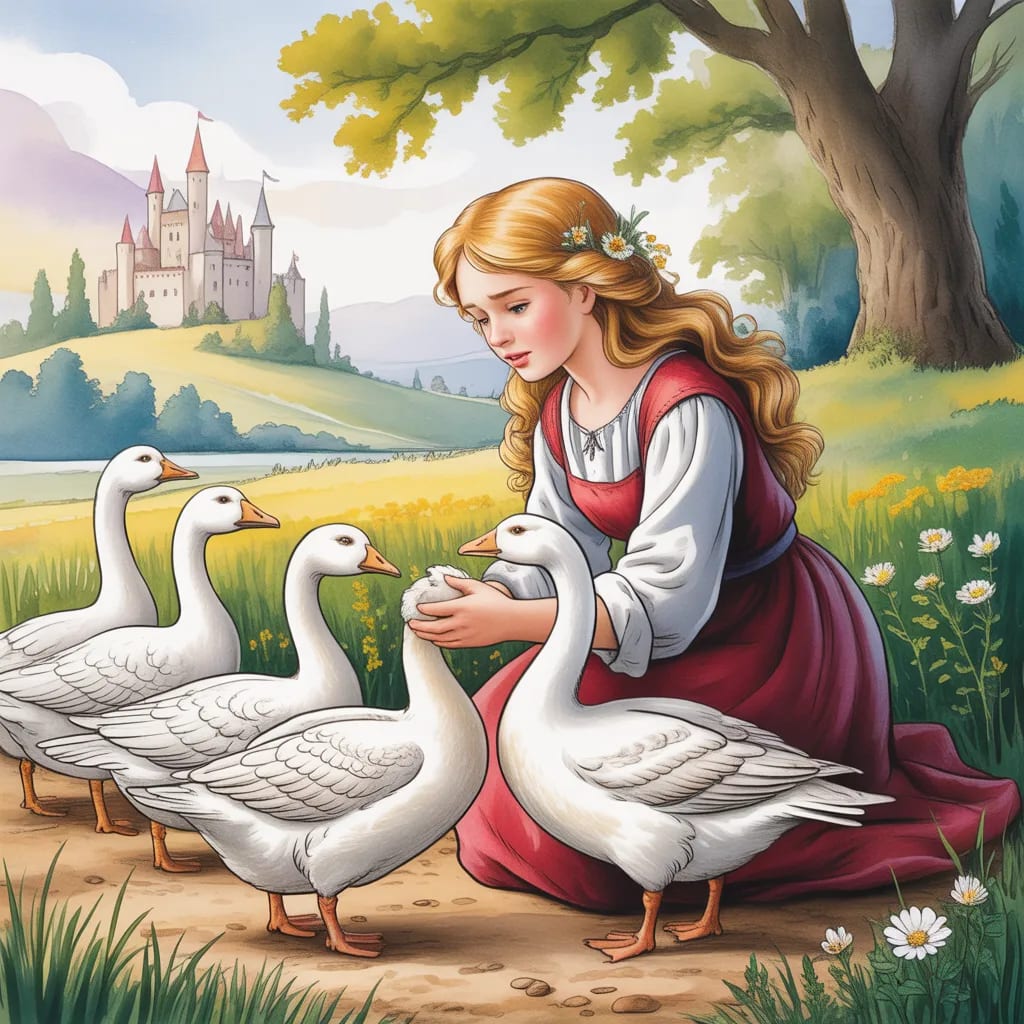
Once upon a time, in a faraway kingdom, there lived a beautiful princess who was gentle, kind, and pure of heart. She was the only daughter of a great queen, and when she grew up, her mother arranged her marriage to a handsome prince who lived in a neighboring kingdom.
When the day came for her to leave, the queen packed many precious gifts—jewels, silks, and a golden cup—and gave her daughter a handkerchief with three drops of her own blood upon it. “Keep this safe, my dear child,” the queen said. “It will protect you when you are in danger.”
The princess set off on her journey with her waiting-maid, who was to serve her faithfully on the way. They rode together through forests and fields until the sun grew hot and the princess became thirsty.
“Please fetch me some water from the stream,” the princess said kindly.
But the maid replied proudly, “If you want water, fetch it yourself. I’m not your servant anymore.”
The gentle princess obeyed, for she did not want to quarrel. She bent down to drink from the stream, and as she did, the handkerchief with her mother’s blood dropped into the water and was carried away. She tried to retrieve it, but it vanished. From that moment, she lost her royal protection.
The maid saw her chance. She forced the princess to change clothes with her and swear never to tell anyone the truth, threatening her life if she disobeyed. Dressed in rags, the poor princess was made to ride the maid’s horse, Falada, while the false bride rode proudly in her silks.
When they reached the prince’s castle, the false bride was welcomed as the princess. The real princess, now dressed like a servant, was not recognized by anyone. Out of pity, the king of that land gave her work tending the geese with a boy named Conrad.
Before Falada, the faithful horse, was taken to the stable, the false bride—afraid the horse might reveal her secret—ordered him killed. The real princess begged to keep his head and have it nailed under the gate where she passed each morning and evening. The king allowed it, and every day, as she passed beneath, she would whisper sadly:
“O Falada, hanging there,
If your poor princess might you hear!”
And the horse’s head would answer softly:
“Alas, poor maid, it is you I see,
False is the bride who rides so free!”
Conrad, the goose boy, noticed this strange sight and told the king about it. The king grew curious and decided to watch the goose girl himself. Hidden behind a wall, he saw her comb her golden hair in the sunlight. Whenever she did, her hair shone so brightly that Conrad tried to snatch a few strands. To stop him, she would say:
“Blow, wind, blow!
Take Conrad’s hat away!
Let him chase it till I’ve combed my hair,
And tied it up all fair!”
Then a gust of wind would blow off the boy’s hat, and he would run after it while she calmly finished combing her shining hair.
The king went home, thinking deeply. Later that evening, he called the goose girl to his chamber and gently asked her to tell him the truth. But she was too afraid of the maid’s threats and said nothing. Then the king had an idea—he told her to speak her troubles into an iron stove, promising it would tell no one.
Believing herself alone, the princess poured out her heart to the stove, telling everything—how she had been betrayed, how Falada was slain, and how she was forced to tend geese instead of becoming the prince’s bride.
But the king, standing behind the stove, heard every word. The next day, he ordered a grand banquet and invited both the false bride and the true one. During the feast, he asked the false bride what punishment should be given to someone who betrayed their master in such a way.
Without knowing the trap, the false bride said proudly, “She should be put into a barrel lined with nails and dragged through the streets by two horses until she dies!”
“Then you have spoken your own sentence,” said the king sternly. He revealed the true princess, who stood there shining with grace and innocence. The prince rejoiced when he saw her, for he had always felt something was not right with the false bride.
The wicked maid was punished as she had said, and the true princess was finally married to her prince with great joy. Even Falada’s head was buried with honor, and peace returned to the land.
And so, the humble goose girl became a beloved queen, wise and gentle, who never forgot the lessons of faith, courage, and truth.
Moral:
Goodness and truth may be hidden for a time, but they always shine through in the end.
About the Creator
The steps to losing a child
Step One: Lose a child. Not what anyone wants to happen and nothing you can do to change it, but you can go through steps to becoming happy again. You can go through steps to loving again. You can go through steps to become a new you because after losing a child you will never be the same person you once were.
By Tabitha Hinkley6 days ago in Fiction




Comments (1)
Wow… I didn’t expect this to make me emotional, but it did. Thank you for sharing this truth.