
The Garden of Silent Hearts
How One Community Found Harmony Among Strangers

THE STORY
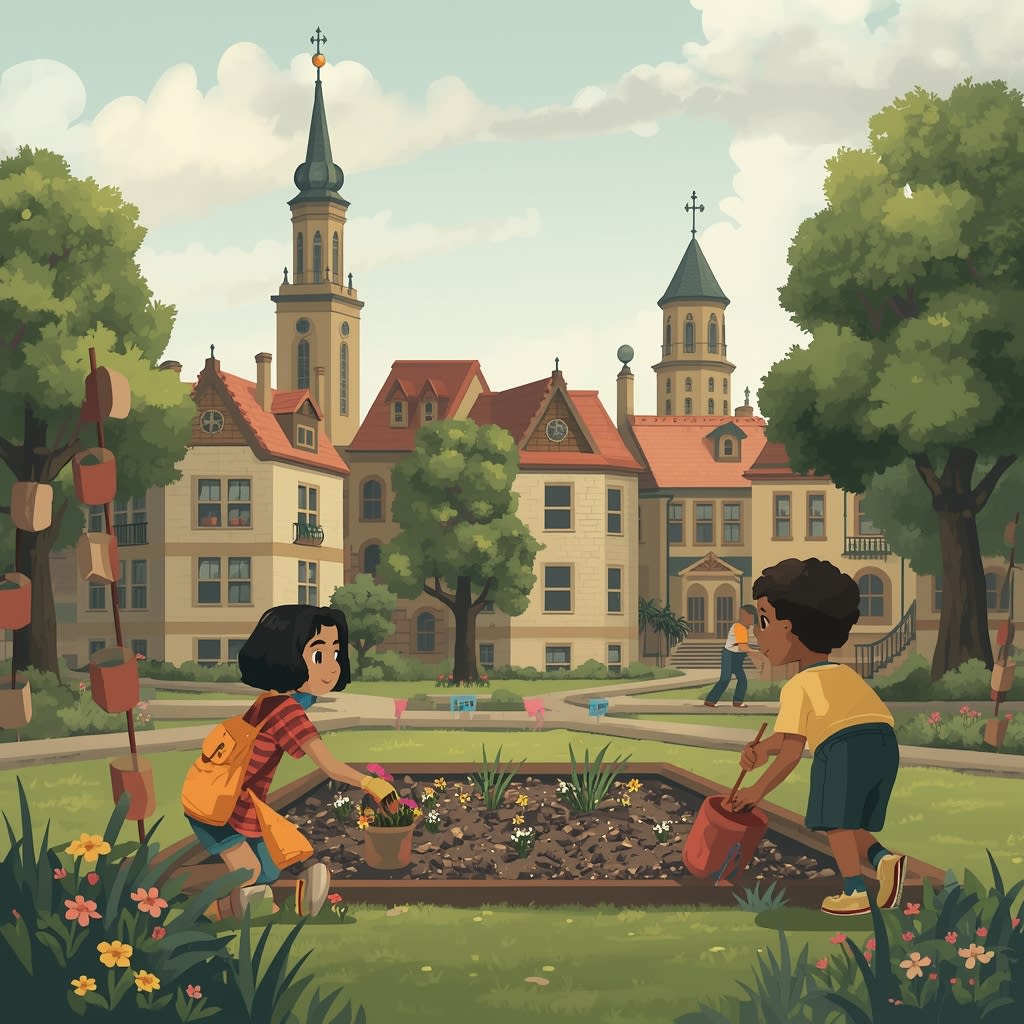
The town of Saharabad had once been famous for its gardens. Every home had a little patch of greenery, a few flowers, or a small vegetable patch. But the largest garden, in the center of town, had been abandoned for years.
It wasn’t weeds that kept people away.
It was resentment.
A decade earlier, a disagreement over the ownership of the garden had turned into a full-blown conflict between two of the oldest families in town. Accusations flew. Friendships shattered. Slowly, families stopped crossing the garden, stopped speaking, stopped meeting.
The once-lively paths were overgrown. The benches were rotting. The fountain had cracked and stopped flowing. Even the birds seemed wary of landing, as though they, too, had sensed the tension in the air.
THE GIRL WITH A SEED
Sara, eleven years old, had moved to Saharabad with her mother recently. She loved gardens more than anything—the feel of soil in her fingers, the first shoots breaking through the earth, the delicate smell of blossoms.
The first time she saw the abandoned community garden, her heart sank.
“This could be beautiful again,” she whispered to herself.
Determined, she began visiting the garden every morning. She carried a small bag of seeds, a watering can, and a trowel. She worked quietly, planting a line of marigolds along the far edge, far from the main path, where no one could see.
Some mornings, she heard voices from the neighboring streets. Children would pass by, laughing or playing, but they never came near.
But Sara didn’t give up. Each day, she watered her little row of flowers, gently patting the soil, whispering, “Grow, little ones. Show us hope.”
THE CURIOUS BOY
One chilly morning, a boy named Rayan, who lived on the other side of the town, spotted Sara crouched among the marigolds.
“What are you doing here?” he asked, frowning.
Sara looked up, startled. “Planting flowers.”
Rayan raised an eyebrow. “This garden belongs to… well, everyone says it belongs to someone else. People here don’t go inside anymore. Why are you wasting your time?”
Sara smiled. “Because it’s lonely. It needs friends.”
Rayan shook his head. “Friends? There are no friends here. Only enemies.”
Sara paused, then said softly, “Maybe that’s why it needs friends the most.”
Rayan didn’t answer at first, but something in her words made him pause. Slowly, he knelt beside her and helped water the seedlings. Neither spoke for a few minutes. The silence was comfortable, filled with the soft rustle of leaves and the smell of damp earth.
For the first time in years, two people from different sides of Saharabad had met in the garden—and no one argued.
THE SPREAD OF HOPE
Over the next few weeks, Sara and Rayan continued to work in secret. Slowly, other children noticed.
One day, Laila, a shy girl from Rayan’s street, watched them from behind a tree.
“Can I help?” she asked quietly.
Sara’s eyes lit up. “Of course.”
Another day, a boy named Omar joined. Soon, children from different streets were sneaking into the garden, each carrying a small plant, a handful of seeds, or a packet of fertilizer.
They started leaving tiny painted stones as decorations, some with messages like “Grow together” or “Peace blooms here”.
The adults noticed. At first, they frowned.
“What are these children doing in that cursed garden?”
“They shouldn’t be mixing with the others,” someone whispered.
But curiosity got the better of them. Slowly, a few parents began visiting. They watched the children work, noticed the laughter, and realized something extraordinary: for the first time in years, there was no shouting, no anger—just cooperation.
THE CHALLENGE
Of course, not everyone was convinced.
One afternoon, Mrs. Hashmi, a woman known for her sternness, approached Sara.
“You think flowers can fix years of hatred?” she asked sharply.
Sara looked up. “I don’t know. But if we try, maybe they can remind people how to care for each other.”
Mrs. Hashmi shook her head. “You’re a child. This is adults’ work.”
Before Sara could answer, Rayan spoke up.
“Maybe adults forgot how to try. We can remember.”
For a moment, Mrs. Hashmi said nothing. Then, unexpectedly, she smiled faintly. “Perhaps you’re right.”
THE FESTIVAL OF BLOOMS
By the end of the summer, the once-forgotten garden had transformed completely:
Bright marigolds and sunflowers lined the pathways.
Rows of vegetables grew healthy and tall.
Painted stones and small wooden signs reminded everyone of messages of hope.
Benches were repaired and repainted.
Even the fountain was flowing again, sparkling under the sun.
Sara suggested a Festival of Blooms, where the children and families could celebrate their work together.
On the day of the festival, families arrived hesitantly. Slowly, laughter replaced whispers. Parents shook hands with neighbors they had avoided for years. Children shared snacks and stories. Music played in the background, and for hours, the garden was alive with connection, friendship, and joy.
THE LESSON
Sara realized something beautiful that day:
Peace is like a garden.
It doesn’t appear overnight.
It needs:
Patience — each seed grows slowly.
Care — tending to small acts daily.
Courage — taking the first step, even when others doubt you.
Sharing — inviting others to participate.
The Garden of Silent Hearts, once abandoned, became a living symbol that even forgotten relationships can flourish again if nurtured with love, patience, and hope.
About the Creator
M.Farooq
Through every word, seeks to build bridges — one story, one voice, one moment of peace at a time.


Comments
There are no comments for this story
Be the first to respond and start the conversation.