
The Future of Vision: Scientists Develop Flexible Cornea-Thin Battery Charged by Saline Solution
THE FUTURE OF VISION

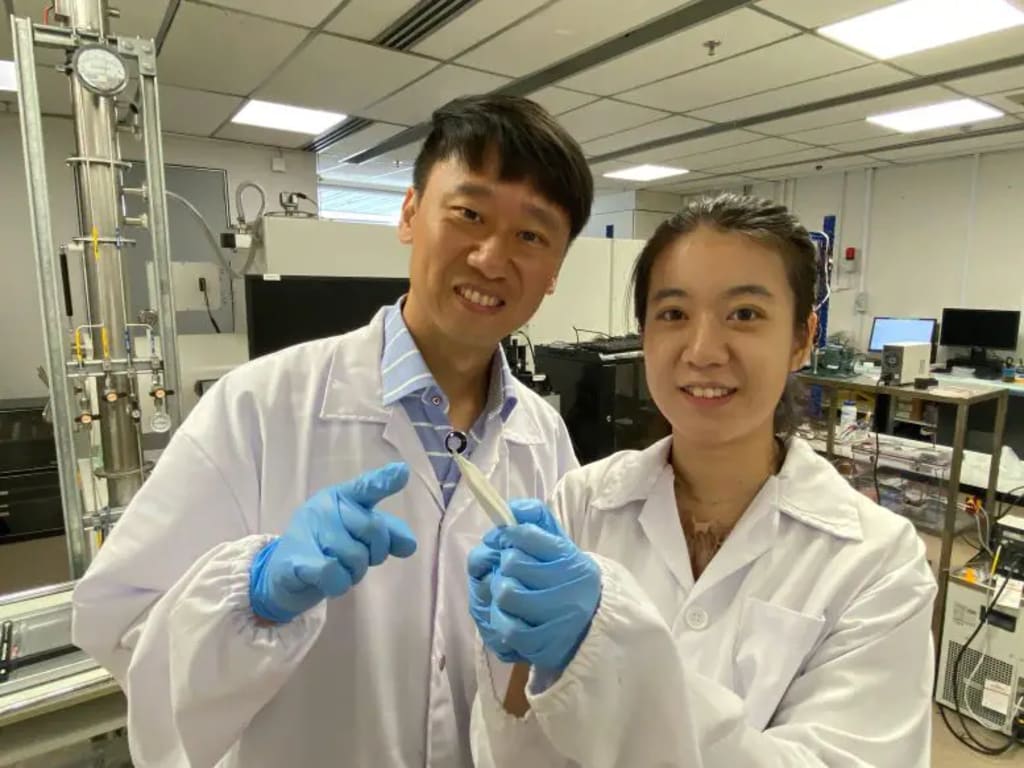
In a groundbreaking development, researchers from Nanyang Technological University (NTU) in Singapore have engineered a revolutionary flexible battery that is as thin as the human cornea. This cutting-edge energy storage innovation, powered by a saline solution, has the potential to reshape the capabilities of smart contact lenses, opening doors to augmented reality experiences and advanced health monitoring.
The Era of Smart Contact Lenses
Smart contact lenses, a remarkable advancement in wearable technology, have already demonstrated their potential to display information directly onto our corneas. From vision correction to health monitoring and disease detection, these lenses have shown great promise. The next phase envisions contact lenses that can record and transmit visual and auditory information to cloud-based storage, ushering in a new era of seamless human-computer interaction.
A Vital Challenge: Powering Smart Contact Lenses
One significant hurdle in realizing the full potential of smart contact lenses has been the development of a safe, efficient, and biocompatible power source. Existing rechargeable batteries with their reliance on metal components, wires, and coils pose risks and discomfort when placed within the delicate confines of the human eye.
NTU's Innovation: A Battery as Thin as a Cornea
Addressing these challenges head-on, the researchers at NTU have created an ultra-thin battery that resolves the limitations of conventional power sources. Unlike traditional lithium-ion batteries or wireless charging systems, this innovative battery is constructed using biocompatible materials, eliminating toxic heavy metals. Its design incorporates a glucose-based coating that interacts with the surrounding saline solution, with water acting as the medium for electricity generation.
Harnessing Nature's Elements for Power
The uniqueness of this battery lies in its capacity to harness the power of the human body itself. The sodium and chloride ions present in the saline solution or tears trigger a reaction with the glucose oxidase coating, initiating an enzymatic and self-reduction process. This reaction generates electricity, effectively eliminating the need for metal electrodes or induction coils.
Unveiling the Potential
The NTU team's research has unlocked incredible potential. Laboratory tests confirmed that the battery could produce a current of 45 microamperes and a maximum power output of 201 microwatts, more than sufficient to power a smart contact lens. The battery exhibited impressive endurance as well, enduring up to 200 charge and discharge cycles, a significant leap from the typical lifespan of lithium-ion batteries.
A Glance into the Future
The researchers recommend an eight-hour immersion in a solution rich in glucose, sodium, and potassium ions for optimal charging. This simple charging method, designed to occur during sleep, ensures a seamless user experience. Moreover, the team's integrated design ensures that the battery's placement doesn't obstruct vision.
Transcending Boundaries: Path to Commercialization
NTU's innovation hasn't stopped at the laboratory stage. The research team has filed for a patent through NTUitive, the university's innovation and enterprise arm. Their goal is to usher this technology from the lab into the market, making it a reality for consumers. The significance of this achievement hasn't gone unnoticed, as the battery's compatibility with the human body and its environment-friendly composition mark a significant advancement in the field of smart contact lenses.
Conclusion: A Glimpse into Tomorrow
As the realm of wearable technology continues to evolve, the development of a flexible, self-charging battery as thin as a cornea marks a turning point. The NTU research team's breakthrough offers a glimpse into the future of human-computer interaction, where seamless integration with our physiology and environment paves the way for previously unimaginable innovations. With steps toward commercialization already underway, the world may soon witness the fusion of technology and biology in ways once thought to be the realm of science fiction.
About the Creator
The Scret of Future
iam writing articale i m blogger
Blogging isn't just about writing; it's about connecting with an audience. Discuss the role of comments sections, social media engagement, and email newsletters in building a vibrant blogging community.
Keep reading
More stories from The Scret of Future and writers in Humans and other communities.
Cade Klubnik, Clemson football offense sputter in season-opening upset loss at Duke sport
Cade Klubnik, Clemson football offense sputter in season-opening upset loss at Duke Clemson's 2023 football season had a rocky start, as the No. 9 Tigers suffered a surprising 28-7 defeat on the road against Duke. This marked the end of their five-game winning streak against the Blue Devils and their first loss to Duke since 2004. Clemson introduced a new offensive scheme under coordinator Garrett Riley, featuring quarterback Cade Klubnik. Unfortunately, the offense appeared out of sync right from the beginning.
By The Scret of Future2 years ago in Gamers
Whiskey At Dusk
Guess the whiskey was more important to you in the end, wasn’t it? It was more than the well-being of your friends; more vital than showing up to the places you promised you would and could come to; more critical of a matter than fulfilling your damn responsibilities and getting the press off your back.
By Snarky Lisa5 days ago in Humans
The Dawn of the Intelligence Revolution: Can Humanity Coexist with the Singularity
The Threshold of Change For decades, science fiction writers like Gene Roddenberry (the creator of Star Trek) and Isaac Asimov envisioned a world where machines could think, feel, and interact with humans. Today, we are no longer looking at a distant future. We are living in it. As we stand on the precipice of what scientists call the "Technological Singularity"—a point where AI exceeds human intelligence—the world is gripped by both wonder and fear.
By Zahid Hussain5 days ago in Humans



Comments
There are no comments for this story
Be the first to respond and start the conversation.