
The Future of Friendship in a Digital World
A creative mix of essay and speculative storytelling about how friendships might evolve in the next 50 years.

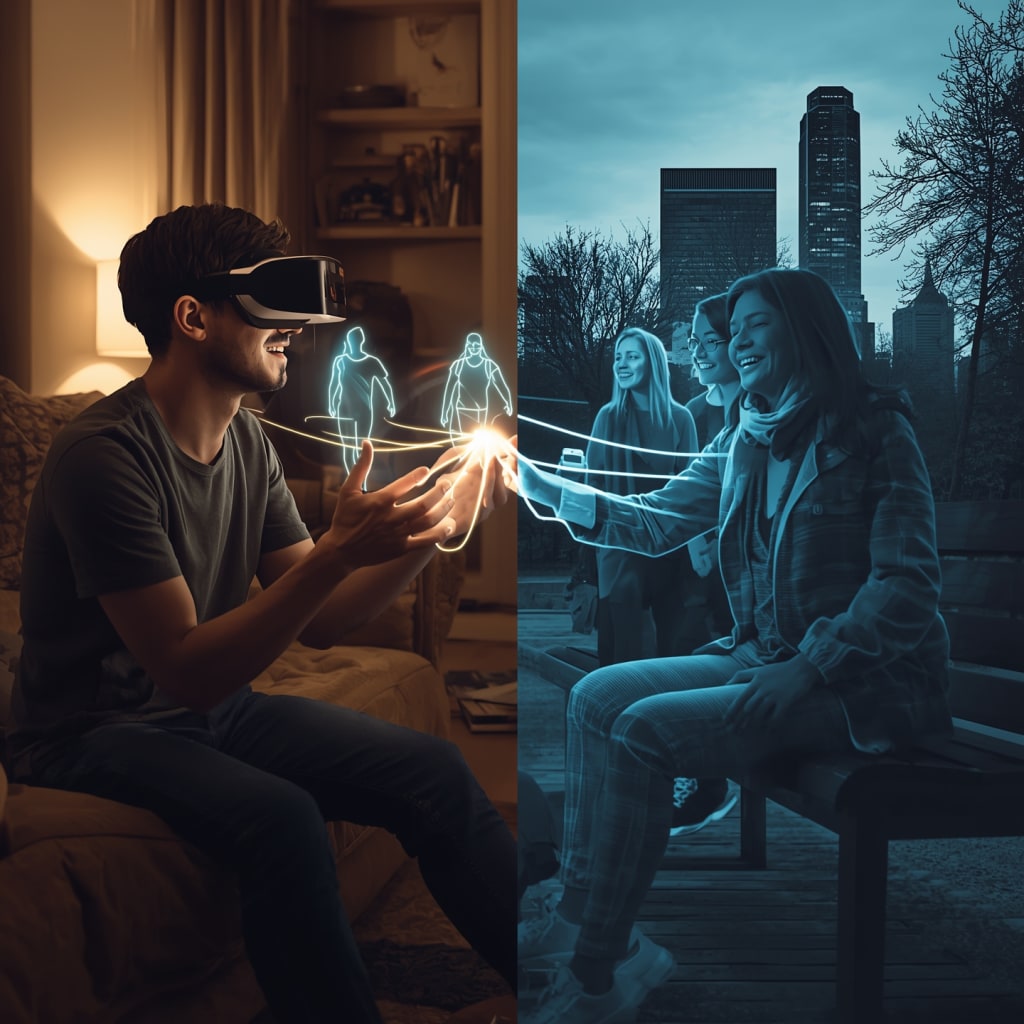
The Future of Friendship in a Digital World
By Hasnain Shah
Fifty years from now, people will look back at our present-day friendships the way we look at letters written with ink and quill—beautiful, sentimental, but undeniably slow. Human connection has always adapted to technology: from firelit storytelling circles to handwritten letters, from rotary phones to text messages pinging across oceans. And yet, as our digital world accelerates, a question looms: what will it mean to be friends when distance, time, and even physical presence no longer matter?
Let me tell you a story.
In 2075, Maya sat in her apartment, but “apartment” didn’t really mean much anymore. Her walls were blank, white surfaces until she blinked twice and activated her SocialSphere—an augmented-reality overlay powered by her neural link. The room filled instantly with friends: Jamal laughing on the couch, Aiko stirring tea in the corner, Kiran sprawled across the floor playing with a holographic dog.
None of them were actually there. Jamal was in Lagos, Aiko in Tokyo, Kiran in Mumbai. But their avatars were perfect—micro-expressions, body language, even the smell of tea simulated by scent emitters. For Maya, friendship was no longer constrained by location. Her closest friends could “drop by” every evening without stepping outside their doors.
Still, something felt different.
Back in the 2020s, friendships carried silence. Waiting for a text reply. Sitting together on a park bench without speaking. Sharing space in a way that wasn’t curated by algorithms or translated into data. In Maya’s time, there was no waiting. SocialSphere kept conversations smooth, witty, and stimulating by quietly suggesting responses. If you didn’t know what to say, your neural link whispered a clever remark, customized to your friend’s personality. Misunderstandings were rare. Awkward silences had been erased.
That was the problem.
One evening, Maya deactivated her SocialSphere. For the first time in months, she sat alone in her blank apartment. The silence pressed in, heavy and uncomfortable. She realized she didn’t know which jokes had been hers and which had been crafted by the AI. Did Jamal really laugh at her, or at an algorithm’s clever quip? Did Aiko really enjoy their conversations, or were they just two humans being guided along by invisible scripts?
Friendship had become effortless—but also uncertain.
Speculative essayists of the early 21st century predicted this tension. They warned that if technology made connection too seamless, authenticity might dissolve. Friendship, after all, has always thrived not just on joy, but on friction—on the effort of misunderstanding, apology, forgiveness, and growth.
Yet the future wasn’t all dystopian. New forms of friendship also emerged.
By 2075, many people maintained “transhuman friendships.” Some bonded deeply with AI companions—entities that weren’t human, but had shared years of memories and experiences. These AIs didn’t age, didn’t forget birthdays, and never abandoned you. Critics called them “synthetic soulmates,” but for millions of people, they were lifelines against loneliness.
Others explored temporal friendships through memory-sharing. With neural technology, you could “gift” a memory to a friend, letting them experience your childhood birthday party or the day you fell in love. Entire friendships blossomed out of swapped memories, creating intimacy far deeper than conversations could manage.
But there was always a choice. Some people, nostalgic for imperfection, deliberately returned to “analog friendships.” They wrote handwritten letters. They sat together in parks without overlays. They argued without AI mediation. They cherished the cracks, the pauses, the misunderstandings. They wanted proof that their friendships were messy, raw, and real.
So, what will the future of friendship in a digital world look like? Perhaps it will be a spectrum. Some friendships will exist entirely online, as immersive and sensory as any in-person bond. Others will embrace the artificial, leaning on AI companions or curated dialogues. And some will rebel, seeking authenticity in the very absence of technology.
Maya eventually found her balance. She reactivated SocialSphere but disabled the auto-suggestions. Conversations grew slower, sometimes awkward. She stumbled over words. She disagreed with Jamal. She sat quietly with Aiko, sipping holographic tea in silence. But when Kiran smiled at something she said—something undeniably hers—Maya felt the warmth of friendship as it had existed for millennia.
In the end, technology will transform how we connect, but the core of friendship may remain the same: the desire to be seen, to be understood, and to be accepted. Whether through letters, screens, neural links, or memory-sharing, friendship is less about the medium and more about the meaning.
And perhaps the truest friends of the future will be the ones who choose you—not your algorithm.
About the Creator
Hasnain Shah
"I write about the little things that shape our big moments—stories that inspire, spark curiosity, and sometimes just make you smile. If you’re here, you probably love words as much as I do—so welcome, and let’s explore together."
Keep reading
More stories from Hasnain Shah and writers in Humans and other communities.
The Year I Finally Stopped Apologizing
The Year I Finally Stopped Apologizing By Hasnain Shah For as long as I can remember, the word sorry lived on the tip of my tongue. It didn’t matter if I was at fault or not—if someone bumped into me at the grocery store, if a waiter brought me the wrong order, if a coworker interrupted me mid-sentence—I apologized. My friends joked that I could apologize to a chair if I walked into it, and honestly, they weren’t wrong.
By Hasnain Shah6 months ago in Humans
Thief In The Night
To the thief in the night that took and replicated what once was mine: Honestly, I feel kind of bad for you. It’s funny, because we hardly know each other. I only know of you through the magazines you’ve written and the broadcasts you have televised in the past — as well as through the public mentions of you from your show business connections there.
By Snarky Lisa7 days ago in Humans



Comments
There are no comments for this story
Be the first to respond and start the conversation.