
The Forgotten Children of Syria
My Week In A Refugee Camp

“When I grow up I want to be a teacher. I would like to go back home”. Shahed is a 10-year-old girl, one of the thousands of people living in this impromptu refugee camp in Turkey, not far from the Syrian border. They were forced to leave their home country when the war began and hope to go back there sometime in the future. At the moment, though, that dream seems more like an utopia than a real possibility. It’s January 2022. I am traveling with Arianna Martini, founder of Italian NGO “Support and Sustain Children” (SSCh), and photographer Paolo Messina. Arianna has set up and runs her organization, the only one to support the more than 9.000 families living in this camp. “These people belong to the poorest layer of society,” Arianna tells me, “In Syria, the majority of them were farmers”.
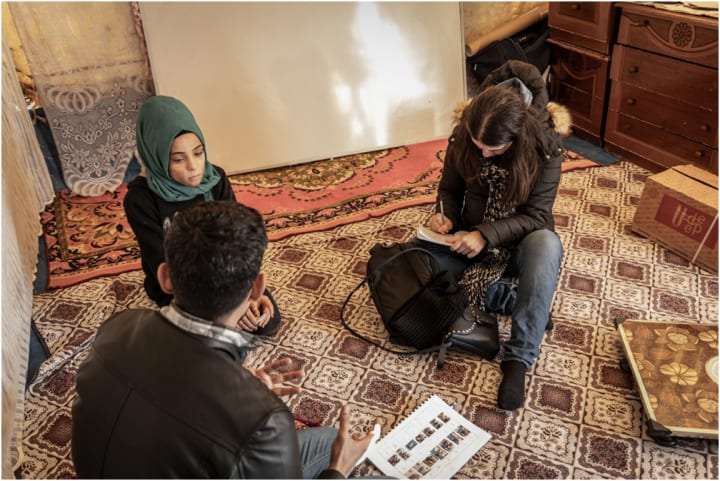
I contacted Arianna after bumping into her NGO’s Facebook page because I wanted to go and see with my own eyes what living in a refugee camp actually means. My mission whilst here is to talk with people (thanks to Yayha, the translator) and then write a book for the NGO.
There are 103 million forcibly displaced people worldwide, 32.5 million of them are refugees (as of mid-2022). The number of refugees worldwide is almost as high as the total population of California. 72% of the refugees originate from just 5 countries, the Syrian Arabic Republic being the first one (6.8 million). We all are used to seeing videos and photos of people on boats in the Mediterranean or walking for many days trying to cross a border. We know what happens to many of them. We know they face prison, beating, rape, hunger, cold, and so on yet we somehow got accustomed to these realities. It’s easy to hear people say, “War, poverty and refugees have always existed. Things are not going to change”.
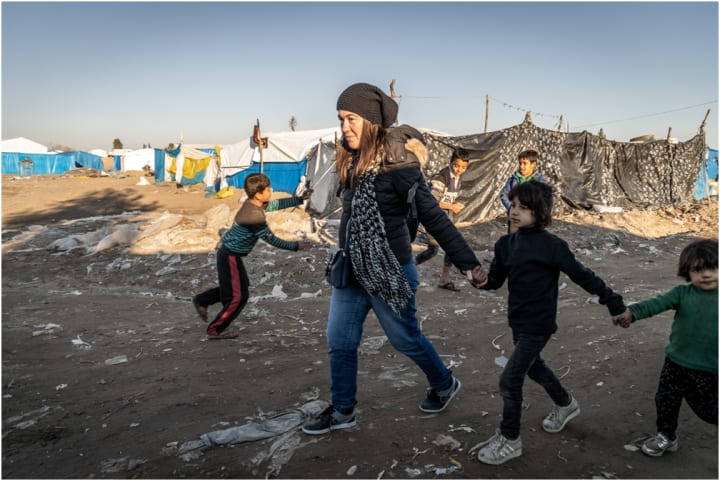
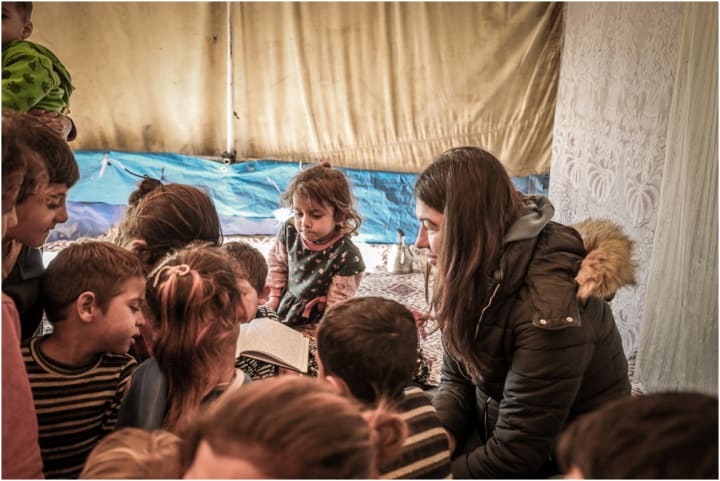
This is one of the reasons why I chose to travel with SSCh. I was tired of reading social media posts and newspaper articles, I felt the need to go there and actually meet these people. The camp is just a sea of tents. There is absolutely nothing inside and around it for these people to have a dignified life. SSCh does its best to support them. They have set up 2 schools (they are inside tents and they are called “Rainbow Tents”) not only to provide the children with some kind of education but also to offer them a place where to study, draw and spend some time with their friends instead of roaming free around the camp. They also provide food packages to groups of orphans and vulnerable families, milk for the babies, and, most important, they bring human compassion and a genuine desire to be with them.

I meet so many people and hear so many stories. What strikes me the most is how everyone here is so kind to us, always making sure we have pillows so we can sit comfortably, offering us some of their food, and checking if we feel cold. Being January, it is very cold yet almost every child here doesn’t have a coat and they wear what we would call “summer clothes”. They walk around the camp with their little bare feet in the mud.
Khaled is a 13 y.o. boy, “I left Syria when I was 4 years old. Life inside the camp is very harsh. I would like to become a doctor when I grow up. And a bike, I would love to have a bike”.
We meet a 18 years old woman who is holding her baby, “This is my second child”. When asked if she is happy, she answers without hesitation, “Yes”. Her eyes don’t seem to agree. I hear about two sisters aged 12 and 13 years old, both married off. I quickly see how girls and women here can’t hope for much, they marry very young and have kids. Besides the lack of infrastructure and proper hygienic conditions, what I find really discouraging is the lack of possibilities. Many of these children work in the fields around the camp, earning almost nothing. That is why the schools open in the evening when the kids have finished working. There are many groups of orphans and they often are taken care of by some women, but sometimes they aren’t treated well. Nour’s story is such an example. The little girl is about 6 years old and she lives in a tent with her aunt. The aunt doesn’t really care for her, doesn’t give her the medicines SSCh has bought for Nour when she had the flu (which happens way too often compared to other children) and the young girl is often left alone to roam around the camp, even in the dark. The aunt has recently forbidden Nour to attend school until SSCh won’t give her more money. Arianna and the rest of the team work hard to make sure Nour’s aunt understands the importance of education and how she shouldn’t be using her niece as a weapon to try to have some special treatment. There is also the chance for Nour to be adopted by a Syrian person currently living in Turkey and his wife. In that case, Nour would have a proper family, a house, and the chance to attend a Turkish school. Most kids will never see such an opportunity. The aunt doesn’t allow the child to be adopted by the couple, even when they promise she could go and see her whenever she wants. I honestly can’t understand how this woman can be so cruel towards her niece and I can’t help but say aloud, “Are you happy? Do you want to condemn Nour to live a life like yours?”. She admits she is not happy but she doesn’t change her mind. Sometimes it is really hard not to judge these people, because their mentality can be so different from ours but, as much as I don’t appreciate this woman or what she has done to Nour, I can’t help but think I didn’t walk in her shoes. Who am I to judge her? How can I know what I would have done in her situation?

There is a young girl who always stays with me. We don’t talk as she doesn’t know English or Italian and I can’t speak Arabic but it’s so clear how these children crave some love and attention. We meet 12 years old Maha, and part of her face has scars and burns because of a bombing in Syria, “In my home country I lived in a village with my mom, my sister, and my brother. My dad passed away. When the war in Syria started, I and my brother came here while my sister and mother remained in the village. They couldn’t come with us because, after a bombing, my sister, who is now 14 years old, has had some wounds and can’t walk anymore. That is why my mother remained in the village so to be able to take care of her. My brother is in this camp as well and he works in the field. I remember one night when I was in our home in Syria, a bomb hit the house and I got burnings in some parts of my body and on my face. I was really scared. My mother felt sorry for me so we went to the doctor but he said surgery could damage my veins so I can’t have it for now. Maybe in the future, the surgery won’t have as many possible complications as it has now. I sometimes help my brother work in the fields. I want all the children to be happy. I would love to do something for them so they can be happy”.
Arianna tells me Maha is under the protection of one of the camp’s leaders so she won’t be married off until her 18th birthday and she hopefully will be able to have surgery. Mussa is just one year younger than Maha, but his story is equally compelling, “When I was 8 years old I was living in Syria with my parents and my siblings. One day, our village got attacked and we ran away until we reached this camp. I don’t know if my house has been destroyed or not. We had to cross the border to come to Turkey. We walked for 2 days, hiding when we felt it was necessary. There are smugglers over there and, based on how much money you have, they tell you where to go. We had to wait for the soldiers at the border to go away before crossing it. The smugglers tell you what to do, “Stay here”, Now you can move” and so on. When we crossed the border I was scared because of the soldiers with weapons. From the moment I entered Turkey, though, I wasn’t scared anymore. Now I work in the fields around the camp. I wake up every day at 7 a.m. and I and other workers go to the fields on foot. We work there until about 4 pm and in the evening I attend school in a tent. Working in the field is very hard. We can’t sit and rest otherwise they scold us. If the Turkish government will allow me to do so, I would love to go back to Syria. My dream, once there, is to go back to my uncle and the rest of my family. I would like to become a teacher or a doctor when I grow up.”
People get to know SSCh is here again and they come flocking to the tent so to be able to speak with Arianna. There are many serious cases, of people with illnesses or disabilities, but SSCh doesn’t have the funds to support everyone so they must choose who they are going to help. There is a young girl with Cat Eyes Syndrome, who SSCh is supporting for quite some time, and her father explains she may have other complications in the future. There is also a young boy whose parents are cousins so that is the reason why he was born with deformities. He only has 2 fingers in one foot but, despite this, he manages to walk. His father tells us the cost of the surgery is about 1.500 Euros. There is also an 8 months old baby boy who struggles to breathe. We find out he has problems with his heart and he may need surgery. The boy with deformities would have been treated in one of the best pediatric hospitals in Italy or any other Western world country but, since he lives in a tent in an impromptu refugee camp, and he’s somehow able to walk, he isn’t considered a serious case, “We must keep the money for the really serious cases. They could save the life of the 8 months old baby boy”.

The tents look all the same to me but Arianna, who has been to this camp many times, knows them all by now. We stop in a tent where some siblings live with their lovely, old grandmother. We have dinner with one of the teachers’ family. We sit on the rugs and eat delicious Syrian food. I sometimes realize where I am, in a tent in a refugee camp in the middle of nowhere, yet I have never felt this way. I am angry and sad, I struggle to comprehend how is possible to even think about throwing some people away like this, forcing them to work and renounce every right or possibility, as if they were the culprits, the ones who have to pay. These are innocent men, women, and children who are only guilty of having fled a country at war.
We then reach a group of orphans. They live with their aunt and uncle, who have kids of their own. We get to know these children's parents are actually alive but do not want them. They simply take the money the government sends them to support the children but it’s clear these kids never see the money. Tonight is really cold. We shiver despite the fact that we are wearing coats, scarves, and heavy clothes. The children are barefoot. They don’t have coats. SSCh gives them coats and has also bought a stove for them. The children sleep alone in a tent, that until now didn’t have a stove, while their cousins, aunt, and uncle sleep in another tent with a stove. Stoves here are not the best because providing people with wood would be too complicated and expensive so they have to make and do with plastic. As you walk around the camp, you can see boys and girls collecting plastic for the stoves. The problem with plastic, though, it’s that the heat doesn’t last much and the air it’s not the best to breathe. The stove warms the air for a little while but then it’s cold again. People can not really use it during the night otherwise they would have to wake up and fuel it every so often. SSCh asks the aunt to promise they will not take the coats away from these kids, “These coats are for the orphans”.
We don’t spend all the time inside the camp. We must go in various shops to buy things for the schools, stoves and so on. I get to chance to see life in a Turkish town which is not on tourists’ travel plans. I happen to see many children and teenagers working in the street or in the shops and someone explains to me that here if a person doesn’t send a child to school, nothing really happens. Many people coming from Syria struggle to adapt to life in Turkey, also because they don’t speak the local language. Omar is 11 years old and he has cancer. I saw him briefly a few days ago in the camp but Arianna said, “He doesn’t live here anymore. He just came to collect the voucher for food”. As I run my own NGO to support Italian young people with cancer, I can not imagine any of them being forced to live in such conditions as they fight cancer. I ask Arianna if I can talk with his family and we agree for me to do so when we get back here from a 2 days trip to some little towns very close to the Syrian border. On the fixed day, Yayha and I enter a small, humble house. There are a few people sitting on the rug. The mother, Omar himself, a young man, and two teenage girls. Omar’s mother explains to me she struggled to understand the Turkish doctor’s diagnosis because of the language barrier, “I don’t really want to know though. I am afraid he will say something bad”.
The doctor said to the woman to leave the camp as it was not a good environment for her child so they did. The older brother now works and, when I ask him if he would like to go back to school, he says, “No, I have to work”. He’s like the man of the house now. 15 years old Alah used to attend school but then her mother forced her to stop because “it was too dangerous. She had to wake up before sunrise and walk for a while in the dark”. I ask Alah if she would like to go back to school and she says “yes”. She seems to glow only thinking about it. The girl who sits close to her is holding a baby. I ask Alah, “Is she your sister?” but the woman says, “No, she’s my brother’s wife”. I can clearly see Alah’s future and I think she can see it too. These girls often don’t stand a chance. They don’t have money, sometimes they can barely read or write, and many people in the camp don’t even have a birth certificate. During our stay in Rehyanli, a little town close to the Syrian border, we visited a teacher who was planning to open a school in his house for the Syrian children of the neighborough and there I meet 15 years old Sidra. She speaks quite good English so I can talk with her without Yayha’s help: “I don’t really like Turkey. My dream is to be able to go to the United States. I have a sister who can’t talk nor hear. I attend Turkish school but I don’t like my teachers. They have better teachers in the U.S. I fled from Syria when I was 7 years old. We went in the South of the country and then reached Turkey. I saw death and I still am afraid. I would like to be in the police when I grow up.” We all know Sidra is not able to leave Turkey. Her dream of going to the United States is nothing more than that, a dream.

Alah’s mother asks me for more support, like money to pay their monthly rent, and I explain to her that I can not take any decision, but I ask her, “If SSCh would give you this support, would you send Alah back to school?” and she says “yes”. She also adds Alah’s older brother is a man now, so he could accompany her. “Isn’t school free in Turkey?” I ask the mother and she confirms it is so I insist, “Then why do you have to wait for the eventual help coming from SSCh to send your daughter back to school? You have to pay nothing and her brother can already accompany her”. The mother replies, “Inshallah”.
This is, once again, really hard to accept and understand. It’s like these people are trapped inside a mentality who wants them, especially girls and women, to suffer and struggle. Alah will not go back to school for no real reason. In a few years, or maybe earlier, she will have a baby, like the girl sitting close to her. I get to know how kids can somehow still be happy and play but once they become teenagers things get more complicated. They are angry, frustrated, and sad and ask questions such as, “Why do we have this kind of life? Why can’t we go to school? Why aren’t we allowed to go back to Syria?”. A teenage boy said, “I don’t wish for much. I just would like to have a house with bricks”.
We all are exhausted, sick, and tired but what really shakes us are all the people we have met and the things we have experienced. I think about a man who’s exactly my age, who came to meet Arianna in the hotel. He has cancer and the disease is literally eating his face away. “Can you help me to see my family once more? They are in Syria, they can not come here, but I would love to see them again” and I remember with a bittersweet feeling how “Flower” – that’s the nickname of one of the girls in the camp - one night wore her most beautiful dress, put a flower in her hair and sang a song about how we all are a part of something bigger. We were sitting inside one of the school tents, power had run out so we used our phones to light the place. I also remember sitting in Abu Khaled’s tent. He’s one of the 2 camp leaders and it means the tent he shares with his family is on the concrete ground and they have some “luxuries” like a television, a stove, an outside shower and a bathroom. It’s really hard to try to explain these feelings in a rational way because they are emotions, but when I was sitting in such a tent, surrounded by the kindest of people who had to face such hardships I will never know anything about, with an inspirational woman like Arianna by my side, I felt I belonged. Yes, I was in a refugee camp in the middle of nowhere but I felt human. A human being with other human beings, sharing love, laughs, tears, dreams, and hardships. There would be so much more to say, like the story of a teenage girl and her siblings who went back to Syria and are still not able to cross the border again, or the magic that happens every single day inside the Rainbow tents. You can see children doing Math exercises and learning about Syria, Italy, and many other countries through an inflatable globe. SSCh also bought pens, notebooks, and even a computer so to be able to show the children how life is outside a refugee camp. When asked what she wants to become when she grows up, little Nour said, “I don’t know”. I remember Arianna telling her, “I don’t care if you will be a doctor or a wife. I will always support you”. Living in a camp where there are no pharmacies, hospitals, shops, cinemas, sports arenas and so on – and where you may have a feeling that the world does not care about you - these people often feel defeated. You can feel how most of them don’t want to be a burden and don’t expect anything anymore. Children do not throw a tantrum. If you give a child a coat, they take it. If you don’t, they don’t really expect one.
This mission has enriched me in ways that are hard to explain. Going back to my regular life in Rome wasn’t easy. It’s impossible not to observe the lives most of us have in the Western world, the things we complain about, and not to think about the grace, strength, the resilience of these thousands of people, especially the children. They are like buds in the mud. They don’t have much, often not even a piece of paper to declare they exist, yet they refuse to give up. They face the cold and the heat, they study even after a day of harrowing work, and they feel hunger, fear, and despair but they hold on to their dreams. It is our duty, and our privilege, to help them fly high.
Photos: Paolo Messina. All rights reserved.
P
About the Creator
Maricla Pannocchia
I travel the world to connect with people and share their stories.
Independent, honest articles + first-hand accounts.
Author of YA novel "Letters from Afghanistan".
Keep reading
More stories from Maricla Pannocchia and writers in Humans and other communities.
We Afghan Women Are Not What They Have Labeled Us
Article by Rebel* from Afghanistan and Maricla Pannocchia Rebel and I connected over an Instagram post. When she wrote me about the situation of women in Afghanistan, asking me to amplify her voice, it felt like the most natural thing to do. We all have heard the recent, horrendous news of the Taliban banning women from university. We all know how this follows their decision of banning girls from high school. As Rebel writes, these are just 2 of the many things Afghan women and girls are not allowed to do anymore.
By Maricla Pannocchia3 years ago in Humans
The CEO of Everything
They say "jack of all trades, master of none," but they forgot to mention the part where the jack of all trades is also the camera woman, the makeup artist, and the person currently yelling at a tangled Wii microphone cable in a her own bathroom while recording herself singing and trying to make it look realistic and professional. (As professional as you can make it with nothing but a cell phone camera and a mic that doesn't work)
By Sara Wilson5 days ago in Humans
Rachel McAdams and the Quiet Power of Staying True
Some actors chase attention. Others seem to let it pass by, choosing work and life on their own terms. Rachel McAdams belongs to the second kind. Her face is familiar across generations, yet her presence has never felt overexposed. She appears, leaves a mark, and steps back again. That balance is rare in an industry built on noise. People return to her films not just for romance or nostalgia, but for something steadier and more human. Rachel McAdams represents a kind of success that does not shout. It listens. It stays grounded. Her story is not about constant reinvention. It is about consistency, emotional honesty, and knowing when to step away.
By Muqadas khana day ago in Humans



Comments
There are no comments for this story
Be the first to respond and start the conversation.